Get Full Government Meeting Transcripts, Videos, & Alerts Forever!
Get email alerts on the Mental Health Hospital Boarding topic
No spam. Unsubscribe anytime.
Missouri hospitals report rising ‘‘boarding’’ of psychiatric and developmental patients as long-term placements remain scarce
Summary
Hospital leaders and child-service advocates told the Missouri House Committee on Health and Mental Health that emergency departments and inpatient units are increasingly used to hold patients with complex behavioral-health needs for weeks or months while placement, guardianship or community capacity is sought.
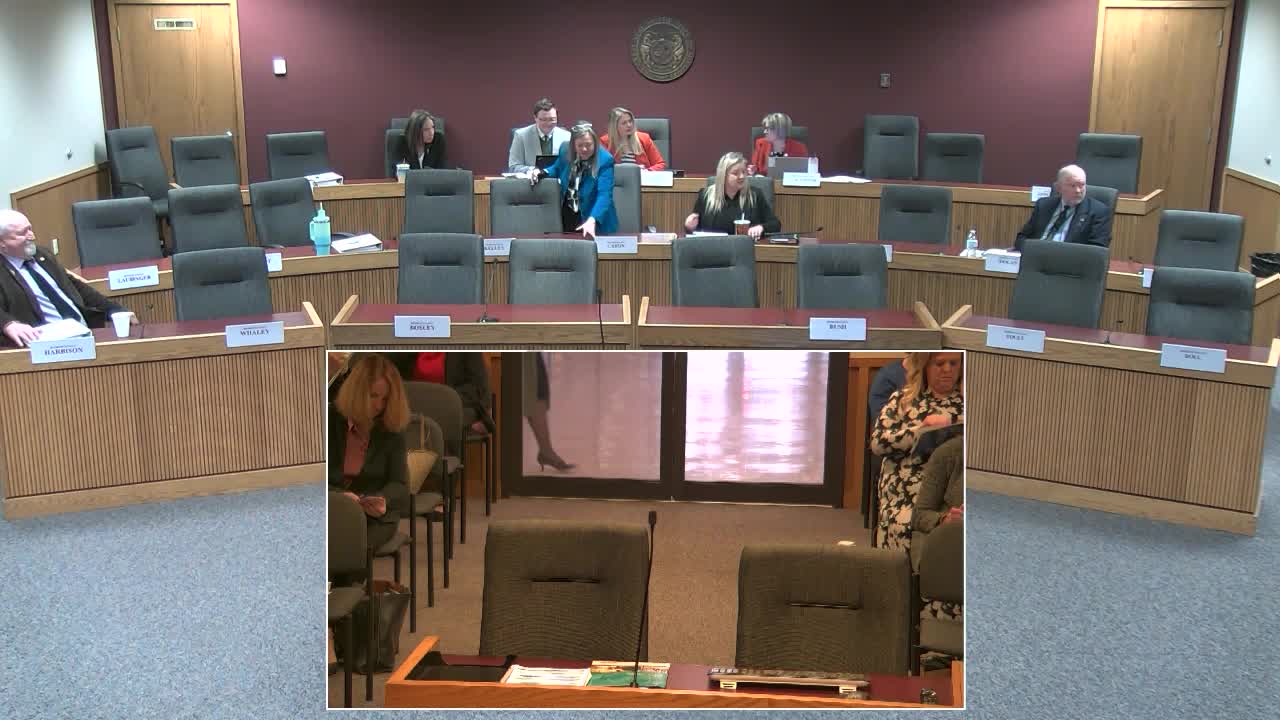
Leaders from Missouri hospital systems and child-service organizations told the House Committee on Health and Mental Health on Oct. 12 that emergency departments and inpatient beds are increasingly being used as de facto long-term care for people with complex behavioral-health needs when appropriate community placements are unavailable.
The testimony centered on children in state custody, adults with intellectual or developmental disabilities (IDD) and patients with chronic behavioral problems who repeatedly present to emergency departments (EDs). Mercy Health vice president Patty Morrow said hospitals are “closing entire units for 1 patient,” and gave an example of a case last fall in which one patient’s aggression forced a 12-bed unit to close for two weeks.
Those closures and lengthy stays, witnesses said, reduce hospital capacity for acute medical and trauma care and create workplace-safety burdens. Mercy reported that in 2024 its staff experienced 1,679 assaults by patients in Missouri, 206 of which involved injury, testimony said.
Why it matters: Committee members heard repeated examples of people who need months of specialized care but have nowhere to go. The result is “boarding” — patients who remain in EDs or medical/psychiatric beds long after the immediate clinical problem has been stabilized because no residential, waiver, or long-term placement is available. Witnesses stressed that boarding can amount to a human-rights concern for patients kept in restrictive settings for months.
From the hospitals: Representatives of CoxHealth described frequent-repeat ED use by one patient who ingested foreign objects and required repeated full workups. CoxHealth’s representative said that patient visited the ED 18 times in 35 days; some visits lasted more than 24 hours and the system incurred about $75,000 in direct costs for that episode, with roughly $25,000 reimbursed by government payers. Andrea Long, deputy general counsel for CoxHealth, and other speakers said such cases divert staff and beds from trauma and other acute care.
Mercy’s Patty Morrow said the number and frequency of complex cases has “exacerbated exponentially” over the past three to five years. She described children and adults in hospital beds for months, unable to attend school or receive appropriate community programming, and emphasized the impact on staff retention.
Child-service providers and pediatric hospitals reported parallel pressures. Catherine Worland of Children’s Mercy said the hospital’s pediatric behavioral ED visits rose from about 1,200 in an earlier year to more than 3,800 in the most recent year cited during testimony. Mary Chant, CEO of the Missouri Coalition for Children, told the committee that February snapshot counts showed roughly 20–60 children boarding in hospitals at any given time and another 50–80 youth placed out of state because in-state options were not available.
Clinical detail and case examples: Testimony described several recurring groups: (1) patients with acute psychiatric conditions who need short-term inpatient care; (2) people with IDD or autism whose behaviors make discharge to community settings difficult; and (3) patients with substance-use disorders seeking treatment while they are motivated. University Health medical director Dr. Jeff Metzner described patients who may require long-term institutional care and patients with IDD who “don't belong in an acute medical or psychiatric hospital, but there is no place for them to go.” He said one patient had been in a hospital for about 18 months.
System limitations and contributing factors: Witnesses identified multiple structural gaps: insufficient long-term residential and intermediate (partial-hospitalization / intensive outpatient) programs, limited waiver slots for IDD populations, variable accountability among contracted providers with the Department of Mental Health, workforce shortages (especially in rural areas), and complex funding and licensing rules that can leave residential providers unable to accept children at emergency rates.
Missouri Coalition for Children testimony noted a funding mismatch in foster-care pathways: when a child is placed into a residential treatment organization before a full assessment, state reimbursement is sometimes set at an emergency rate that can be “less than half” the true cost of care, discouraging providers from accepting placements.
Proposed responses discussed in the hearing: Witnesses and committee members suggested a range of approaches already underway or under consideration: expanding waiver slots for IDD populations; increasing partial-hospitalization and intensive outpatient capacity for children and adults; improving accountability and contract performance for state-contracted providers; streamlining timely, high-quality assessments for children entering foster care; strengthening hospital–residential provider partnerships for short-term medical coverage; expanding mobile crisis and 988-linked response teams; and collaborative regional planning through the Missouri Hospital Association and the Missouri Behavioral Health Collaborative.
What remained unresolved: No formal policy proposals were adopted during the hearing. Committee members repeatedly asked witnesses for evidence-based options and for regional collaborations to propose concrete solutions. Witnesses said more data on early indicators and longitudinal trajectories would help target preventive investments.
Ending: Hospital and child-service leaders urged the committee to consider both short-term fixes — more step-down, crisis-respite and substance-use treatment capacity — and longer-term investments in home- and school-based prevention, workforce development and residential licensing/funding reforms to reduce boarding and restore hospital capacity.