Get Full Government Meeting Transcripts, Videos, & Alerts Forever!
Get email alerts on the Driving Under Influence topic
No spam. Unsubscribe anytime.
Committee backs change to allow pending DUIs to be counted together for sentencing
Summary
The committee concurred on House Bill 6 26, a change that lets courts consider pending or subsequently convicted DUI offenses when determining prior convictions for enhanced sentencing. Proponents said the change will help prosecutors address repeat dangerous drivers and increase access to treatment programs earlier in an offender’s history.
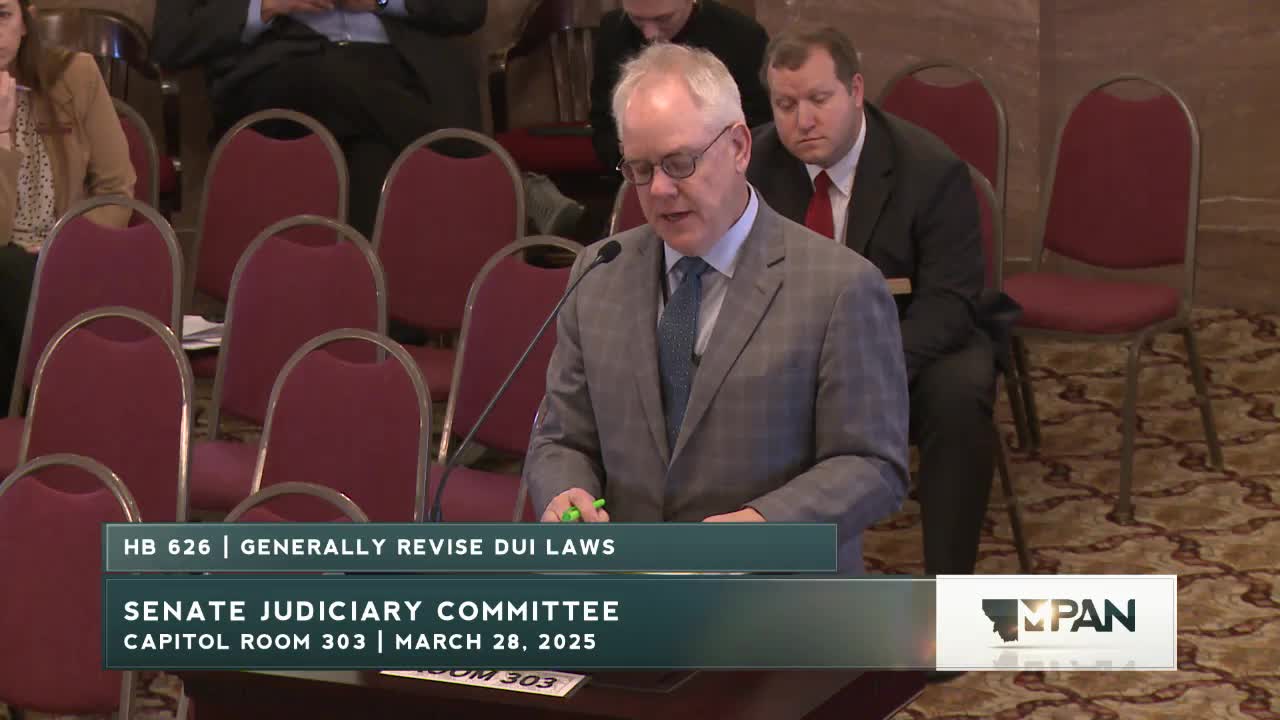
Representative Bill Mercer, sponsor, told the Senate Judiciary Committee House Bill 6 26 is designed to let courts count pending or subsequently concluded DUI offenses together when determining whether an offender has multiple prior DUI convictions that trigger enhanced penalties.
The bill adds language so that, for purposes of counting prior offenses referenced in Montana DUI statutes, a "conviction" may include a pending or subsequent offense that results in conviction before sentencing for the present offense. Mercer used a Missoula County fact pattern to illustrate how multiple arrests within a short period previously produced only misdemeanor convictions and prevented the state from treating the cumulative conduct as a higher‑level offense for sentencing.
Missoula County Attorney Matt Jennings testified in favor, saying the change would allow the criminal justice system to escalate accountability and get high‑risk drivers into treatment programs earlier. "DUIs are an anomaly — they're the only statute under the code that doesn't allow us to stack those," Jennings said. "This law allows us to do that."
Nanette Gilbertson, representing the Montana Sheriffs and Peace Officers Association, agreed the bill aligns DUI statutes with other crimes and urged support; she also noted a technical amendment to correct one stray word on page 6. Several other law‑enforcement and prosecutors' associations testified in favor.
The committee voted to concur on House Bill 6 26. The bill’s supporters said the change would enable courts to consider the totality of an offender’s DUI conduct at sentencing and expand access to treatment and other programs for repeat offenders earlier in the process.