
Committee recommends fossil-fuel-free construction ordinance for pilot program, subject to exemptions and clarifications
Get AI-powered insights, summaries, and transcripts
Subscribe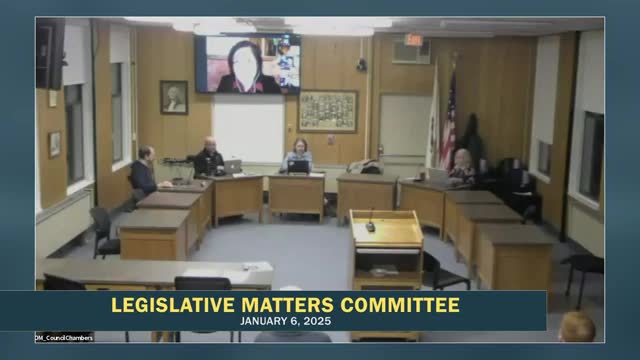
Summary
A Northampton legislative committee voted to recommend a proposed municipal ordinance to join the Massachusetts Department of Energy Resources fossil fuel–free construction pilot, but asked sponsors and staff to tighten exemptions and clarify how the rules would affect renovations, standby power and locations with limited electrical capacity.
Northampton — The legislative matters committee voted on Jan. 6 to recommend a local ordinance that would opt the city into the state’s fossil fuel–free construction pilot, but asked sponsors to refine exemptions and waiver language before the matter moves to the full City Council.
The committee’s vote followed more than two hours of public comment and technical discussion about how the proposed ordinance interacts with the state’s specialized stretch energy code, electrical-grid capacity and the costs of renovating older buildings. Benjamin Weil, director of Climate Action and Project Administration for the city, told the committee that “we were invited by the Department of Energy and Resources to participate as the only Western Mass municipality in their pilot.”
The proposed ordinance would narrow the “mixed-fuel” pathway in the current specialized stretch code by prohibiting mixed fossil-fuel and electric compliance routes for many new low-rise residential projects and by applying the fossil-fuel-free requirement to any project that installs or replaces heating equipment. The draft keeps existing exemptions for historic buildings and adds specific waivers for work where (a) a utility cannot provide sufficient electric capacity, (b) fossil-fuel-free designs impose “extraordinary costs” and (c) process loads for manufacturing, medical or research uses cannot be met without fuels.
Why it matters: the pilot is intended to test real-world impacts of tighter, fuel‑neutral construction rules in communities with different building stocks and utility circumstances than wealthier Eastern Massachusetts suburbs. Sponsors said Northampton’s inclusion matters because the city faces a regional gas‑service moratorium in some areas and a higher share of renovation‑ and retrofit‑driven construction than the suburban communities that originally proposed similar rules.
Public commenters and building professionals raised three broad concerns: grid capacity and interconnection delays; the cost and scope triggers associated with major renovations; and whether the ordinance allows reasonable standby or emergency power for vulnerable housing and other uses. Bob Sprow, a Northampton resident who heats his home with a ground‑source heat pump and maintains propane for backup, said, “I really object to the term fossil fuel free,” arguing the grid currently shifts emissions to other locations. Architect Dory Brooks—past president of the American Institute of Architects Massachusetts chapter—called the idea “a learning opportunity,” but urged caution because “if we take this and add this burden on top of other burdens… we create the conditions by which [owners] may choose not to renovate at all, or they may leave the city and do exactly the same project just across the street in another community.”
Supporters and technical experts urged the opposite perspective: Aden Maynard of Powerhouse Energy Consulting said “electrification is the most cost effective way to go” for new construction, and several speakers noted Massachusetts incentives now favor all‑electric new builds. Other speakers, including nonprofit housing developers, asked for explicit protections so affordable multifamily housing can maintain limited fossil‑fuel backup or battery/backup strategies while the grid and storage markets evolve. Laura Baker of Valley Community Development Corporation said, “for us, it’s extremely important to have flexibility to use a fossil fuel driven backup system, not only for heating and cooling,” citing tenant health and elevator needs.
Committee direction and decision: committee members and staff identified three topics to refine before the Council vote: 1) add or clarify exemptions for emergency and standby power (including low‑rise residential), 2) specify exemptions or definitions tied to major renovation triggers so ordinary repairs or incremental additions do not unintentionally force full system replacements, and 3) consider narrow exemptions for certain change‑of‑use cases (for example, child care or other public‑benefit conversions) or at least define a path for case‑by‑case waivers.
Councilor Maury made a motion to recommend the ordinance to the full City Council “subject to addressing” those points; Councilor Jarrett seconded. The committee recorded members on the roll call expressing support; the motion passed. City staff and the ordinance sponsors said they would take public and industry feedback from the forum and return revised language to the Council at the scheduled vote week later.
What remains uncertain: the meeting clarified that the proposed ordinance relies on several state codes and programs—primarily the Massachusetts specialized stretch code and the Department of Energy and Environmental Affairs’ pilot guidance—and that some triggers (for example, the International Existing Building Code definition of “major renovation”) are code‑driven and not entirely within local control. The state requires municipalities joining the pilot to submit final adoption documentation by Jan. 27 to be part of the current round; committee members explicitly flagged that deadline as driving a need to finalize clarifications quickly.
Next steps: sponsors and staff will revise the draft ordinance to address the committee’s requested clarifications on exemptions and reporting, and the refined version will return to the City Council for a formal vote. The ordinance and any adopted changes will be reported to DOER as part of Northampton’s participation in the pilot.