Get Full Government Meeting Transcripts, Videos, & Alerts Forever!
Get email alerts on the Veterinary Workforce topic
No spam. Unsubscribe anytime.
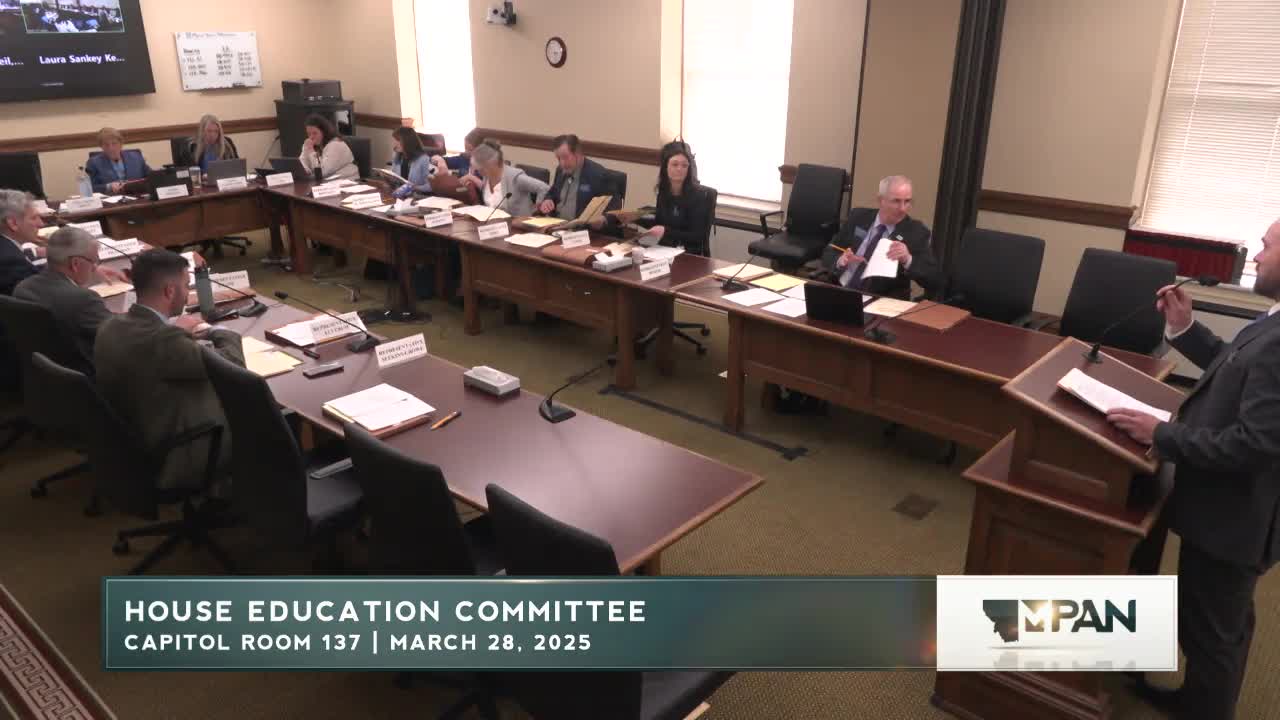
Committee hears broad support for veterinary loan‑repayment bill to address rural shortages (HB 860)
Summary
Lawmakers heard testimony in support of HB 860, a bill to create a veterinary loan-repayment program with a four‑year rural service commitment, an oversight board, and a biennial appropriation to seed initial cohorts.
Representative Greg, sponsor of House Bill 860, opened the hearing saying Montana faces a ‘‘severe shortage’’ of veterinarians in rural and underserved counties and proposed a student loan repayment program to incentivize veterinarians to practice in those areas.
Proponents representing veterinary education, producer groups and statewide veterinary associations urged the committee to approve the bill. Jocelyn Cahill of Rocky Vista University College of Veterinary Medicine described the program design: students enrolled in an accredited veterinary program would be eligible for annual reimbursement (up to $25,000 for four‑year DVM programs or $33,333 for three‑year DVM programs) in return for a four‑year service commitment in an area designated by the administering office as underserved. Cahill said preference would be given to Montana residents and that the commissioner (OCHE) would have authority to recover funds if terms were not met.
Ellie Brighton, representing the Montana Stockgrowers Association, Montana Cattlewomen and Montana Association of State Grazing Districts, and Ross Morgan of Rocky Mountain Stock Growers Association described on‑the‑ground shortages in large‑animal coverage and urged passage. Stuart Doggett of the Montana Veterinary Medical Association and Dr. Robert Murtaugh, founding dean at Rocky Vista, also testified in favor, noting 38 of 56 Montana counties have veterinary workforce shortages.
Witnesses clarified program mechanics and funding. Witnesses and sponsors said the draft appropriation seeds a biennium of funding: $425,000 per biennium is in the bill (intended to support cohorts of approximately four new students selected each year), and an administrative line of $20,000 was inserted to support OCHE administration pending the fiscal note. Committee members asked how long the appropriation would last; witnesses explained the appropriation covers the biennium as drafted and the sponsor indicated legislative intent language that the appropriation be considered part of the ongoing base, subject to future legislatures.
Committee members asked how forgiveness is applied: the bill ties forgiveness to service, with one quarter of the award forgiven for each 12 months of continuous service in the designated underserved area, culminating in full forgiveness after four years. If a participant fails to complete the DVM program, fall out of good standing, or fails to meet service obligations, the contractual agreement may be voided and funds recovered. The Department of Revenue witness, Mr. Bell, explained loan forgiveness is federal taxable income; the bill contains language to “back out” forgiven loan income from Montana taxable income on state Form 2.
Several rural veterinarians and cattle producers described difficulty recruiting and retaining veterinarians and urged passage; speakers referenced similar programs in other states (Kansas and the USDA Veterinary Medicine Loan Repayment Program) as models. No opponents testified in the hearing; one informational witness addressed state tax treatment.
Why it matters: sponsors and supporters said rural large‑animal veterinary access is critical to livestock health, public health, and rural economies and that debt burden and lower rural compensation drive new veterinarians toward higher‑paying urban small‑animal practice.
Status: this item was a public hearing; committee discussion focused on mechanics, appropriations, service definitions and tax treatment. No committee vote on final passage was recorded during the hearing.