Get Full Government Meeting Transcripts, Videos, & Alerts Forever!
Get email alerts on the Legislative Roundup topic
No spam. Unsubscribe anytime.
Votes at a glance: Key House bills the Montana Senate acted on March 28
Summary
The Senate took up a slate of House bills on March 28; several were concurred in on second reading with varying margins, one bill was indefinitely postponed after a close vote.
The Montana Senate on March 28 considered a large number of House measures. Below is a concise summary of formal actions taken on second reading during the floor session. Each listing notes the recorded Senate action and vote tally as announced by the Clerk.
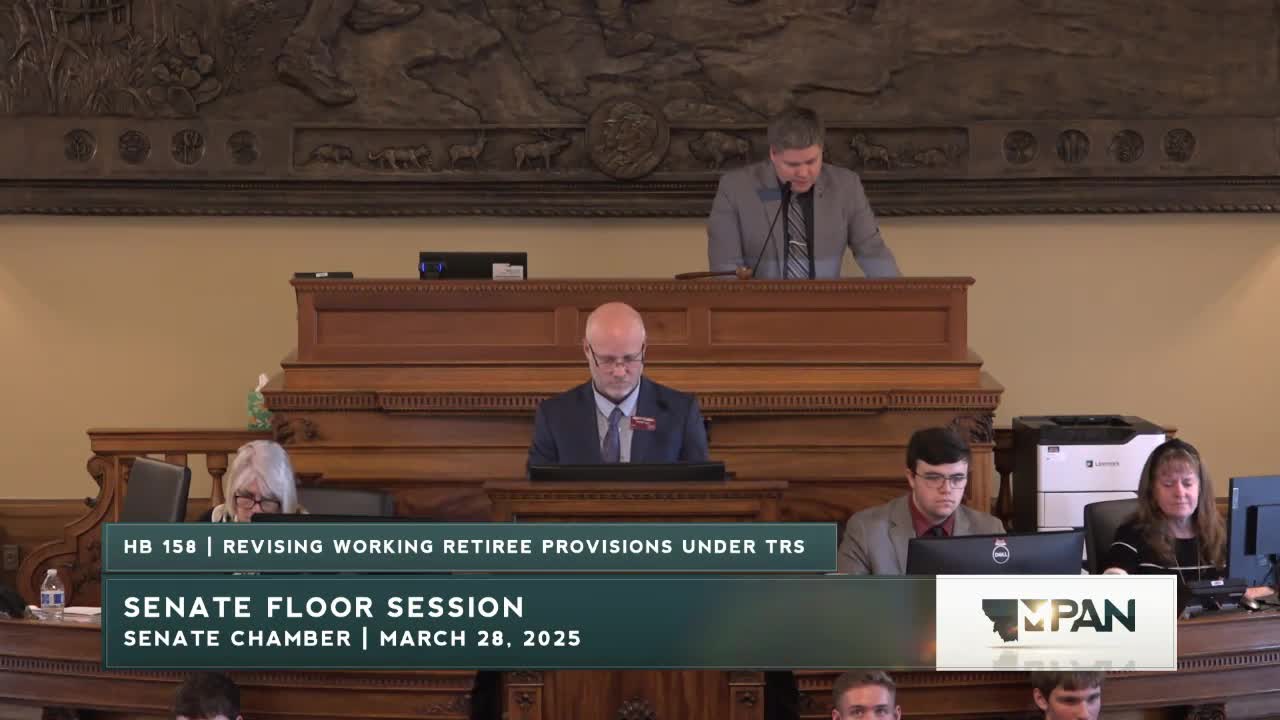
- House Bill 158 — Extends working-retiree provisions under the teachers’ retirement system: Concurred in on second reading; Clerk announced 50 ayes (unanimous vote recorded for the chamber's quorum reporting).
- House Bill 186 — Increases the size of the Board of Pardons and Parole and provides transition provisions; sponsor said the change reflects workload increases: Concurred in on second reading, recorded vote 42 ayes, 7 nays.
- House Bill 198 — Prohibits contracts that restrict specified health-care providers from practicing (non-compete restrictions for mental/behavioral health providers highlighted): Concurred in on second reading, recorded vote 49–0.
- House Bill 228 — Revises reporting requirements for actual costs of legislation that have projected fiscal impacts (twice-yearly reporting): Concurred in on second reading, recorded vote 50–0.
- House Bill 238 — Standardizes processes for mental and physical evaluations for professional licensees on health boards: Concurred in on second reading; unanimous or near-unanimous concurrence recorded.
- House Bill 253 — Requires the Department of Public Health and Human Services to disclose aggregate hospitalization and death counts in a public health emergency: Concurred in on second reading (vote recorded; proxy votes noted).
- House Bill 254 — Eliminates fingerprint background-check requirement for certain professional employer organization (PEO) applicants (limited to PEO CEOs): Concurred in on second reading, recorded vote 36 ayes, 13 nays.
- House amendments to Senate Bill 11 — Revisions to local government ballot-issue procedures and signature-gathering rules: House amendments concurred in on second reading, recorded vote 48–1.
- House Bill 223 — Would have required motor vehicle insurance policies to cover reasonable towing, recovery and debris-cleanup costs for commercial tow operators. The Senate voted 24–26 against concurrence; majority leader moved and the Senate approved a motion to indefinitely postpone HB 223 (39 ayes to 9 nays to indefinitely postpone).
Other bills read and passed on third reading earlier in the session were recorded as passed by the Senate; committee reports adopted and other first- and second-reading actions were announced by the Clerk during adjournment.
Why it matters: These votes move a range of policy areas forward — from retirement rules and corrections board staffing to healthcare provider non-competes, workplace licensing, and government fiscal transparency. Several bills drew unanimous support while a few prompted close or contentious votes requiring further action by the House or potential conference.