Get Full Government Meeting Transcripts, Videos, & Alerts Forever!
Get email alerts on the Health Insurance Coverage Glp1s topic
No spam. Unsubscribe anytime.
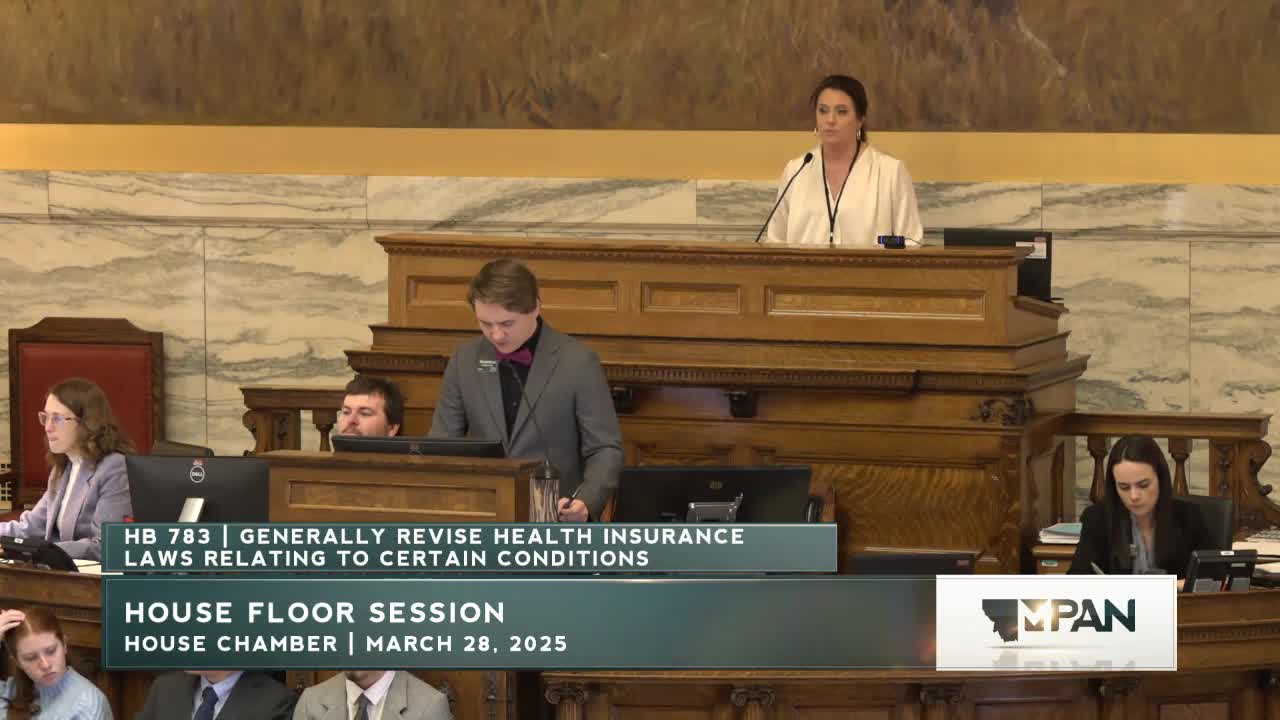
House rejects bill to require state plan coverage for weight-loss drugs and PCOS treatments; vote 50-50
Summary
Lawmakers debated a bill to require the state employees’ health plan to cover GLP-1 weight‑loss drugs and some treatments for polycystic ovary syndrome. After extended debate over cost, side effects and fiscal notes, House Bill 783 failed on a 50–50 vote.
House representatives on Thursday debated House Bill 783, which would have required the Montana state employee health plan to cover certain glucagon‑like peptide‑1 (GLP‑1) receptor agonists for people with class 3 obesity and for treatment of polycystic ovary syndrome (PCOS). Representative Rosenzweig introduced the bill, calling it a two‑year pilot limited to the state plan and urging members to send it to appropriations for further review.
The sponsor said the bill would allow doctors to prescribe GLP‑1 drugs ‘‘for patients with significant type 3 obesity risks or polycystic ovarian syndrome’’ and that the program would be reviewed after two years. Rosenzweig said the initial fiscal note overestimated cost because the original draft had broader coverage; she and committee amendments narrowed the proposal to state employees only and removed broader diabetes coverage from the bill’s language.
Lawmakers spent nearly an hour on medical efficacy, side effects and the fiscal impact. Representative Gillette cited studies showing annual per‑patient savings of roughly $1,500 to $8,000 in avoided downstream health costs but said the fiscal note and utilization assumptions needed tightening. Representative Perry, who described his personal experience taking a GLP‑1 drug, said the medicines can be effective but noted side effects and described current out‑of‑pocket costs of ‘‘about $1,600 a month’’ for some patients. Majority Leader Fitzpatrick argued mandates drive insurance costs and said the rolled‑up fiscal estimates were ‘‘crazy expensive.’’
Sponsor Rosenzweig said the amended bill would be OTO (one‑time only) for the state plan, include a reporting requirement for cost and utilization, and could be opened to Medicaid, Medicare or private plans later if the pilot proved cost‑effective. She said the Department of Administration estimated a take‑up and cost that could be kept to about $1 million in the first year and $1.2 million in the second year after narrowing the bill’s scope. The fiscal note available to members earlier listed an appropriation of roughly $1.5 million per year; the sponsor said that number reflected an earlier, broader version of the bill and would likely drop after the committee changes.
After debate, the House voted on the motion to pass and advance House Bill 783. The clerk recorded 50 votes in favor and 50 opposed; the motion failed and HB 783 did not pass second reading.
The bill text would have required insurers in the state employee plan to cover specified classes of drugs for defined conditions, included reporting back to interim committees on utilization and cost effectiveness, and contained an appropriation provision. The sponsor and other lawmakers emphasized the limitation to the state employee plan and the pilot nature of the measure. Opponents cited potential premium impacts, the novelty of long‑term side‑effect data and unresolved fiscal uncertainties.
Representative Rosenzweig said she would seek consideration in appropriations if members supported a narrower pilot, but the 50–50 vote ended this bill’s advance on Thursday.