Get Full Government Meeting Transcripts, Videos, & Alerts Forever!
Get email alerts on the Broadband Incentives topic
No spam. Unsubscribe anytime.
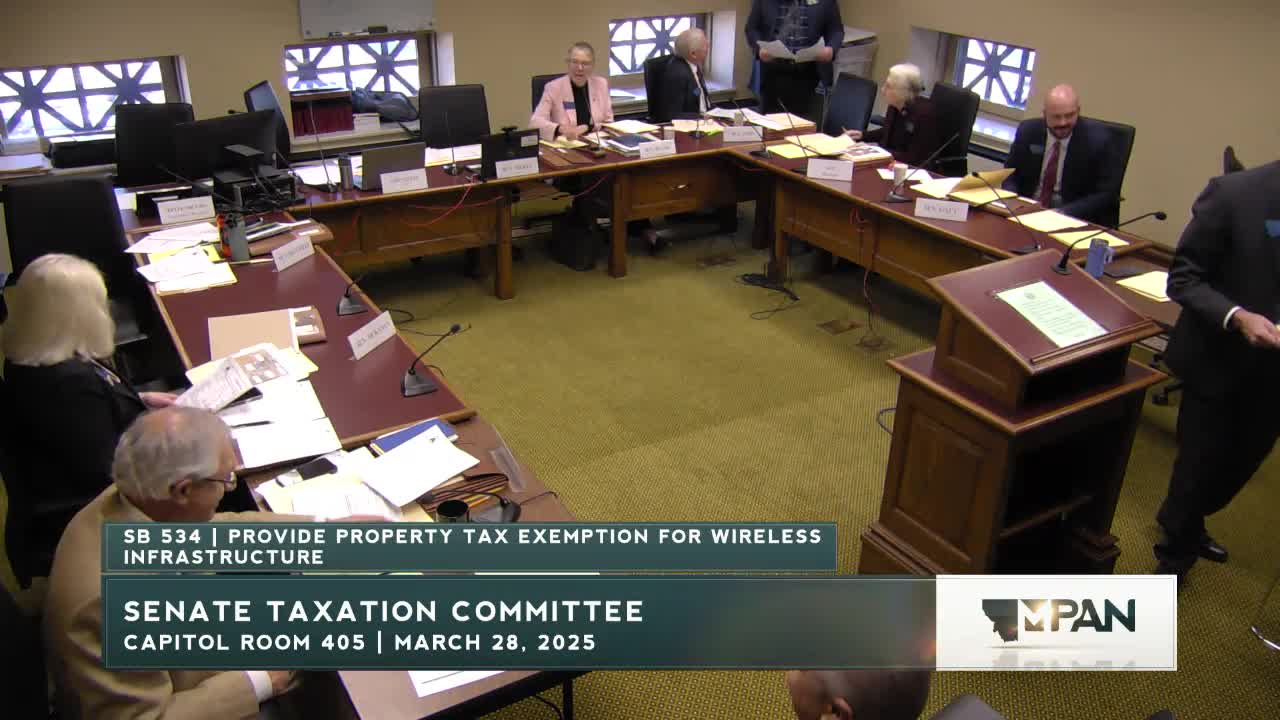
Committee considers adding wireless infrastructure to five-year property tax abatement for broadband
Summary
Senate Taxation Committee heard proponents for extending the statutorily authorized abatement for fiber to wireless broadband equipment, arguing parity would encourage investment in underserved areas; telecom companies and the Montana Chamber supported the change, while the Department of Revenue provided fiscal detail.
Sen. Greg Hertz told the committee the bill would add wireless broadband infrastructure to an existing property-tax abatement that now applies to fiber optic and coaxial cable investments, and require that tax savings be reinvested in Montana broadband infrastructure within two years.
Industry witnesses said the change brings parity between wireline and wireless investments and can spur deployment in rural and underserved areas. Margaret Morgan of T‑Mobile said wireless needs wireline backhaul and vice versa; she urged the committee to approve parity so companies will have an incentive when deciding where to invest. Mark Baker of AT&T said the existing wireline framework enacted in 2021 has been "proven to benefit the state of Montana" and that extending the abatement to wireless would help providers allocate capital into harder-to-reach areas.
Proponents noted the bill limits eligible property and excludes central office/backroom equipment, pointing to fiscal-note assumptions that only a share (the fiscal note used a 20% estimate) of new wireless-related property would qualify for the exemption. Jared Isom, an economist with the Department of Revenue, answered fiscal-note questions and said where the installations occur and the tax base of the taxing jurisdiction determine the local revenue shift; taxes not paid by exempt property would shift to other taxable property in the same jurisdiction.
Supporters included Verizon, T‑Mobile, AT&T and the Montana Chamber of Commerce; Scott Mackey, an economist working with facility-based wireless companies, told the committee the abatement is timely and helps offset Montana's relatively high effective property tax burden on telecommunications infrastructure. No opponents appeared during the hearing.
Committee discussion touched on the expected fiscal effect and the potential multiplier from improved connectivity. Members asked Department of Revenue analysts about the fiscal note and how much investment the abatement might leverage; witnesses said the policy would lower upfront and operating costs for carriers and could generate broader economic activity in the long run. No final committee vote was recorded during the hearing.