Get Full Government Meeting Transcripts, Videos, & Alerts Forever!
Get email alerts on the Traffic Calming topic
No spam. Unsubscribe anytime.
NDOT outlines speed-cushion plan for Oakley Drive; neighborhood to vote
Summary
Jeff Hammond, a consultant for the Nashville Department of Transportation, presented a speed‑cushion traffic‑calming proposal for Oakley Drive and said neighbors in the project area will vote by mailed/online ballot; a two‑thirds affirmative return is required for the project to advance to construction.
Jeff Hammond, a consultant for the Nashville Department of Transportation, presented a speed‑cushion traffic‑calming proposal for Oakley Drive at a neighborhood meeting and said the project will move to a mailed and online ballot if neighbors generally support the plan.
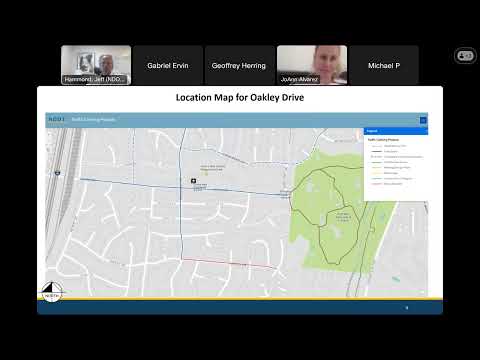
Hammond said NDOT measured speeds and volumes on the project limits — from Trousdale to near Cochrane — and recorded an 85th‑percentile speed of 35 mph, traffic volumes of about 1,200 vehicles per day and a typical roadway width of about 20 feet. "We do focus on residential streets, and we do focus on, or emphasize, physical solutions," Hammond said, adding that NDOT’s prioritization score gives 70 percent weight to vehicle speeds and volume and the remainder to factors such as pedestrian presence and crash history.
The recommended design is a speed‑cushion based project with three sets of cushions spaced along the roughly one‑half mile corridor. Hammond said NDOT’s cushions come from a single contracted vendor (TrafficLogix) and use a 3‑inch profile; available cushion lengths are 7, 10.5 and 14 feet, and the agency generally targets 400–600 feet between devices but noted hill grades on Oakley compress spacing in places.
Residents pressed several concerns. A neighbor asked whether drivers simply speed up after cleared cushions; Hammond said NDOT does not have definitive data for every context and that subsequent diversion or follow‑up requests are handled through separate applications. One resident asked whether sidewalks could replace cushions; Hammond said sidewalks are not part of NDOT’s traffic‑calming toolbox and that sidewalks follow a separate, generally more expensive process. Another resident asked about noise and local consent rules; Hammond acknowledged noise is a known effect and described NDOT’s public‑buy‑in and ballot process.
Hammond described technical restrictions that shaped the design: NDOT avoids installing cushions on slopes steeper than 8 percent and generally tries to avoid segments greater than 5 percent grade; those grade limits caused cushions to cluster where they can be placed. He also said NDOT will add advance warning signage at each installation to discourage drivers from leaving the roadway to bypass cushions.
On procedure, Hammond said NDOT will post the refined plans on the agency’s traffic‑calming webpage and on the city engagement portal (engage.nashville.gov), then run a six‑week ballot. Ballots are mailed to property owners in the project limits and permit one vote per owner; the project advances if two‑thirds of ballots returned are in favor. Hammond warned that even after a favorable ballot the earliest construction is likely months away because NDOT is currently scheduling projects about eight to ten months out.
Residents asked about alternatives NDOT has tried, including radar feedback signs, pavement‑marking treatments, speed tables, traffic circles and pavement‑marking strategies that visually narrow streets. Hammond said those are options in NDOT’s toolbox but that paint‑ or radar‑based measures generally produce smaller and sometimes shorter‑lived speed reductions than physical devices; he noted intersection treatments and traffic circles require sufficient width and can cause other operational issues.
Hammond said staff will check whether restriping the western section of Oakley can be added to the project and will post the updated plan. If there is neighborhood consensus to proceed, NDOT will start the ballot; if the ballot does not reach a favorable two‑thirds return, no construction will proceed. No formal vote occurred at the meeting.
The meeting concluded with staff encouraging neighbors to review the recording and materials online and to discuss the plan with other residents before the ballot.