Get Full Government Meeting Transcripts, Videos, & Alerts Forever!
Get email alerts on the Traffic Calming topic
No spam. Unsubscribe anytime.
NDOT proposes speed cushions and radar signs for Willow Lane; residents raise drainage and spacing concerns
Summary
David Greaves, a facilitator with the Nashville Department of Transportation (NDOT), presented a draft traffic-calming design for Willow Lane at a virtual neighborhood meeting on March 25, 2025, proposing speed cushions, a radar feedback sign and lane-edge striping to address speeds measured above the posted limit.
David Greaves, a facilitator with the Nashville Department of Transportation (NDOT), presented a draft traffic-calming design for Willow Lane at a virtual neighborhood meeting on March 25, 2025, proposing speed cushions, a radar feedback sign and lane-edge striping to address speeds measured above the posted limit.
Greaves said the Neighborhood Street Traffic Calming (NSTC) program generally treats an entire street rather than single blocks and that its primary objective is to reduce vehicle speeds. "We don't do these, like, 1 block at a time. We try to, look at an entire street all at once, just for efficiency's sake and to make sure that these measures are working as intended," he said.
The meeting followed NDOT’s data collection on Willow Lane, a roughly 26-foot-wide residential street spanning Faulkner Drive to Willard Drive. NDOT reported an 80th-percentile speed of 35 mph on the street, compared with a posted 25 mph limit, and an average daily volume of about 575 vehicles. Greaves cited Vision Zero research on crash survivability to underline the safety rationale for lowering speeds.
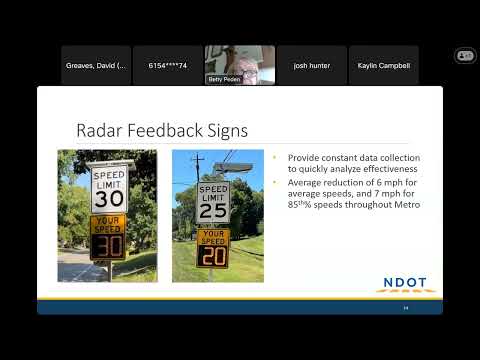
NDOT’s proposed toolkit for Willow Lane includes modular rubber speed cushions (bolted down, about 3 inches high and 6 feet wide), radar feedback signs paired with speed limit signs, and painted lane-edge striping. Greaves described cushions as a default treatment for the program and said they are designed to allow larger emergency vehicles to travel over the roadway gaps between cushions; the recommended target speed for the cushions is 20 mph and they are effective at 25 mph. He also summarized results from a limited evaluation that showed average speeds falling from 31 mph to 22 mph and 80th-percentile speeds dropping from 37 mph to the posted limit after traffic-calming installation.
Several residents supported physical measures but disagreed about the proposed concentration and placement of cushions. Multiple commenters said the three cushions shown in one central block felt excessive for their properties and noted a recurring street-flooding problem in low-lying sections that could affect placement. One resident suggested moving a cushion closer to Hillbrook to slow vehicles coming down the hill; others recommended two cushions in certain locations rather than three. NDOT acknowledged drainage concerns and said site topography will be assessed during a field visit.
Residents also expressed support for painted edge striping to create clearer pedestrian space; one volunteer who helps schedule neighborhood activities identified herself as the area’s beautification commissioner and offered to help coordinate a second meeting. Greaves said striping is feasible and typically provides about three feet of space on either side when installed 20 feet apart.
NDOT described the next steps as a field site visit to collect topographic data, refinement of the design to reflect resident feedback, and a second neighborhood meeting to present construction plans. After the second meeting NDOT will initiate an online ballot of property owners; the ballot requires two-thirds of respondents to vote yes for the project to move into the construction queue. Greaves said construction typically takes eight to ten months after a successful ballot because of the backlog of projects. He named two NDOT field staff, Jordan and Hannah, as the technicians who have already begun measuring street grades.
The meeting record contains no formal votes or motions. Instead, NDOT directed a site visit and committed to return with a revised design and to schedule a second meeting; residents volunteered to help schedule that follow-up.
Residents also asked about effects on school walkers and crossing guards near Haywood School; NDOT said staff have not received specific feedback from Haywood but welcomed that input. Greaves provided an NDOT contact email, n.trafficcalming@nashville.gov, for follow-up and said the team will post plans online before balloting.
NDOT will return for a second neighborhood meeting to present revised plans that reflect the feedback on cushion spacing, drainage and striping. If two-thirds of property-owner respondents approve the ballot, the project will be scheduled for construction and placed in NDOT’s queue, subject to the typical 8–10 month wait time for traffic-calming installations.