Get Full Government Meeting Transcripts, Videos, & Alerts Forever!
Get email alerts on the Housing Investor Policy topic
No spam. Unsubscribe anytime.
Lawmakers Hear Bill Aimed at Shifting Large Investor‑Owned Homes Toward Owner Occupancy
Summary
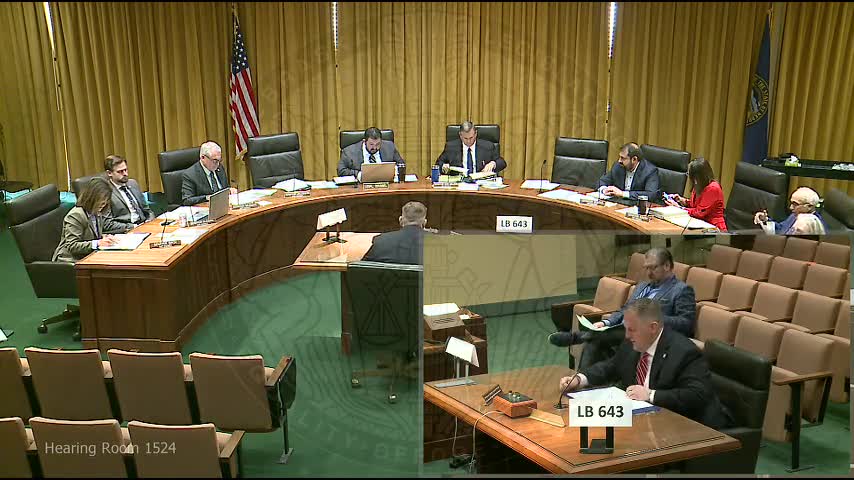
Senators heard testimony on LB 643, introduced by Sen. Jason Prokop, a bill intended to encourage owner‑occupied housing by changing eligibility for state income tax benefits for large investors who own many single‑family houses.
Senators heard testimony on LB 643, introduced by Sen. Jason Prokop, a bill intended to encourage owner‑occupied housing by changing eligibility for state income tax benefits for large investors who own many single‑family houses.
Prokop told the committee the bill targets investor owners with more than 30 single‑family residential properties (apartments are excluded) and would require such owners to either sell at least 10% of those properties to owner‑occupants or sell at least 5% to first‑time homebuyers before claiming the state income tax benefit. The bill includes carve‑outs for projects operating under other incentives (for example, Affordable Housing Trust Fund projects, Community Land Trusts, land banks and similar programs) and provides an appeals pathway to the Department of Revenue if an owner can document a good‑faith sale attempt (properties must be on the market at fair market value for at least 90 days to qualify for an appeal).
Justin Brady, speaking for Habitat Omaha, said the committee’s earlier stakeholder meeting showed investor buying alters local markets and can price owner‑occupants out. Brady described a simple model used by stakeholders that, he said, can leave an investor thousands of dollars ahead after three to four years because of tax treatment. “An investor can come in and say, ‘I'll buy it for a hundred and 80 because in 3 years, 4 years, I've made that $30,000 back,’” Brady said, describing the competitive pressure on would‑be owner‑occupants.
Committee members raised questions about property rights and potential unintended consequences. Senator Sorrentino called the measure “a reverse affordable housing bill” and asked how forcing sales would help households that cannot afford to buy. Sen. Jason Prokop and advocates said the draft is meant to level the tax treatment between investor‑owned and owner‑occupied housing while avoiding immediate state revenue impacts; Prokop acknowledged the bill is an early‑stage concept and indicated further stakeholder work during the interim.
Supporters noted localized examples: testimony to the committee referenced a Papillion area study in which more than half of homes were investor‑owned. Proponents asked for continued committee dialogue to refine definitions and exemptions so rental development, affordable rental housing and rent‑to‑own projects would not be unintentionally harmed.
No committee vote occurred during the hearing. Prokop said he would continue work with stakeholders and committee members on the measure.