Get Full Government Meeting Transcripts, Videos, & Alerts Forever!
Get email alerts on the Defense Workforce Incentives topic
No spam. Unsubscribe anytime.
Senators Hear Proposal to Offer Tax Credits to Companies Supporting Offutt Air Force Base
Summary
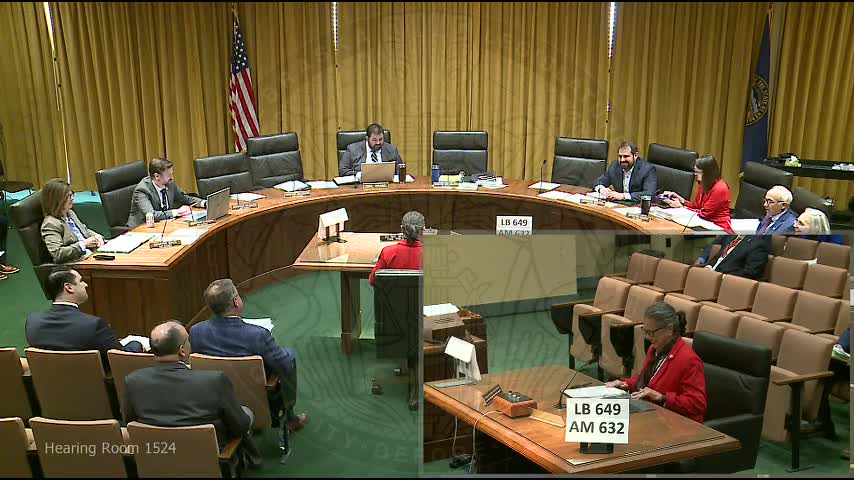
A joint hearing on LB 649 (AM 06:32), the Defense Efforts Workforce Act, drew supporters who said targeted tax credits could attract civilian defense jobs to Nebraska and bolster Offutt Air Force Base missions. The proposal sets eligibility rules, wage thresholds and caps but the committee did not vote on the amendment during the hearing.
Senators on the Revenue Committee heard testimony on LB 649, as amended by AM 06:32, a proposal called the Defense Efforts Workforce Act that would create state tax credits for companies that establish and maintain Nebraska civilian workforces supporting missions at Offutt Air Force Base.
The bill’s sponsors and backers told the committee the measure is designed to attract high‑paying defense‑sector employers and protect national security missions by keeping civilian jobs in Nebraska. Supporters said credits would be paid against withholding liabilities, subject to yearly and program caps.
Senator Rita Sanders, sponsor of AM 06:32 and the bill’s introducer, told the committee the program would require qualified employers to employ “at least 10 full time employees in Nebraska during the base year” who “dedicate exclusively to the Offutt Air Force Base mission,” maintain workforce size at or above prior‑year levels (excluding the base year), and verify work eligibility electronically. Sanders said the wage credit would be “calculated at 5% of the total compensation paid to the Nebraska employees earning at least 100% of the Nebraska statewide average hourly wage,” with a $4 million per‑year cap and $40 million over 10 years; credits would offset withholding tax liabilities and, if larger than withholding owed, could be carried forward (duration not specified in the hearing). She also confirmed that E‑Verify would be used to confirm eligibility.
Mayor Rusty Hike of Bellevue and business and defense‑sector representatives including Dana Bradford (chairman, Strategic Command Consultation Committee), Heath Mello (Greater Omaha Chamber), Mike Kasling (Zarbon Foundation), Bryan Sloan (Nebraska Chamber of Commerce and Industry) and others testified in support, saying the measure would help recruit and retain civilian talent for cyber, electromagnetic spectrum and other mission areas hosted at Offutt. “The Defense Efforts Workforce Act … is a critical piece of legislation designed to encourage the growth of skilled, dedicated civilian workforce that will support the missions at Offutt Air Force Base and beyond,” Mayor Hike said.
Dana Bradford read a passage of testimony from U.S. Strategic Command leadership highlighting workforce and industrial base concerns, saying, in part, “I urge Congress to continue to support these critical national security capabilities and associated infrastructure,” a line Bradford attributed to Gen. Anthony Cotton in testimony to the U.S. Senate Armed Services Committee.
Committee members pressed for technical clarifications. Senator Kaut asked whether the bill requires E‑Verify; Sanders replied, “Yes. That's the standard when you put together a package of qualified employees.” A committee member asked how long unused credits can be carried forward; Sanders deferred to staff for that detail and no carryforward period was provided on the record. Supporters told senators the program is intended to make Nebraska competitive with other states recruiting defense contractors and civilian talent.
Supporters emphasized Offutt’s local economic footprint: testimony supplied to the committee estimated roughly 11,000 base employees (about 7,000 military and 4,000 civilian) and said the base supports an associated population of roughly 50,000 Nebraskans when family members and retirees are counted.
Senator Sanders closed by calling AM 06:32 her personal priority and asked the committee to “vote AM 06:32 out of committee.” The record for the hearing shows no committee vote on the amendment during the session.
Looking ahead, proponents said the measure would depend on program design details, verification procedures and the state’s ability to accommodate the fiscal cost of credits if the program is widely used.