Get Full Government Meeting Transcripts, Videos, & Alerts Forever!
Get email alerts on the Energy Policy topic
No spam. Unsubscribe anytime.
Ohio House approves broad energy bill including rollback of OVEC subsidy
Summary
The Ohio House passed House Bill 15 on a 90-3 vote after hours of debate. The measure reduces certain utility tax rates, ends legacy generation riders, expands oversight of transmission and requires utilities to publish capacity maps and reliability reporting; it also ends the OVEC subsidy that originated in HB 6.
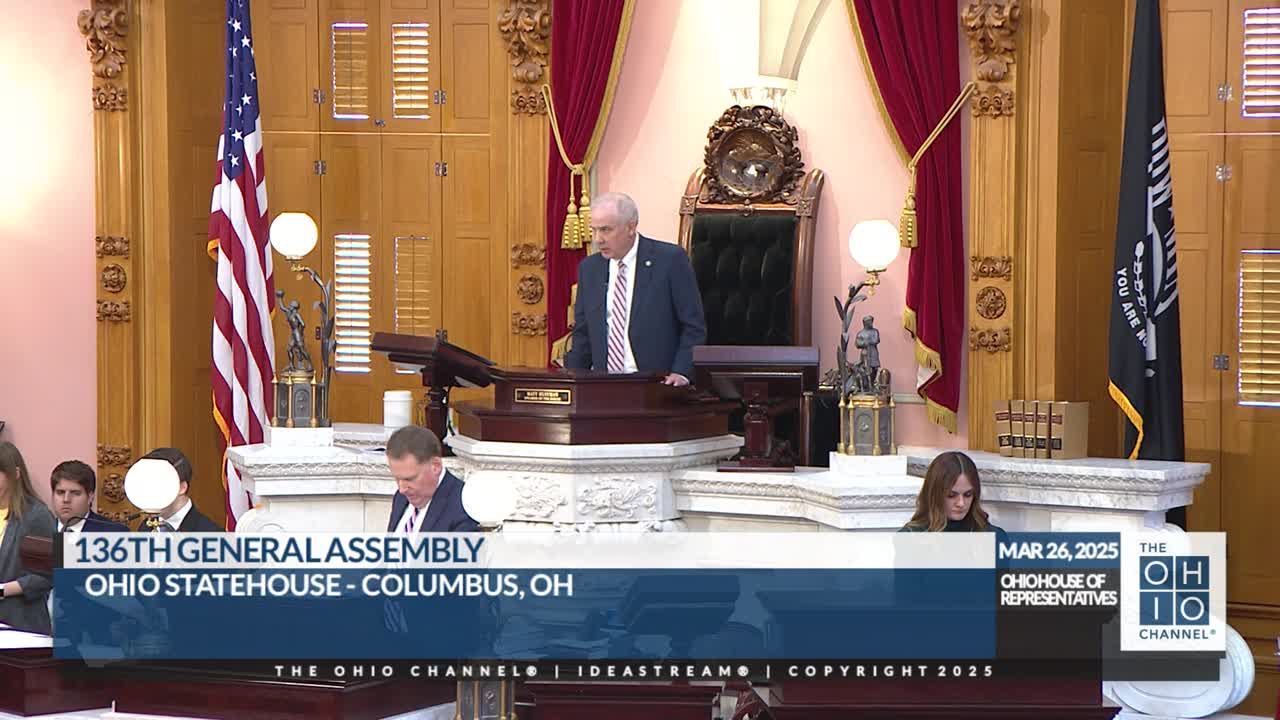
The Ohio House on March 20 passed House Bill 15, a wide-ranging energy measure that cuts certain utility tax rates, expands state oversight of transmission projects and phases out a subsidy tied to legacy coal plants, by a 90-3 vote.
Supporters said the bill will lower costs and improve grid reliability. Representative Klopfenstein, the bill sponsor, said the package “sends a clear message that Ohio is open for business” and described tax and regulatory changes intended to spur new generation and better transparency.
The bill cuts the tangible personal property tax on generation from 25% to 7% and reduces the tax treatment for transmission and distribution property from 87% to 25%, provisions Klopfenstein said will help Ohio remain competitive with neighboring states. The measure also eliminates the legacy generation rider and halts collection of a solar generation fund; supporters said those moves will return money to ratepayers. The bill requires electric distribution utilities to publish and update capacity heat maps and mandates an annual statewide reliability report from PUCO (Public Utilities Commission of Ohio). It also expands Power Siting Board review of transmission projects from those over 100 kilovolts to those over 60 kilovolts.
Several members spoke in favor of the bill’s reliability and consumer-protection measures. Representative Glassburn, the ranking member on energy matters, said HB 15 “creates provisions that will ensure that utilities will document by circuit, not just system wide,” and argued that documenting reliability and corrective plans at a more granular level is vital to reducing outages.
Opponents focused on the bill’s treatment of the OVEC subsidy and the effect on coal communities. Representative Jones said he respected the bill’s benefits but could not support the measure because of its OVEC provision, noting concern for miners and coal-dependent communities in eastern Ohio. Representative Stevens and others argued the state has made commitments tied to earlier law and local property-tax impacts that warrant more gradual changes or protections for affected communities.
Representatives on both sides referenced House Bill 6 and the scandal that followed its passage; supporters characterized HB 15 as a needed correction to return money to consumers and tighten oversight, while critics urged more care for workers and local tax bases.
After floor debate and amendment work in committee, the House voted to pass the bill 90-3. The clerk announced "90 affirmative votes and 3 negative votes; having received the required constitutional majority, the bill is hereby passed and entitled." The title was subsequently agreed to on the floor.
What happens next: With House passage, the bill proceeds to the Ohio Senate (if not already there in companion form) and would require concurrence and the governor's signature to become law. The bill includes several items that will require implementation and oversight by PUCO and the Power Siting Board.