Get Full Government Meeting Transcripts, Videos, & Alerts Forever!
Get email alerts on the Legislative Votes Roundup topic
No spam. Unsubscribe anytime.
Votes at a glance: Iowa Senate advances multiple bills on March 26, 2025
Summary
The Iowa Senate took final action on multiple bills on March 26, 2025, covering medical‑conscience refusals, DMV plate‑data limits, licensing compacts, mortgage fee rules, consumer protections for digital‑asset kiosks, home‑inspector standards and civil‑rights referrals.
The Iowa Senate took final action on several bills on March 26, 2025. Short summaries and outcomes for each item follow; vote totals are included where recorded on the floor.
Senate File 180 — Right to refuse certain medical services (conscience protections): Passed. Summary: Allows a person to refuse a medical service for reasons of conscience, including religious convictions; sponsors said the measure responded to mandates imposed during the COVID‑19 pandemic. Final recorded vote on the floor: 32 ayes, 15 nays. Proponent: Senator Taylor (Sioux). Opponent concerns: Senator Blake (Polk) and others said the bill as written could harm vulnerable patients in congregate settings by limiting the ability to segregate caregivers who refuse required vaccines.
Senate File 259 — Limit release of personal information from traffic cameras: Passed (as amended). Summary: Prohibits the DOT or law‑enforcement agencies from releasing personal information captured by traffic cameras for the purpose of collecting fines from out‑of‑state violations; amendment S3006 added local authorities to the prohibition, allowed the DOT to adopt emergency rules and set an effective date of Jan. 1, 2026. The final roll call total was not fully recorded in the on‑floor transcript excerpt; the amendment was adopted and the bill was declared passed.
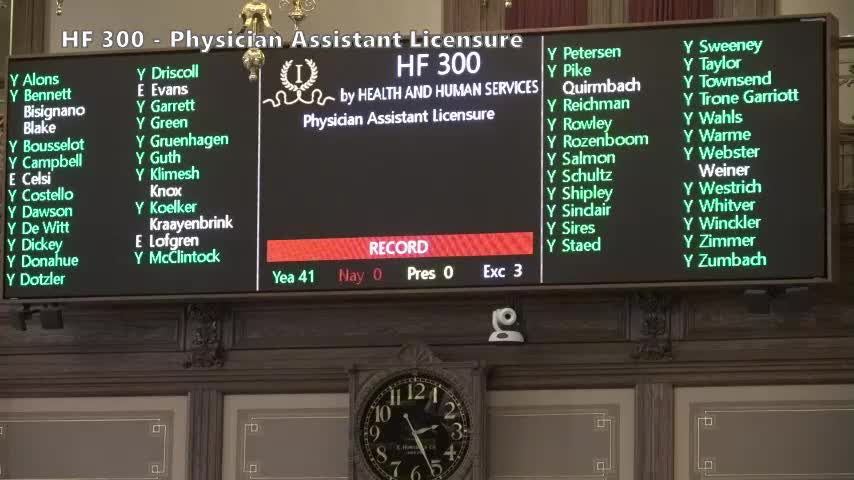
House File 300 (substituted for Senate File 312) — Physician assistant licensure compact: Passed. Summary: Joins a multi‑state licensure compact for physician assistants to facilitate reciprocal licensing; sponsors said the compact will begin in 2026 and expand access to clinicians in border communities. The on‑floor transcript does not include a final roll‑call tally in the available excerpt; the Senate declared the motion prevailing.
Senate File 398 — Consumer credit: loans secured by real estate: Passed. Summary: Exempts certain mortgage loans from state code limits if points and fees do not exceed federal regulatory limits; sponsors described the change as aligning state practice with federal regulation. Final recorded vote: 47 ayes, 0 nays.
Senate File 449 — Digital financial asset transaction kiosks (Bitcoin ATM protections, refund rules, reporting): Passed (as amended). Summary: Adds consumer protections and refund procedures for digital‑asset kiosks, requires reporting and creates limited penalties; sponsors cited FTC data on fraud targeting older adults by scammers using Bitcoin ATMs. Final recorded vote: 45 ayes, 2 nays.
Senate File 460 — Home inspection licensing standards: Passed (as amended). Summary: Establishes qualifications, licensure and minimum standards for home inspectors and clarifies availability for licensed professionals from other states. Final recorded vote: 47 ayes, 0 nays.
Senate File 579 — Referral of local civil‑rights complaints to state division: Passed. Summary: Allows local civil‑rights commissions to refer complaints to the Iowa Civil Rights Division, permits referral on request if unresolved after 12 months and limits local commissioner terms; sponsors said the change speeds resolution of long‑running cases. Final recorded vote: 43 ayes, 4 nays.
Why it matters: The package touches consumer protections (digital kiosks, home inspectors), civil‑rights process changes, licensing compacts for healthcare professionals, mortgage regulatory alignment, and disputes over medical‑conscience claims and privacy of plate‑camera data. Several bills passed unanimously or with wide margins; a few (notably the pesticide tort bill, covered separately) drew more contentious debate.
What to watch next: Bills that passed the Senate will move to the next legislative step; where the Senate invoked unanimous consent to “message” a bill, that indicates immediate transmittal to the next chamber or executive consideration per legislative rules.
Notes on recorded tallies: Where the on‑floor transcript excerpt included a final roll call, a tally is listed above. For several bills the transcript excerpt shows adoption of amendments and that the measure “passed” but does not include a final numeric roll call in the provided text; those totals are marked “not specified” in the internal record if needed for verification.