Get Full Government Meeting Transcripts, Videos, & Alerts Forever!
Get email alerts on the Paid Sick Leave topic
No spam. Unsubscribe anytime.
Nebraska senators debate rollback of voter-approved paid sick leave; motion to bracket pending
Summary
Lincoln — The Nebraska Legislature spent the floor session debating AM 7‑70, an amendment to LB415 that would revise implementation of Initiative Measure 436 (the voter‑approved paid sick leave law). Senators spoke for and against the amendment, with author Senator Jasen Stroman saying the language aims to protect small employers and opponents warning the amendment would strip enforcement and other protections enacted by voters.
Lincoln — The Nebraska Legislature spent the floor session debating AM 7‑70, an amendment to LB415 that would revise implementation of Initiative Measure 436 (the voter‑approved paid sick leave law). Senators spoke for and against the amendment, with author Senator Jasen Stroman saying the language aims to protect small employers and opponents warning the amendment would strip enforcement and other protections enacted by voters.
Senator John Kavanaugh, speaking on the motion to divide the committee amendment, told colleagues the division lets them “vote down Senator Stroman's bill and vote for the other portions of the bill.” He framed the procedure as a way to separate Senator Stroman’s portion (described in committee as LB698) from the rest of the committee package for distinct votes.
Why it matters: Initiative Measure 436 was approved by a statewide vote last November and, as written on the ballot, grants accrual and use of paid sick time (40 hours annually for employers with fewer than 20 employees and 56 hours for employers with 20 or more employees) and includes anti‑retaliation and enforcement provisions. Several senators emphasized that the Nebraska Constitution’s Article III, Section 2 (amended in February 2004) raises the legislative threshold to change voter‑enacted statutes, and many speakers said the amendment would effectively roll back what voters passed.
Discussion highlights:
- Senator Hunt objected to AM 7‑70’s substantive changes, saying, “This amendment takes away the anti retaliation protections for workers who use their sick leave. . . . It would no longer prohibit an employer from punishing or firing someone for using the sick days that they've earned.” Hunt and multiple other senators warned that removing retaliation protections would render the right to use sick leave effectively meaningless for many low‑wage workers.
- Senator Stroman, the amendment’s proponent, said the change is intended to avoid unintended consequences for the state’s smallest employers. “What we're trying to do here is ensure that the smallest businesses and the individuals that work for these smallest businesses are in a place where they don't find themselves having to lose those jobs because we have unintentionally created a situation where the employer doesn't have the ability to continue to pay for those jobs,” he said.
- Senator John Kavanaugh and others highlighted enforcement language. Kavanaugh said the amendment “eliminates the individual right of action. It cuts out 3 paragraphs of the statutory change that was enacted by the voters by 75%,” and argued removing those paragraphs would remove the mechanism that lets workers enforce the new right.
- Several speakers emphasized the ballot text and attorney general’s summary that appeared on the ballot. Senator Spivey cited that the attorney general’s description states the law “entitles employees of employers with fewer than 20 employees to accrue and use up to 40 hours of such time annually and those employed by employers with 20 or more employees to accrue and use up to 56 hours of such time annually.” Senators on both sides referenced that language as central to interpreting voter intent.
- Multiple senators warned of political and legal fallout from altering an initiative. Senator Conrad and others invoked the constitutional supermajority requirement for modifying initiative statutes and urged caution about eroding voter‑passed protections.
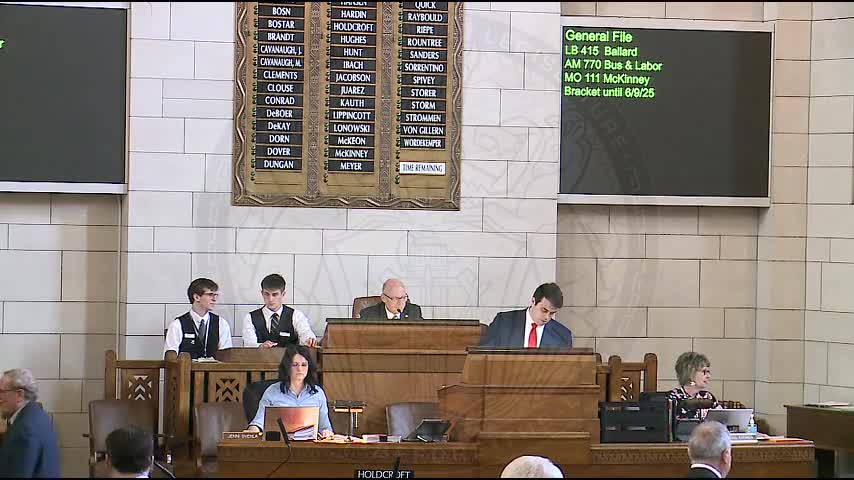
Procedural actions and status: On the floor Senator John Kavanaugh moved to divide the committee amendment so members could vote on Senator Stroman’s portion separately from the rest. Senator McKinney moved to bracket the matter (motion MO111) until June 9. The transcript record does not include a floor vote outcome on the bracket motion or on the divided question; those outcomes were not specified in the session excerpts provided.
What’s next: LB415 (as amended by the committee package) remains on general file with the divided question pending. Floor action on the first division (AM 7‑70 / LB698 component) and any votes on the bracket motion were not recorded in the provided transcript segment; future floor sessions or roll‑call minutes will show final tallies.
Context and background: LB415 is the vehicle identified on the floor to implement Initiative Measure 436 (paid sick leave). Supporters say the initiative provides modest paid sick time to hundreds of thousands of Nebraskans who lack it; opponents counter that AM 7‑70 is intended to prevent job losses and protect very small employers or seasonal agricultural operations. Senators also noted the constitutional history: an amendment adopted in February 2004 raised the threshold for the Legislature to amend voter‑enacted statutes, which many senators cited when arguing against significant rollbacks.
Ending note: Floor debate continued with repeated appeals to respect voter decisions and to weigh real economic impacts on small employers. The transcript does not record final votes on the amendment or on the bracket motion; those outcomes will determine whether changes to the voter‑approved law move forward.