Get Full Government Meeting Transcripts, Videos, & Alerts Forever!
Raj Chetty: Neighborhoods, social ties and schools drive economic mobility; Seattle voucher trial, Hope VI, college access show measurable gains
Summary
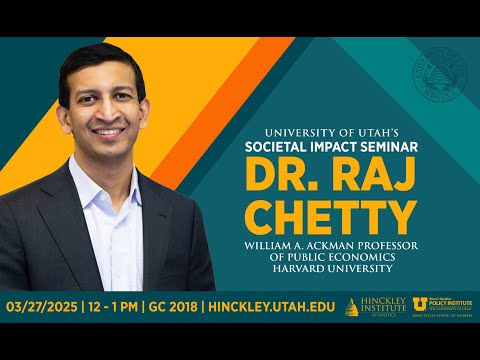
Raj Chetty, the William A. Ackman Professor of Public Economics at Harvard University and director of Opportunity Insights, told a Hinckley Institute forum that neighborhood conditions, social ties and schools — not just statewide policy — largely determine children’s chances to earn more than their parents.
Raj Chetty, the William A. Ackman Professor of Public Economics at Harvard University and director of Opportunity Insights, told a Hinckley Institute of Politics forum that where a child grows up strongly shapes that child’s economic outcomes and that targeted interventions can raise long‑term earnings.
Chetty opened by showing long‑term trends in intergenerational income mobility. “We estimate that 92 percent of children born in 1940 went on to earn more than their parents did,” he said, and added that for children born in the 1980s the chance of earning more than their parents has fallen to roughly one‑in‑two. He stressed the geographic scale of the variation: “It’s not about differences in state level policies or differences across cities. It’s about what’s happening in one neighborhood versus another neighborhood.”
Using anonymized tax records, Opportunity Insights maps upward mobility across metro and rural areas and down to census tracts. Chetty highlighted Salt Lake City as one of the nation’s stronger metros for mobility: children from families at roughly the 25th percentile of income (about $27,000 a year, he said) in Salt Lake City earn on average about $37,000 in adulthood — a larger intergenerational gain than in many U.S. metros.
Chetty summarized four robust, cross‑place predictors of higher mobility: lower neighborhood poverty and mixed‑income communities; greater family stability (for example, higher…
Already have an account? Log in
Subscribe to keep reading
Unlock the rest of this article — and every article on Citizen Portal.
- Unlimited articles
- AI-powered breakdowns of topics, speakers, decisions, and budgets
- Instant alerts when your location has a new meeting
- Follow topics and more locations
- 1,000 AI Insights / month, plus AI Chat