Get Full Government Meeting Transcripts, Videos, & Alerts Forever!
Get email alerts on the Middle Housing Code topic
No spam. Unsubscribe anytime.
Kirkland planning commission votes 5-1 to defer citywide inclusionary requirement as it updates middle-housing code
Summary
After staff presented options for middle-housing compliance with state law, the Kirkland Planning Commission voted 5-1 to recommend that City Council defer adopting a citywide inclusionary zoning requirement and continue work in a second phase, while advancing changes on density, ADUs and parking.
The Kirkland Planning Commission voted 5-1 to recommend that the City Council defer adopting a citywide inclusionary housing requirement tied to the city's middle-housing code updates, after a lengthy staff briefing and public comment.
Planning commissioners and staff said the deferral will allow more time to analyze economic impacts and gather input from builders and other stakeholders before imposing new affordability rules that could alter the cost of constructing small-scale housing.
City staff, led by Scott Guter, described a set of options the commission could send to council. The options addressed three central issues: whether accessory dwelling units (ADUs) should count toward a property's allowed unit density; which of the state-required housing typologies to allow in which zones; and whether to adopt an inclusionary zoning requirement in this first phase of code updates.
Guter told the commission that council had reviewed staff's work and offered specific feedback. He said council favored continuing to exempt ADUs from density calculations but keeping a limit of two ADUs per property. "City council was very, very, supportive of just allowing ADUs to continue to be exempted. But... keeping that limit to 2," Guter said.
Staff presented three inclusionary zoning approaches: 1) adopt the state-prescribed option (which would require affordable units at the fifth and sixth unit on some projects), 2) a staff-preferred approach that would apply an inclusionary requirement starting at the first additional unit but exempt small projects (a size exemption in the draft ranged between about 1,700 and 2,000 square feet), and 3) defer imposing any new inclusionary requirement until a later phase of code work. As an example of how the in-lieu fee methodology now works, staff said the current calculation yields a rough in-lieu cost of about $400,000 for one affordable housing unit; under a 10% requirement that would translate to roughly $40,000 for a single-family project in the example staff gave.
Commissioners voiced a mix of concerns. Several said they worried an immediate inclusionary requirement could discourage small-scale middle-housing development or penalize homeowners, and that the city needed more detailed feasibility analysis from builders and lenders. Commissioner Gina Medea said she had "shifted" toward supporting a deferral after hearing members of the building community. Commissioner Aaron Jacobson said he was open to exemptions and a delayed implementation date but wanted to preserve the option to adopt an inclusionary requirement in phase 2.
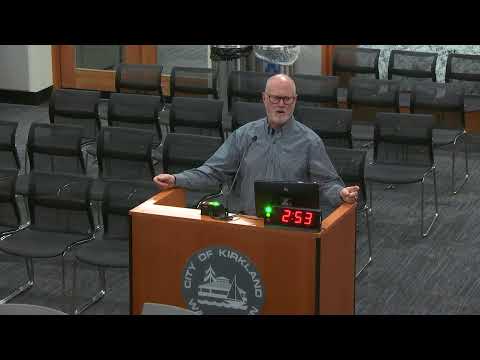
Public commenters raised infrastructure and code-clarity questions. Kirkland resident Liz Hunt said she supported reducing some required housing typologies in low-density areas but asked how the city would manage infrastructure as lot sizes shrink and density grows. Architect and resident John Kapler urged clearer and consistent definitions for floor-area and gross-floor-area calculations across housing typologies so professionals could reliably design compliant projects.
On parking, staff proposed a hybrid approach: inside a half-mile of a major transit stop the city would meet the state maximums, and outside that radius the city would revert to its existing, more permissive standards. Staff also recommended aligning ADU parking with state requirements (which in many cases would remove a required second stall for a detached ADU).
After discussion, a commissioner moved to recommend option 3 (defer inclusionary requirements until phase 2); another commissioner seconded. The motion passed 5-1. The commission asked staff to convey commissioners' concerns to council and to return for a public hearing and formal recommendation prior to council action. Staff told the commission a public hearing was tentatively scheduled for May 8, with council consideration expected in late May or early June.
The commission advanced other elements of staff's draft middle-housing package, including limiting which housing typologies would be allowed in low-density versus multifamily zones and adopting clarifications to gross-floor-area calculations and multifamily density rules, while reserving larger massing and design changes for a later phase of code refinement.
The commission's vote sends the staff's draft code (without a new inclusionary requirement) to City Council along with a recommendation to defer any citywide inclusionary zoning adoption until a subsequent phase that will include more detailed economic analysis and additional code changes.