Get Full Government Meeting Transcripts, Videos, & Alerts Forever!
Get email alerts on the Suicide Prevention Committee Meeting topic
No spam. Unsubscribe anytime.
Committee hears police suicide-response data, 988 funding gap and public-health tools; trainings and rallies planned
Summary
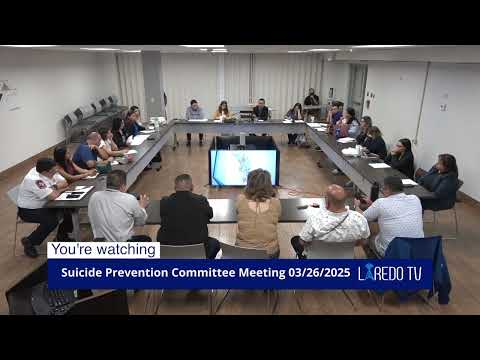
At a March meeting of the Suicide Prevention Committee, law enforcement presented local suicide-attempt and emergency-detention totals, public-health staff detailed gaps in 988 funding and digital resources, and the group confirmed training and monthly outreach events.
Law enforcement and public-health staff told the Suicide Prevention Committee in March that local responders handled dozens of suicide-related incidents in recent months while state and federal funding gaps limit crisis-line capacity and local services.
The committee heard the most immediate operational update first: local mental-health unit supervisors reported 34 attempted-suicide calls and 48 attempted-suicide reports over the past three months, seven deaths so far in 2025, 128 emergency-detention reports and 154 emergency-detention calls. The speaker said there were eight suicide-related calls and two deaths in March alone.
The numbers matter because they affect how quickly police and hospitals can respond. Sergeant Terrigo Torres, who presented the department’s data, said officers must follow statutory criteria when deciding whether to detain someone for an emergency mental-health evaluation. "Remember, a lot of these times when we ED somebody, it's because they have to show an immediate threat," Torres said. He also described the department’s staffing: "I do have 3, mental health, unit officers that assist me, and and 1 of them is Jacqueline Navaros, Emerson Barbosa, and Gilberto Ramirez." The committee discussed recurring operational friction: hospital staff sometimes delay signing admission paperwork needed for involuntary emergency holds, which officers said can lengthen the incident and paperwork burden.
Why this matters: committee members said those delays and high call volumes complicate response during peak hours and overnight. Speakers emphasized that emergency detention is a removal of liberty requiring careful legal justification and documentation; the department said it holds monthly meetings with hospital caseworkers to coordinate procedures.
Funding and crisis-line capacity
Public-health presenters said statewide capacity at the national 988 crisis line is strained. Savannah Morales (identified in the meeting as a reductions specialist with the public-health team) told the committee that the 988 network is understaffed in Texas and that the state’s allocation falls short of operational needs. "They only have 5 centers. They only 5 5 centers in North Texas. So, they only have 106 crisis counselors," Morales said. She added that Texas allocated $40 million but that roughly $61 million is needed to operate the centers, leaving a multi‑million dollar shortfall. The committee discussed proposed state-level funding to sustain and expand 988 services; meeting presenters referenced a pending legislative vehicle described in the discussion as "Senate Bill 188," which would create a trust-fund mechanism similar to 911 funding and could allow a dedicated charge on phone bills to support 988 operations.
Committee members said they have already sent letters to state legislators to press for durable 988 funding. The group also discussed bringing back a staffed inpatient crisis unit formerly overseen by San Antonio State Hospital; presenters said the local 20‑bed crisis unit had been closed and that restoring inpatient capacity is part of the advocacy agenda shared with state lawmakers.
Public-health digital tools and community outreach
Public-health staff demonstrated a suite of digital tools and apps the committee can promote locally if 988 capacity is intermittently unavailable. Presenters described several free tools and how the committee might use them in outreach: - Virtual Hope Box — an app that stores personalized coping tools and distraction exercises; presenters noted it is English-only and does not connect directly to live clinicians. - Suicide Safety Plan apps — interactive safety-plan tools that allow users to store and share a personal plan with counselors or trusted contacts. - SAMHSA Suicide Safe — presented as a professional tool for clinicians and caseworkers; staff said it is useful for training and practice scenarios. - TakeSpaceToPause.org — a web-based tool oriented to teens with educational components and a customizable plan. - Work to Be Well — a school-oriented resource with ready-made lesson materials and shareable campaigns.
Presenters said they tested these tools and that some are available in Spanish or have Spanish-language materials, but several are English-only. Staff recommended committee members try the apps themselves before recommending them to community groups.
Data-driven outreach and training
Public-health staff showed the committee the CDC PLACES mapping tool to target outreach in neighborhoods with higher-than-average self-reported depression and related risk indicators. The presenter explained how the tool uses behavioral risk-factor survey data to map crude prevalence rates at small geographic levels and recommended using it to select outreach locations and tailor messaging.
The committee also confirmed training plans: a mental-health first-aid course and a suicide-loss team training are scheduled for the coming weeks and months; the presenters reported registration limits and asked agencies to confirm attendees. One mental‑health first-aid offering had 25 seats total and eight open slots at the time of the meeting; organizers asked members to register and to circulate slots to law-enforcement and school partners.
Awareness campaign and local fundraising
The committee reaffirmed its monthly "You Are Not Alone" street‑corner outreach (the group agreed to continue gatherings on the last Friday of each month), and members reported community momentum: Laredo Daybreak Rotary agreed to award a local grant to support 988 outreach and materials. Presenters asked members to consider how the grant should be spent and to return suggestions at the next meeting.
What the committee directed and decided
- Discussion points: police statistics and ED procedure issues; 988 staffing and funding gaps; digital-tool promotion; targeted outreach using CDC PLACES; scheduled trainings; and the monthly outreach rallies. - Directions given: committee members agreed to continue letter-writing and advocacy for 988 funding, to promote tested apps and tools in their agencies, to recruit attendees for scheduled trainings and to coordinate logistics for the monthly rallies. No formal ordinances or binding policy changes were adopted at the meeting. - Formal action recorded: a motion to adjourn was moved, seconded and carried by voice vote.
Ending
Committee members asked staff to return to the next meeting with proposals for spending the Rotary grant, confirmation of training rosters, and an outreach plan that uses CDC PLACES to prioritize neighborhoods. The group also asked the police mental-health unit and hospital partners to continue monthly coordination to reduce paperwork delays for emergency-detention cases.