Get Full Government Meeting Transcripts, Videos, & Alerts Forever!
Get email alerts on the Housing Infrastructure topic
No spam. Unsubscribe anytime.
Committee approves HB1005 to prioritize housing infrastructure and permit review options
Summary
An Indiana Senate committee approved House Bill 1005 as amended after testimony from business and housing stakeholders; the measure prioritizes loans from the Residential Housing Infrastructure Assistance Fund for pro-growth communities and allows optional private plan reviewers and inspectors with clarified conflict-of-interest rules.
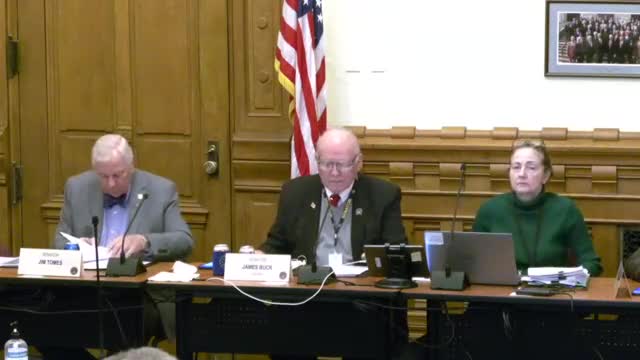
The Indiana Senate committee chaired by Senator Buck approved House Bill 1005 as amended during a committee hearing, advancing the measure by a 9-1 roll call after testimony from business groups, manufactured-housing representatives and local-government advocates.
The bill matters because it ties state infrastructure loan priority to local land-use actions while changing how plan review and inspections may be provided. Supporters said the changes will speed housing production; critics warned affordability decisions are left to local governments.
Carol Auslander, with Torchbearer Public Affairs representing the Indiana Chamber of Commerce, told the committee, "The Indiana Chamber supports House Bill 1005, and housing is an issue that our members are extremely passionate about, and it continues to impact workforce attraction and retention across the state." Auslander described the bill's prioritization language for the Residential Housing Infrastructure Assistance Fund and said that Round 1 of the fund "awarded $51,000,000 to support the construction of approximately 2,000 homes across Indiana," with Round 2 totaling "around $31,000,000" in additional investments in communities she named.
Representative Miller, the House author, described the amendment the committee considered as the result of negotiations with local governments and industry. Miller said the amendment "beef[s] up the priority ranking system" used by the Indiana Finance Authority for the Residential Housing Infrastructure Assistance Program and said the amendment expanded options drawn from Senator Todd Young's GMB act. Miller summarized operational changes in permitting and inspection: the effective date for some permit/inspection statutes was moved to Jan. 1, 2026 to allow local units time to adjust; permit applicants will be required to indicate on filing whether they will use a private provider; the amendment bars a private provider from being a unit employee and removes home inspectors from the pool of authorized private providers; and it requires a unit that cannot timely perform a plan review to refund the applicant and allows a convenience fee up to $100.
Miller also said the amendment clarifies when an engineered stamp may be required, aligns insurers' liability requirements for private providers with similar professions, and resolves a timing conflict with the vested rights statute (which allows 12 days for issuing a permit or certificate of occupancy when required). "To wrap up, it really does two things," Miller told the committee, "Communities that adopt zoning and regulatory changes are given priority consideration when applying for financial assistance for the infrastructure to support housing and if the local unit requires a plan review and an inspection for a class 2 structure, those services are provided in a timely manner regardless of whether the unit performs the service or the permit applicant uses a private provider."
A representative of the Indiana Manufactured Housing Association identified in the record as Ron said federal changes under the HUD code are allowing more flexible manufactured-home designs in coming years. He told the committee, "HUD is giving us the... ability to build, triplexes and fourplex manufactured homes under the HUD code," and said anticipated federal changes in 2026 would allow removal of the steel chassis requirement, enabling stacked units.
Committee members pressed for details on the housing fund and repayment terms. Miller described the Residential Housing Infrastructure Assistance program as a revolving loan fund: he said the first round of funding was $75 million (and that funds will revolve back as loans are repaid) and that the current budget provides $50 million in new funding. Committee members also discussed the role of Tax Increment Financing (TIF) in projects supported by the fund and noted statutory TIF limits of 20 years.
Senator Taylor explained his no vote, saying he supported the bill's goals but planned a second-reading amendment to require affordability guardrails if state funds are used. "I'm going to vote no and I'll have a second reading amendment to make sure that even if the community doesn't want affordable housing, that we as legislators being responsible with Hoosier taxpayer dollars, make sure that it is affordable," Taylor said during his statement.
The committee voted by roll call to approve the amended bill, 9-1. The committee record shows the amendment was moved and seconded and the amended bill passed on the committee floor; the measure will proceed to second reading.
Votes at a glance: Jackson (Aye); Yoder (Aye); Taylor (No); Niemeyer (Yes); Bohotjek (Yes); Becker (Yes); Durnell (Yes); Schmidt (Aye); Thoms (Yes); Buck (Aye).