Get Full Government Meeting Transcripts, Videos, & Alerts Forever!
Get email alerts on the Water And Sewer topic
No spam. Unsubscribe anytime.
City staff propose no change to FY2026 water and sewer rates; warn of long-term capital pressure
Summary
Donna LaScalia, director of Public Works, presented the Northampton water and sewer enterprises’ FY2026 outlook and recommended no changes to usage or base rates for the coming fiscal year.
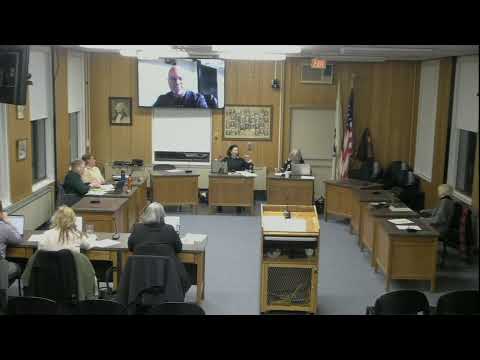
Donna LaScalia, the director of Public Works, presented the Northampton water and sewer enterprises’ FY2026 budget outlook and recommended no changes to usage or base rates for the coming fiscal year at a March 20 public hearing.
The nut of the presentation: the utilities are carrying major, multi‑year capital programs and higher debt service even as revenue from the city’s largest industrial customer has fallen sharply; LaScalia said staff set rates in 2023 to replace lost Coca‑Cola revenue and that the enterprises must now protect rate stability while funding aging infrastructure.
LaScalia said the city’s water system includes three surface reservoirs and a water treatment plant capable of more than 6 million gallons per day, and about 135 miles of distribution mains. She told the council that usage and flows have declined in the last two fiscal years largely because Coca‑Cola reduced operations; the plant historically produced roughly $1.5 million a year in revenue for the enterprises. The city’s 2023 rate adjustment shifted Coca‑Cola’s lost revenue into base charges; the director said that change increased the average residential water bill by about $128 annually and the sewer impact was roughly $115 per year for the average user.
LaScalia described recent unexpected receipts from Coca‑Cola after the company delayed its planned closure: $933,000 in FY2024 and about $461,000 year‑to‑date for the current fiscal year; she said projections for FY2026 assume approximately $300,000 from the plant but that the number is uncertain. The enterprises are “closed systems,” LaScalia said — all revenue must stay within water and sewer funds — and the city cannot rely on uncertain industrial receipts when building a balanced budget for DOR review.
Capital pressures were a central theme. LaScalia said the sewer enterprise is in the midst of a roughly $20 million upgrade at the wastewater plant following an earlier $12 million project; she summarized “nearly $30 million” in upgrades and noted a total list of projects that together exceed available budgets. She said that water and sewer have needed investments including transmission main repairs, dam work and lining old sewer pipe, and that recent water main failures — including a run of seven breaks between December and January — cost tens of thousands of dollars per repair.
LaScalia also reported the utilities’ stabilization balances: roughly $12.1 million for sewer and $2.4 million for water. She said those balances were built to smooth rate impacts as debt service rises but added the sewer debt service is increasing and may require transfers from stabilization to the operating budget in future years.
On policy, the director proposed no rate changes for FY2026 — both usage and base charges would remain at current levels. She also reminded residents of an income‑based exemption administered by the assessor’s office that can waive base charges for eligible households; applications are accepted year‑round and the assessor’s office can provide details.
Councilors pressed staff on program details and next steps. Councilor Moulton asked about the income exemption year referenced in the presentation; staff and the assessor’s office clarified the current eligibility year and that FY2026 guidance will be provided after July 1. Several councilors and the mayor asked about efforts to recruit new large water users for the Coca‑Cola site; the mayor said city and federal officials have worked with Coca‑Cola and that outreach to potential new users has been ongoing but complicated because the company’s plans have changed repeatedly.
Public commenters thanked utility staff for service and raised related operational issues: a restaurant owner described repeated fouling of grease and non‑disintegrating toilet paper that can wrap pumps; others asked about the apparent contradiction between conservation messages and the city’s need to replace industrial revenue.
Procedural outcome: after the hearing, Councilor Moulton moved and Councilor Clemmer seconded to close the hearing; the council voted to close the public hearing. The council later referred the FY2026 water and sewer rate order to the consent agenda for the April 3 meeting for final consideration.
Next steps: the administration will present the formal financial order on the April 3 consent agenda; councilors and staff will continue capital‑planning work and monitor Coca‑Cola’s remaining usage and any future revenue.