Get Full Government Meeting Transcripts, Videos, & Alerts Forever!
Get email alerts on the Animal Services topic
No spam. Unsubscribe anytime.
Marshall Pet Adoption Center chief outlines staffing, intake and reporting challenges
Summary
Chief of the Marshall Pet Adoption Center reported that the shelter took in 994 animals last year, is operating with one full-time employee and zero animal control officers, and committed to providing quarterly reports to county and city officials to improve transparency and coordination.
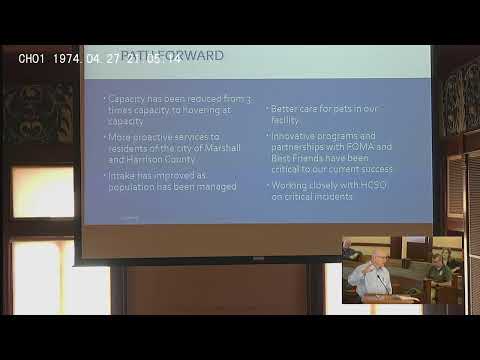
The chief of the Marshall Pet Adoption Center told Harrison County officials on the record that the shelter took in 994 animals during the past year and is operating with one full-time employee and three open positions, including zero animal control officers on staff. The chief said the facility opened in 2021 and that staff have reduced the facility’s occupancy from three times the state capacity to ‘‘at capacity’’ by changing procedures and increasing transports, fosters and partnerships.
The report mattered to county leaders because commissioners have questioned differences in how the center treats animals from city and county residents. The chief said intake and treatment are the same for city and county residents and that the center’s contract prevents charging the county for drop-offs. The chief also offered to provide quarterly reports to the judge and commissioners so officials can track closures or managed intake periods.
The chief provided specific numbers and operational details: 380 animals were dropped off by county residents, 587 by city residents, and 27 had unknown origin; transports frequently move dozens of animals out of the shelter; and disease outbreaks such as parvovirus have forced ‘‘managed intake’’ or temporary intake stoppages. The chief said ShelterLuv software, volunteers, spay-and-neuter programs, transport partners and a newly formed advisory committee of animal-care professionals have helped reduce overcrowding. He also said the center received some grants and philanthropic support from groups including FOMA and Best of Friends, though voucher funding is limited and case-by-case.
Staffing and capacity were recurring themes. ‘‘Right now, we have one full-time employee at the Marshall Pet Adoption Center. We have three openings,’’ the chief said, later adding that the city had provided an additional animal-control officer position but staff have not been able to fill it. The chief said the center is working to hire three animal-control officers and has recently hired a new manager who came from the veterinary industry. The manager was named as Justin Cerna, supervised by Lieutenant Ames of the sheriff’s office.
The chief described partnerships used to manage population and care: the sheriff’s office provides inmates to help clean the facility seven days a week; FOMA and other volunteers operate foster and transport networks; and transport partners such as North Shore take large groups of animals when capacity allows. The chief said transports sometimes move 30 to 60 animals and that those moves free space for additional intakes.
On euthanasia, the chief clarified the facility’s status. The center has been recognized as a ‘‘zero-kill’’ facility but that does not mean no animals are euthanized. ‘‘We do euthanize dogs and certainly vicious dogs, dogs that aren’t adoptable or injured,’’ the chief said, noting that some facilities that are called no-kill still euthanize animals when humane or safety considerations require it. The chief estimated that the facility’s euthanasia applies to a minority of intake (described as not adoptable) rather than being a blanket policy.
Commissioners and the judge pressed for clearer, regular reporting so they can explain intake limits and closures to constituents. The chief proposed a quarterly report generated from ShelterLuv and said staff could email the judge and the city commission when the shelter enters managed intake or reaches capacity. Officials on the dais supported the reporting idea as a way to reduce confusion when residents call.
The chief identified several continuing challenges: limited budget relative to demand, disease outbreaks that require temporary intake suspensions, difficulty recruiting animal-control officers, and episodic funding for spay/neuter vouchers. He described the advisory committee as a vehicle for policy and cost-saving recommendations and encouraged promotion of volunteer and foster opportunities.
Officials did not take a formal vote on policy changes; the meeting record shows the chief’s pledge to provide regular reports and ongoing collaboration with Harrison County and municipal partners. The presentation concluded with council members and commissioners thanking the chief and staff for the update.