Get Full Government Meeting Transcripts, Videos, & Alerts Forever!
Get email alerts on the Campaign Finance topic
No spam. Unsubscribe anytime.
Committee hears SB 116 to reinstate contribution limits; sponsors propose $2,000 per-election cap and inflation adjustments
Summary
SB 116 would raise Alaska campaign contribution limits to $2,000 per individual per election cycle and $4,000 per group per cycle, and direct the Alaska Public Offices Commission to adjust limits for inflation; the Senate State Affairs Committee heard proponents and set the bill aside for further legal review.
Juneau — Senate Bill 116, presented Thursday to the Senate State Affairs Committee, would amend campaign contribution limits for state and local office, setting a $2,000 individual-per-election-cycle cap and a $4,000 group-per-election-cycle cap and directing the Alaska Public Offices Commission (APOC) to adjust limits for inflation once each decade beginning in 2031.
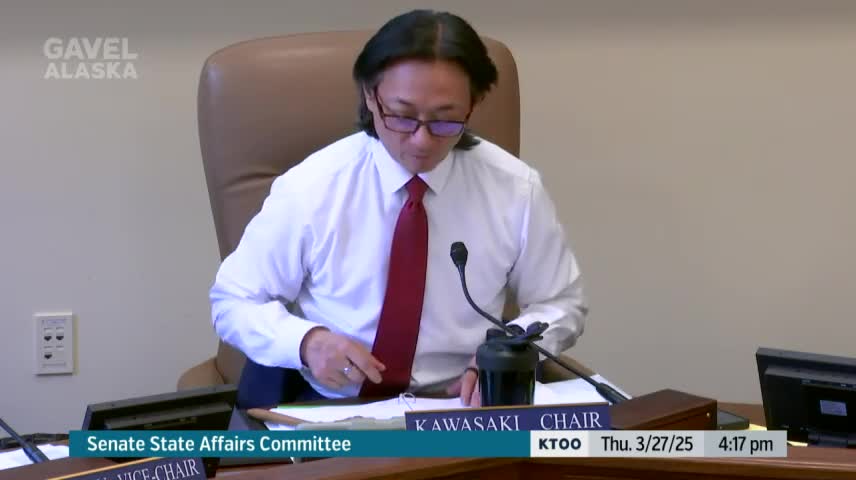
Joe Hayes, staff to Chair Kawasaki, presented the bill overview and said the measure aims to restore fair, reasonable and constitutionally defensible contribution limits after federal court decisions have altered Alaska’s prior statutory limits. Hayes told the committee the bill moves limits to a per-election-cycle basis and increases the individual-to-candidate limit from $500 (yearly under prior statute) to $2,000 per election cycle and the group-to-candidate limit from $1,000 to $4,000 per cycle; it also directs APOC to adjust limits for inflation.
Proponents told the committee SB 116 mirrors a certified 2024 ballot initiative and supporters urged the legislature to enact the measure before it appears on a 2026 ballot.
Pat Race, a volunteer on the ballot initiative, summarized the legal history and cited U.S. Supreme Court precedent that allows contribution limits (Buckley v. Valeo) while recognizing that limits set too low can impede challengers (as discussed in other federal cases). He said the proposed limits are intended to balance enabling challengers to run viable campaigns while preventing large, direct contributions to candidates from undermining public confidence.
"We're trying to fix that…there's this porridge problem — not too hot, not too cold, just right," Pat Race said, describing the history of contribution limits in Alaska and court scrutiny.
Several public witnesses and activists spoke in favor, arguing the limits are popular with Alaskan voters and would reduce the time candidates spend fundraising. Sharman Haley, retired economist and activist with Alaska Move to Amend, told the committee the initiative was vetted to be legally defensible and urged legislative passage to avoid a ballot campaign. Carolyn Storm, who helped gather signatures for the initiative, said lower fundraising needs would allow candidates to spend more time with constituents and less on solicitation.
Committee members asked procedural and legal questions. Senator Yount asked whether APOC had issued a formal legal opinion; Hayes said legislative legal will provide analysis before subsequent hearings and that APOC staff will be invited. Committee members also discussed limitations on independent expenditures (not covered by this bill because of U.S. Supreme Court precedent such as Citizens United) and the practical effects of limiting contributions to candidates while independent groups may still spend without a cap.
The committee took public testimony and set SB 116 aside for a future hearing that will include APOC and legislative legal staff; no committee vote to advance the measure was recorded in this session.