Get Full Government Meeting Transcripts, Videos, & Alerts Forever!
Get email alerts on the Permanent Fund Dividend topic
No spam. Unsubscribe anytime.
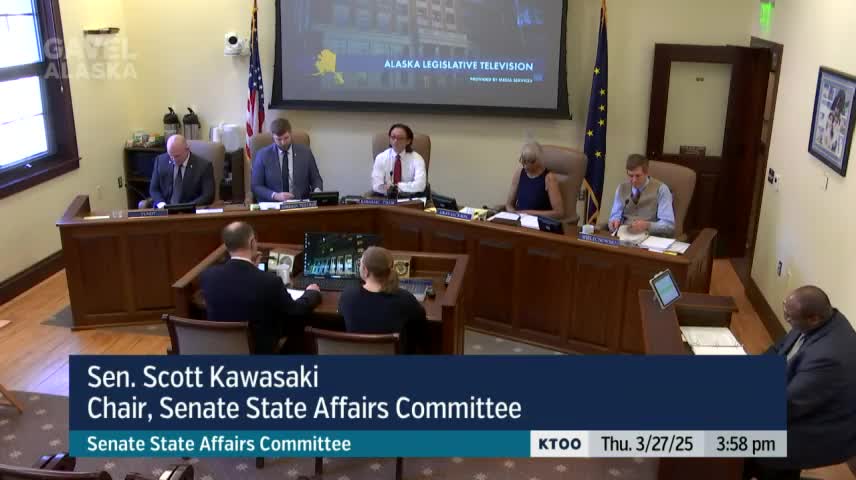
Senate committee hears SB 77 to modify PFD eligibility rules; bill sets fingerprinting for division staff and makes applicant names confidential
Summary
SB 77, a Permanent Fund Dividend cleanup bill, would adjust allowable absences (merchant marine training, school breaks, medical care), authorize fingerprinting of division staff, make PFD applicant names confidential, and allow electronic levy notices; the committee heard public support and set the bill aside for further consideration.
Juneau — Senate Bill 77, presented Thursday to the Senate State Affairs Committee, would make a series of changes to Permanent Fund Dividend (PFD) administration, including expanding allowable absences for eligibility, permitting fingerprinting of PFD division staff applicants and employees, making lists of PFD applicants confidential, and allowing electronic notification of levy notices with opt-in consent.
Sponsor Senator Peter Kiel told the committee SB 77 is a "cleanup bill" for the Permanent Fund Dividend Division and not a change to the PFD formula. The bill keeps the baseline allowable out-of-state absence at 180 days during a qualifying year but clarifies and expands categories for additional allowable absences, including merchant marine training and school breaks during the academic year (but not summer vacation). It also simplifies complex rules for medical treatment outside the state so late-year medical emergencies do not retroactively disqualify applicants who otherwise met requirements earlier in the year.
"The primary qualification to get a Permanent Fund Dividend is to be a resident in the state of Alaska with the intent to remain," Senator Kiel said. He described fixes including allowing merchant marine trainees and students on school breaks to count those absences toward eligibility and simplifying medical-treatment rules that have produced confusing retroactive results.
Kathy Schlingheide, staff to Senator Kiel, summarized the bill sections for the committee, noting sections that require fingerprinting of PFD division staff and applicants, expand allowable absences for college breaks and merchant marine training, make PFD applicant names confidential, and set an effective date.
Director-level and public testimony supported the changes. Beverly Woolley, a retired public-health official from Big Lake and cancer survivor, told the committee that treating medical emergencies that require out-of-state treatment more flexibly would avoid forcing ill Alaskans to delay necessary care or lose their dividend. "Medical emergencies are not planned…Alaskans who have already used their allowable 180 days out of state shouldn't be penalized and face losing their Permanent Fund Dividend," Woolley said.
Katie Capozzi, president and CEO of the Alaska Chamber of Commerce, testified in support on behalf of the chamber, noting the bill would clarify vocational training absences so Alaskans who attend merchant marine apprenticeship programs remain eligible for their PFD. She said denying benefits to trainees discouraged recruitment and local hiring goals in the maritime industry.
Senator Kiel and staff said fingerprinting is intended to allow the division to properly screen employees who will handle sensitive applicant information, including bank routing numbers and medical details. "These folks get our bank account and routing numbers for direct deposit…it's important for Alaskans to feel safe and secure," Senator Kiel said.
The committee took public testimony and set SB 77 aside for further consideration; no committee vote to advance the bill was recorded in the transcript during this hearing.
Key details: the bill maintains the 180-day baseline for allowable absences, explicitly allows additional absence days for merchant marine training and for school breaks during the academic year, simplifies medical-treatment absence rules to avoid retroactive disqualification, authorizes fingerprinting for division job applicants and employees (not PFD applicants), makes applicant name lists confidential, and permits levy notices to be delivered electronically to those who opt in. The bill's staff summary states an effective date is included in section 6.