Get Full Government Meeting Transcripts, Videos, & Alerts Forever!
Get email alerts on the Elections topic
No spam. Unsubscribe anytime.
Senate committee adopts SB 64 committee substitute adding residency clarifications, roll-cleanup notices and ballot-tracking language
Summary
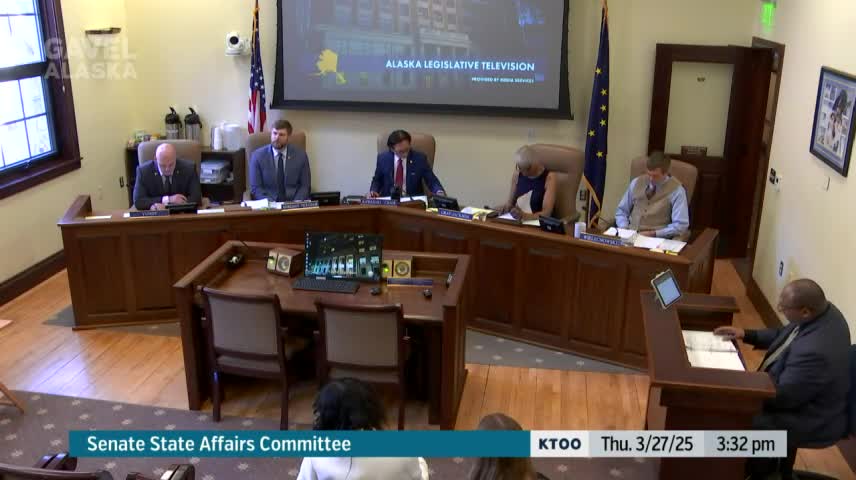
The Senate State Affairs Committee adopted a committee substitute for SB 64, the Elections Omnibus bill, after staff outlined changes clarifying residency rules, new voter-roll cleanup notices for Alaskans living outside the state, and revised ballot-tracking language the Division of Elections can implement.
Juneau — The Senate State Affairs Committee on Thursday adopted a committee substitute for Senate Bill 64, an omnibus elections bill that clarifies residency rules, directs additional voter-roll cleanup notices for Alaskans recorded as living outside the state, and replaces existing ballot-tracking language with provisions the Division of Elections can implement.
The committee adopted the substitute version (work draft 34-LS0153\o) without objection after staff described the new provisions and Division of Elections officials answered questions. The bill was then reported out of committee with individual recommendations and attached fiscal notes.
The committee substitute adds residency clarifications in section 1 and section 25 so that “voters will have their ballot counted for the races they are still eligible to vote in if they vote in a district which includes their former voting residence,” according to Maxine LaBerge, staff to Senator Willikowski. LaBerge summarized additional additions to the bill, including new voter-roll cleanup procedures that require notices to voters whose permanent mailing address in division records has been outside Alaska for at least two years, giving them the option to confirm residency, cancel registration, or move to federal-only status.
"The following provisions were added to the bill…notices be sent to voters whose permanent mailing address in division records has been outside of Alaska for at least 2 years," Maxine LaBerge, staff to Senator Willikowski, said while reciting the draft’s summary of changes.
Committee members pressed Division of Elections Director Carol Beecher about the ballot-tracking language in the new section 38. "The only one that could be tricky is checking the date of the ballot's delivery to the voter because all we would have is basically the USPS tracking," Beecher said, noting that the division could comply with the other requirements either through existing systems or a vendor.
Public commenters generally supported the bill’s ballot-tracking provision and raised cybersecurity concerns. Rob Welton, testifying from Douglas, said the cyber provisions in the draft (section 42 in an earlier version) should be broader and suggested election administration and security be managed by a nonpartisan official rather than an elected lieutenant governor. "Having an elected official having a direct role in this cybersecurity will increase mistrust in the system," Welton said, and recommended that authority be given to the division director and expanded to include tabulation systems as well as voter registration records.
Committee legal drafting staff and committee counsel discussed the bill’s residency language at length. Sonia Kawasaki, Senate majority legal counsel, said the added provisions were intended to require an "articulable and reasonable plan to return to the state" for voters who temporarily leave Alaska, to make residency determinations less subjective and align with how the division currently treats ballots cast by persons who have moved from their originally registered location.
Senator Willikowski described the intent behind the changes as addressing bloated voter rolls caused by people who register in Alaska and later move elsewhere but remain on Alaska rolls without a concrete plan to return.
Action at a glance: Senator Bjorkman moved to adopt the committee substitute; after discussion and no objections, the committee removed objections and adopted the substitute (work draft 34-LS0153\o). Senator Bjorkman subsequently moved that SB 64 be reported out of committee with individual recommendations and attached fiscal notes; the motion passed with no objections and staff completed the paperwork.
The bill will next move to the Senate Finance Committee. Committee members noted similar measures are progressing in the House and that many elements in SB 64 have appeared in prior sessions.
The committee opened the record to public testimony and accepted written submissions to senatestateaffairs@akleg.gov. No formal roll-call vote was recorded in the transcript; committee actions were taken by voice and "hearing no objections."