Get Full Government Meeting Transcripts, Videos, & Alerts Forever!
Get email alerts on the Campaign Finance topic
No spam. Unsubscribe anytime.
Committee reviews bill to reinstate campaign contribution limits, tie adjustments to inflation
Summary
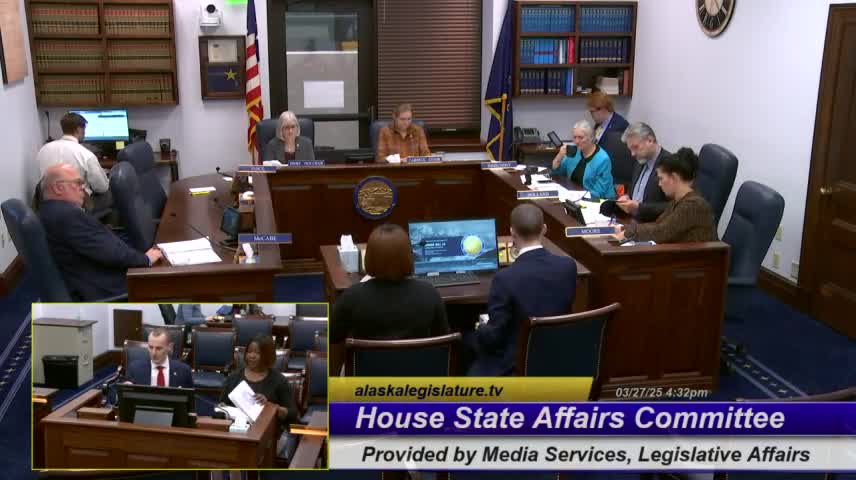
Representative Schrage told the House State Affairs Committee on March 27 that House Bill 16 would restore statutory campaign contribution limits for Alaska state and local races and require the Alaska Public Offices Commission to adjust those limits for inflation once each decade.
Representative Schrage presented House Bill 16 on March 27, saying the measure would restore constitutional contribution limits for Alaska state and local races and direct the Alaska Public Offices Commission to adjust limits every decade for inflation. "House Bill 16 reinstates fair and reasonable and constitutional campaign contribution limits, adjusted, to Alaska's consumer price index moving forward," Representative Schrage said.
The sponsor told the committee the bill mirrors a 2024 citizen initiative that gathered nearly 30,000 signatures and met the statutory threshold for certification; the presentation said the initiative will appear on the 2026 ballot if the Legislature does not pass materially similar legislation. The sponsor reviewed background including past statutory limits, ballot initiatives and court challenges. Committee presentation materials and testimony repeatedly cited the legal context of Thompson v. Hebden and referenced Randall v. Sorrell as a controlling test for constitutionally permissible contribution limits.
Key provisions summarized to the committee include moving contribution limits to a per‑election basis rather than per calendar year; raising an individual‑to‑candidate cap to $2,000 per election cycle (from a previous $500 per year, which inflation‑adjusted would be about $751 today) and setting related group and party limits (for example, a non‑party entity to a candidate at $4,000 and a party to candidate limit of $5,000 as presented). The bill directs APOC to update limits once each decade beginning in 2031 to account for inflation and to reduce the legal risk identified in recent court decisions.
Policy experts and advocates also testified. Sharman Haley, who identified herself as a longtime policy analyst and researcher, endorsed the measure and described it as carefully drafted to meet the four‑ and five‑factor tests referenced in recent case law. “The bill should not be controversial. It is unassailable legally and has solid support among your constituents across the political spectrum,” Haley said, and cited past ballot results showing strong voter support for contribution limits.
Committee members asked technical questions about definitions (for example, the statutory definitions for "group" and "non‑group" are located in AS 15.13.400), whether the bill would apply to municipal and school board races (the sponsor said state and local races, not federal contests), and whether passage this session would preempt the certified ballot initiative (the sponsor said the bill mirrors the initiative and would have that effect if enacted). Members also raised longer‑term concerns about out‑of‑state independent expenditures and the Alaska Public Offices Commission’s capacity and enforcement tools; the sponsor said those structural issues could be considered in separate legislation but that HB16 is intended as a focused, legally defensible fix.
The committee scheduled public testimony and set amendment deadlines for a follow‑up hearing; no formal action or vote was taken during the March 27 meeting.