Get Full Government Meeting Transcripts, Videos, & Alerts Forever!
Get email alerts on the Alaska Seafood Industry topic
No spam. Unsubscribe anytime.
Alaska seafood leaders brief Senate Arctic Affairs Committee on industry slump, workforce and policy needs
Summary
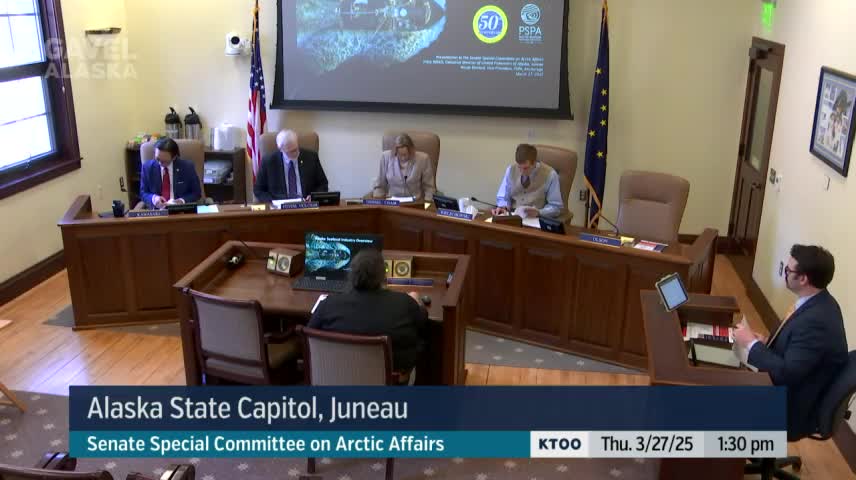
The Senate Arctic Affairs Committee heard a presentation March 27 from representatives of the United Fishermen of Alaska and the Pacific Seafood Processors Association on the size, challenges and policy needs of Alaska’s commercial seafood industry.
The Senate Arctic Affairs Committee heard a presentation March 27 from representatives of the United Fishermen of Alaska and the Pacific Seafood Processors Association on the size, challenges and policy needs of Alaska’s commercial seafood industry.
The presentation, delivered by Tracy Welch, executive director of United Fishermen of Alaska (UFA), and Nicole Kimball, vice president of Pacific Seafood Processors Association (PSPA), outlined the industry’s economic footprint, recent market disruptions and a list of state and federal policy steps industry groups say could ease near-term strain and support long-term viability.
The briefing matters because Alaska supplies the majority of U.S. wild-capture seafood and because fishing and processing are a primary economic engine for dozens of coastal communities. Committee Chair Senator Giesel led the hearing in Juneau as members questioned presenters about market access, bycatch management and workforce development.
UFA and PSPA described the industry’s scale and recent losses. Kimball said, “We very, very consistently produce 60%, sometimes over 60% of total US seafood harvest.” Presenters said the combined state and federal harvest typically reaches into the billions of pounds annually and supports tens of thousands of jobs. Kimball and Welch cited McKinley Research Group and NOAA analyses showing millions of dollars in annual activity and export links: roughly 70% of Alaska production is exported to more than 100 countries.
Presenters described a sharp, multi-species downturn beginning in 2022 and carrying into 2023. Kimball summarized a NOAA “snapshot” economic analysis that, she said, “showed that we sustained a $1,800,000,000 economic loss in just Alaska seafood.” They attributed the decline to large global inventories, low-priced foreign supply (including increased Russian volumes), reduced consumer demand after COVID-era disruptions and a strong U.S. dollar that made exports more expensive.
Rising operating and labor costs were another major theme. Kimball said processing-sector taxable wages spiked between about 2020 and mid‑2023 and that overall labor costs rose sharply; Welch noted state support that temporarily reduced borrowing costs for fishermen. Welch told the committee the state’s commercial fishing revolving loan fund had allowed interest rates for some fishermen to be reduced “from 10 and a half percent down to 5.25 for a short period of time” and that the program’s maximum loan had been raised from $200,000 to $400,000.
Committee members pressed on workforce and resident hire. Kimball said resident hires in many processing jobs remain lower than industry leaders would prefer and that processors are running apprenticeship and vocational partnerships (including company-sponsored training at AVTEC) to grow local, year‑round skilled workforces. Kimball described recruiting and apprenticeship programs that pay trainees while they attend school and that guarantee jobs on completion.
On fishery stewardship, presenters and senators discussed bycatch management in high-volume fisheries, especially pollock. Kimball explained that the North Pacific Fishery Management Council and National Marine Fisheries Service (NOAA/NMFS) set hard caps and require independent observers, cameras and genetic sampling. She described industry-run real‑time bycatch-avoidance programs that spatially move vessels when observer data show higher incidental catch and said Chinook bycatch has fallen dramatically from earlier highs. Kimball noted ongoing council consideration of further chum salmon protections and new excluder designs that would lower incidental catch.
Industry proposals to the committee included expanded market development funding, financing tools, workforce development and infrastructure modernization. Welch and Kimball urged continued funding of the Alaska Seafood Marketing Institute (ASMI) and said ASMI’s budget—and therefore its marketing capacity—falls as product value declines. They asked the committee to support programs and bills recommended by the seafood task force, and they flagged a set of bills and programs under active legislative consideration, including commercial fishing revolving loan programs, fisheries development tax credits and bills addressing insurance, gillnet co‑ops and conflict-of-interest rules for the Board of Fisheries.
Both presenters stressed the industry’s dependence on effective federal science and management. Kimball warned that reduced NOAA survey funding or staffing could impair stock assessments and the federal response needed to manage Alaska fisheries.
The committee did not take votes on any of the items; senators followed the presentation with questions about consolidation, export processing and continued bycatch reductions. Chair Giesel closed the hearing noting related bills (Senate Bill 115 and 130) to be heard in the Resources Committee and adjourned the special meeting.
Ending note: The presenters left senators with a mix of short‑term asks (loan and financing measures, ASMI support and USDA procurement inclusion) and longer-term priorities (infrastructure modernization, workforce training and sustained federal survey and management capacity).