Get Full Government Meeting Transcripts, Videos, & Alerts Forever!
Get email alerts on the Criminal Justice Reentry topic
No spam. Unsubscribe anytime.
Panel hears bill to authorize tablets in correctional facilities to expand reentry, education and telehealth
Summary
House Bill 35 would amend state statute to permit secure electronic tablets in Department of Corrections facilities for rehabilitative and reentry purposes, law library access, telehealth and expanded visitation; the committee heard invited testimony and DOC described a limited pilot costing about $50 per user per month.
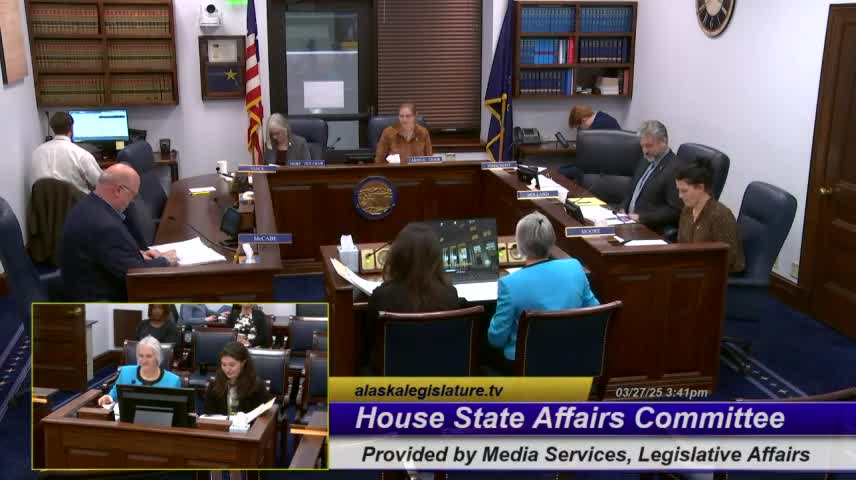
Representative Rebecca Himshuet presented House Bill 35 to the House State Affairs Committee on March 27, saying the legislation would bring Alaska into alignment with most other states by allowing secure tablets in correctional facilities to support reentry and reduce recidivism. "We are trying to bring Alaska into alignment with the other 48 states who allow tablets in their departments of correction facility Department of Corrections facilities," she said.
The bill proposes several statutory changes: it would amend AS 33.30.101.5(a) to permit computers and electronic tablets when used for approved purposes; add accepted uses such as rehabilitative and reentry programming, access to legal materials, telehealth and expanded visitation; prohibit correctional facilities from charging fees for email or online visitation services; and specify that online visitation may supplement, not supplant, in‑person visitation where practicable. The sponsor’s staff reviewed the sectional language to the committee and noted conforming changes and an effective‑date clarification.
Supporters urged the committee to consider the bill’s potential to reduce recidivism and improve reentry outcomes. Terry Tibbett, coordinator for the Alaska Reentry Partnership, told the committee the state’s reentry coalitions work across eight communities and support the bill because access to digital technology can increase access to education, treatment, telehealth and employment supports. She cited state recidivism figures discussed in testimony, noting a decline from about 63.17 percent in 2015 to about 54.59 percent in the most recent FY2021 measure, while acknowledging the testimony did not assert a causal link between the decline and reentry work.
Bobby Dorton, a peer advocate and formerly incarcerated person from Fairbanks, gave personal testimony about lost learning opportunities while serving a long sentence and described how access to training and educational materials on tablets could have changed his trajectory.
Department of Corrections Deputy Commissioner April Wilkerson described an existing pilot at Highland Mountain Correctional Facility and the department’s security approach. Wilkerson said the pilot uses a restricted, closed network and a vendor platform; tablets include a digital law library, the facility offender handbook, and professional (attorney‑client) visitation. "Tablets have the digital law library. It has the offender handbook, on it. And then it also allows for the, professional visitation with their attorneys," Wilkerson told the committee. She said the pilot does not currently provide family video visitation on the tablet but does allow monitored instant messaging and paid electronic mail (paid by the sender), and the department is piloting electronic request‑for‑information and grievance workflows to replace manual paper processes.
Cost and procurement questions were a focus. Wilkerson said the Highland Mountain pilot currently operates at about $50 per month per user and that any wider rollout would require an RFP and likely a future budget request. Committee members pressed about vendor choices and the risk that vendors recoup costs through fees; Wilkerson said the department would pursue procurement and funding decisions if the statutory authority is granted.
The bill would also prohibit correctional facilities from charging for email or online visitation if enacted as described. Supporters and DOC officials said tablets in remote Alaska communities could increase family and faith‑based contact where in‑person visitation is impractical.
No formal vote was taken; the committee set House Bill 35 aside and said it will take the bill up at the next hearing where public testimony and amendment deadlines will be scheduled.