Get Full Government Meeting Transcripts, Videos, & Alerts Forever!
Get email alerts on the Child Welfare topic
No spam. Unsubscribe anytime.
Citizen Review Panel urges better handling of screened‑out reports; OCS outlines staffing, tribal coordination progress
Summary
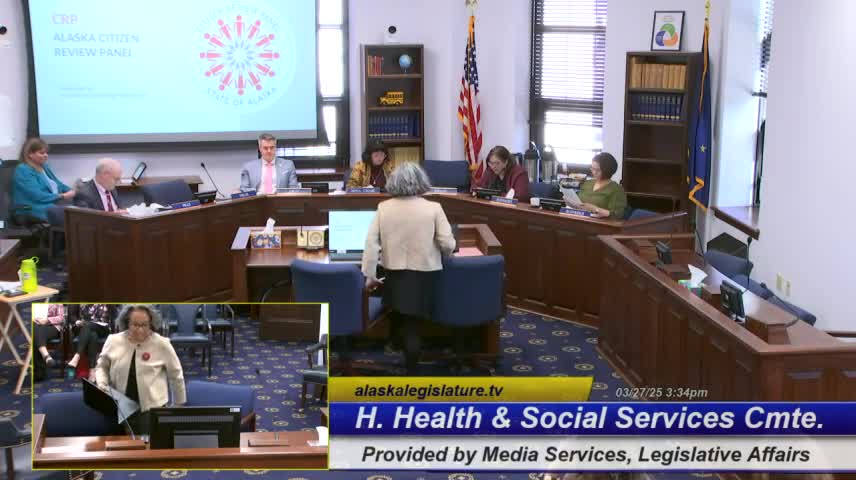
The Alaska Citizen Review Panel told the House Health and Social Services Committee on March 20 that state child‑welfare systems need stronger links between screened‑out reports and community services to prevent later removals.
The Alaska Citizen Review Panel told the House Health and Social Services Committee on March 20 that state child‑welfare systems need stronger links between screened‑out reports and community services to prevent later removals. The panel asked the Office of Children’s Services to pursue policy and administrative changes to make referrals and prevention services more accessible.
The panel’s chair, Richard George Bettisworth, said the panel’s two‑year work plan will focus first on education and data gathering about mandatory reporting and out‑of‑home placements, and then on actionable recommendations. “We will prioritize focus areas critical to improving child welfare services in Alaska,” he said.
Why it matters: The panel cited national data showing that neglect accounts for most screened‑in investigations and noted that it often takes multiple reports before neglect cases are screened in. The panel recommended more collaborative approaches to ensure families who are screened out are still connected to prevention services, including exploring models used in other states and producing an annual report on screened‑out cases.
The Office of Children’s Services responded to the panel’s recommendations and to committee questions. Director Kim Guay said the division is working on recruitment and retention and on data reviews of screen‑in and screen‑out decisions. She told lawmakers the division received 21,590 protective‑services reports (calls or faxes) in the most recent reporting period, with about 69 percent screened out and 31 percent screened in for investigation.
Guay said OCS has reduced turnover from a pandemic high of about 59 percent to about 37 percent and currently records roughly a 30 percent vacancy rate in positions statewide. The division has created a talent acquisition team, shifted toward competency‑based hiring, paid internships and coursework for staff, and expanded supervisor coaching and career ladders. “We are finally seeing a little bit of some results,” Guay said of turnover metrics.
On screened‑out cases, Guay and citizens review panel members described confidentiality and statutory limits as barriers to OCS directly referring families to community providers after a report is screened out. Guay said 7 AAC 54.08 and related regulations constrain what information OCS can share without parental consent. She added that tribes receive protective‑services reports when children are identified as Alaska Native and often follow up independently or alongside OCS.
The panel and OCS both said Alaska’s geography and workforce distribution affect outcomes. Panel members noted the panel will examine placement stability and cultural connections in out‑of‑home care during phase‑one work. Guay said OCS shares protective‑services reports with tribes under signed confidentiality agreements and that roughly 180–200 tribes receive those reports.
Lawmakers pressed for specifics and possible legislative fixes. Representative Grama asked what Minnesota does differently; the panel chair said the panel had cited Minnesota as a model but did not recall the exact mechanism and recommended further study. Multiple lawmakers asked whether legal or regulatory changes could allow OCS to make direct referrals; panel members and Guay said privacy law and confidentiality rules complicate broad policy fixes and that some issues may require legislative discussion.
OCS said it is using quality‑improvement work to examine whether screen‑out decisions miss high‑risk children and to refine intake triage. Guay described outreach efforts—community town halls and partnerships such as the Alaska Impact Alliance and the 907 Navigation app—to improve prevention and connect families to local services.
The panel’s near‑term priorities include mandated‑reporter training, better tracking of screened‑out referrals, and data analysis of out‑of‑home placement stability and outcomes. OCS said technology and staffing constraints limit some reforms; Guay said replacing or upgrading major case‑management systems would be costly and that the division is pursuing interim project‑management tools.
The committee hearing record includes the panel’s written annual report and OCS’s response. Panel members and the director welcomed follow‑up questions and suggested continued legislative engagement on privacy, funding and workforce strategies.
The presentation and Q&A covered both the panel’s recommendations and OCS responses; the committee did not take formal legislative action during the session.