Get Full Government Meeting Transcripts, Videos, & Alerts Forever!
Get email alerts on the Human Rights Commission Reform topic
No spam. Unsubscribe anytime.
House committee hears bill to expand commission jurisdiction to include most nonprofits and to rename and reform reporting and removal rules
Summary
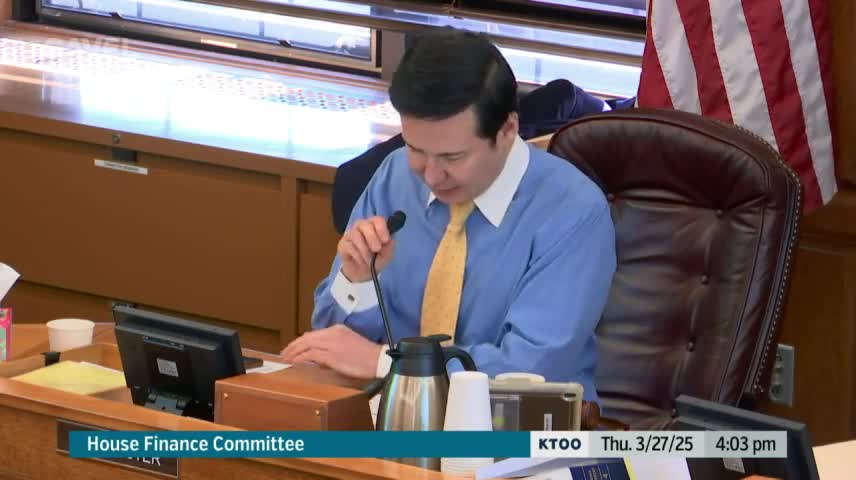
Representative Andy Josephson, sponsor of House Bill 23 and a Democrat from Anchorage, told the House Finance Committee the bill’s core change would extend the state commission’s jurisdiction to employees of many nonprofit employers who are not now covered and to clarify exceptions for religious employers.
Representative Andy Josephson, sponsor of House Bill 23 and a Democrat from Anchorage, told the House Finance Committee the bill’s core change would extend the state commission’s jurisdiction to employees of many nonprofit employers who are not now covered and to clarify exceptions for religious employers. “About 40,000 Alaskans … are not subject to the jurisdiction of the Human Rights Commission,” Josephson said, and the bill aims to close that gap.
The measure has several parts. It would revise the statutory definition of “employer” so that many nonprofit organizations fall under the commission’s authority while explicitly preserving a religious‑employer exception for employees engaged in ecclesiastical or religious functions. The bill would change the agency name (draft language would rename the Alaska State Commission for Human Rights to the Civil Rights Commission), shift the annual report timeline to align with the fiscal year and remove the statutory requirement to print and distribute hard copies to the legislative library, and it would add a removal‑for‑cause provision so governor‑appointed commissioners would have a defined due‑process standard for removal.
Rob Corbusier, executive director of the Alaska State Commission for Human Rights, testified in support. Corbusier described the current statutory gap that leaves employees of many smaller nonprofits without an administrative route for claims. He said the agency already operates under a contract with the U.S. Equal Employment Opportunity Commission (EEOC) and that bringing nonprofit cases under state jurisdiction could increase federal work‑sharing receipts (the commission receives about $800 per co‑filed case under its EEOC agreement). Corbusier estimated the change would generate perhaps 30–60 additional nonprofit cases a year, and he said the commission’s current staffing and recent regulation updates mean it can absorb that additional volume without new appropriations.
Why it matters: The change would give staff at the state commission the authority to investigate and pursue conciliation for discrimination claims by employees at many nonprofits who currently must either go to federal EEOC (only when the nonprofit meets the EEOC’s employer‑size threshold) or file a private suit in superior court. Corbusier told the committee that employees with smaller claims often cannot afford private litigation; administrative jurisdiction provides a lower‑cost route to investigation and conciliation.
Religious and other carve‑outs: The bill’s language preserves an affirmative defense for religious corporations and institutions where the employee’s role is to perform ecclesiastical or spiritual duties; sponsors emphasized the change is not intended to force religious organizations to alter doctrines or clergy roles. Committee members raised related questions about educational institutions, single‑sex schools and fraternal organizations; sponsors and the executive director said they can review carve‑outs and that some prior statutory tweaks have been made in response to narrowly focused conflicts.
Reporting timeline and name change: Corbusier and staff asked to move the annual report deadline to November and to publish electronically rather than deliver printed copies to the legislative library. Corbusier said the current requirement — to provide printed annual reports shortly before the legislature gavels in — made it practically impossible to prepare a complete, accurate report; he said a November deadline would align better with fiscal‑year data collection and internal EEO assessments the commission performs.
Removal for cause: The bill adds language that would allow removal of commissioners only for cause (for example, neglect, misconduct or incapacity) and would provide a defined due‑process route for removal. Corbusier said commissioners requested the change so boards could not be removed arbitrarily and to preserve the commission’s quasi‑judicial independence.
Fiscal impact and capacity: The commission submitted a fiscal note showing zero general‑fund cost for the bill; Corbusier told members that the commission’s budget is under $2.5 million and its staff footprint is about 17 positions (PCNs). He said most costs are personnel and that the commission already had administrative efficiencies that lowered average case‑investigation time; he estimated 30–60 additional nonprofit cases per year could be handled within existing resources and that the change could also increase federal receipts through the EEOC work‑share agreement.
Committee action: Members asked clarifying questions about scope, educational institutions, religious exceptions, commissioners’ terms and geographic representation on the commission. No vote occurred; the bill was discussed and the committee reviewed the fiscal note and testimony and proceeded to next items.
What’s next: Sponsors and commission staff indicated a willingness to refine statutory language where members identified edge cases (for example, how educational institutions or single‑sex organizations are treated). The bill remains in committee for further consideration.