Get Full Government Meeting Transcripts, Videos, & Alerts Forever!
Get email alerts on the Government Appointments topic
No spam. Unsubscribe anytime.
House committee hears bill to make OPA public advocate appointment mirror public defender process
Summary
Lawmakers and invited testifiers heard House Bill 58, which would change how the state’s Office of Public Advocacy (OPA) head is appointed — making the post a four‑year position appointed by the governor from Judicial Council nominees and subject to legislative confirmation, similar to the public defender.
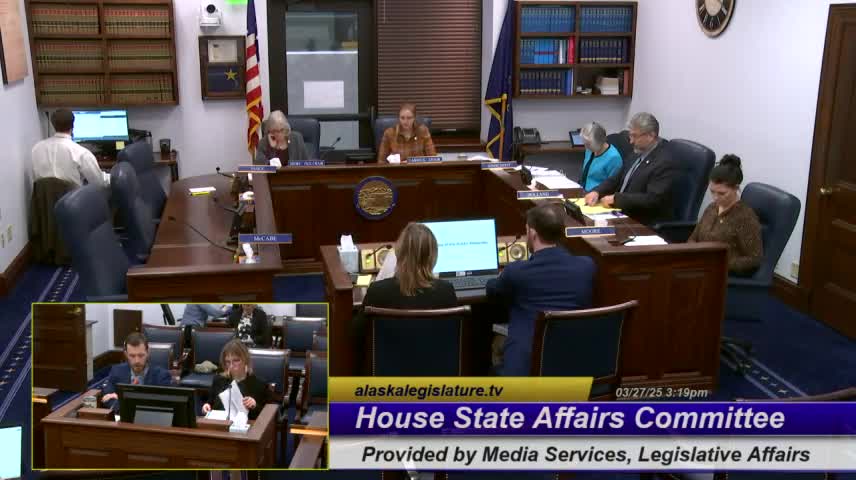
Representative Zach Fields, sponsor of House Bill 58, told the House State Affairs Committee on March 27 that he introduced the bill to change how the director of the Office of Public Advocacy is selected. “I introduced house bill 58 when a constituent who had worked in the office of the public advocate explained to me that the selection of the, head of the office of the public advocate or OPA, is very different from the selection of the public defender,” Fields said on the record.
The bill would rename the position “public advocate,” require appointment by the governor from nominees submitted by the Alaska Judicial Council, make the position subject to a majority confirmation by the joint legislature, and set a four‑year term with retention requiring similar legislative approval. The sponsor’s staff reviewed the sectional language for the committee, citing changes to multiple Alaska Statutes (for example, sections described in the presentation as amendments to AS 44.21.405 and related sections) and an uncodified transition clause preserving continuity of orders, contracts and the employment of the incumbent until a new public advocate is appointed.
Why it matters: invited testifiers said the change is intended to add independence and accountability to an office that represents vulnerable Alaskans in confidential proceedings. Brent McGee, who said he was the first public advocate appointed in 1984, called the bill “a good government bill” and told the committee the appointment process should match that used for the public defender to reduce conflicts of interest and strengthen accountability. “This bill is a good government bill that is designed to correct the mistake made in 1984 when the agency was created,” McGee said.
Suzanne DiPietro, executive director of the Alaska Judicial Council, walked members through the council’s screening and nomination procedures, describing a publicized application process, a 27‑page application, bar surveys, background checks, public hearings and 45‑minute interviews before the council nominates the most qualified applicants to the governor. DiPietro said the council’s criteria include legal ability, administrative skills, integrity, temperament and commitment to equal justice and community service.
Committee members asked clarifying questions about the bill’s mechanics and about whether anything in the bill was new since its prior referral to Community and Regional Affairs; the sponsor’s office said there had been no substantive changes since that prior review. Committee staff read the bill’s sectional changes into the record, including the appointment, removal and vacancy provisions and the uncodified transition language that would allow the current director to remain in place until the governor appoints a new public advocate.
No formal action or vote was taken; the committee set House Bill 58 aside for further consideration at a later hearing.
The committee will take the bill up again at its next scheduled hearing, where members may set amendment deadlines or request additional information from the sponsor and invited witnesses.