Get Full Government Meeting Transcripts, Videos, & Alerts Forever!
Get email alerts on the Occupational Therapy Licensure Compact topic
No spam. Unsubscribe anytime.
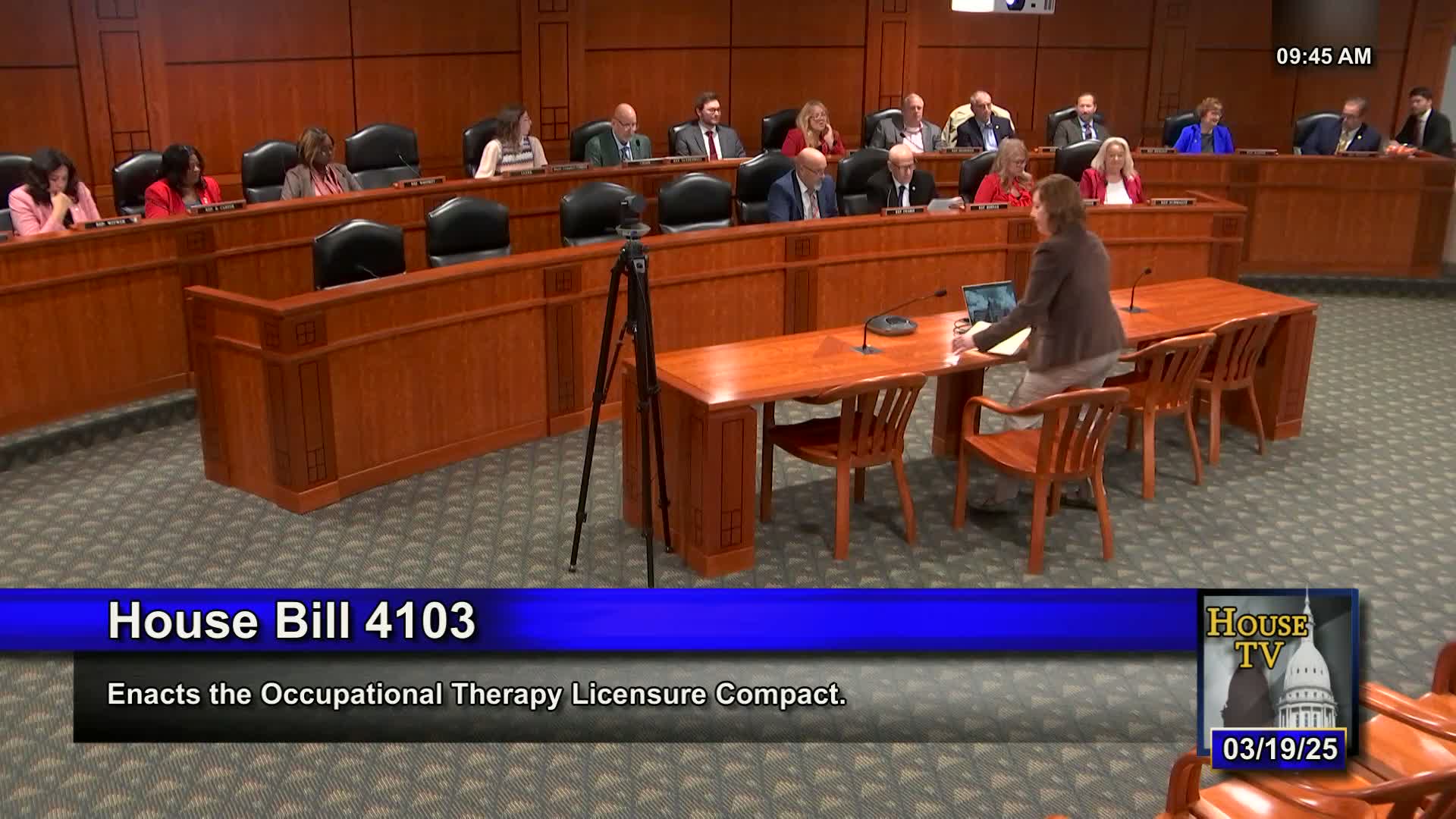
House committee reviews Occupational Therapy licensure compact bills to expand access and telehealth
Summary
House Bills 4103 and 4104 would allow Michigan to join the Occupational Therapy Licensure Compact. Supporters including Representative Rogers and occupational therapy association leaders said compact membership would increase access in rural areas, speed care for children and specialty patients, and help military families; witnesses said states r
Representative Rogers introduced House Bills 4103 and 4104 to authorize Michigan to join the Occupational Therapy Licensure Compact (OT compact). Rogers, who identified herself as a practicing physical therapist who works alongside occupational therapists, said the compact would ease portability for occupational therapists and assistants and help address workforce shortages that delay care in some areas.
"The OT compact will improve access to occupational therapy providers in rural areas and shortages," Denise Hoffman, legislative chair of the Michigan Occupational Therapy Association and a doctor of occupational therapy, told the committee. Hoffman said rural families and children with feeding or specialty conditions can wait months for services; she told the committee she has seen waiting periods of up to eight months for infants and children in some areas.
Rogers and Hoffman outlined benefits similar to the PT compact: preservation of state regulatory authority, the ability to use telepractice to reach patients, streamlined portability for military families and reduced financial burden for practitioners who otherwise must hold multiple state licenses. Rogers noted that 31 states had joined the OT compact and that additional states were considering legislation. Dan Logsdon of the Council of State Governments' National Center for Interstate Compacts appeared by Zoom to answer technical questions and said the center advises on compact formation and implementation.
Committee members asked about jurisprudence or jurisdictional requirements; witnesses said states use different approaches and some use a short jurisdictional attestation or modified exam to confirm awareness of state laws and practice rules. Written registrations from health systems and academic programs supporting the bills were entered into the record. No committee vote on the OT compact bills was recorded at the hearing.
Procedural note: toward the close of the hearing Representative Smaltz moved to excuse absent members; the motion prevailed by unanimous consent.