Get Full Government Meeting Transcripts, Videos, & Alerts Forever!
Get email alerts on the Tobacco E Cigarettes topic
No spam. Unsubscribe anytime.
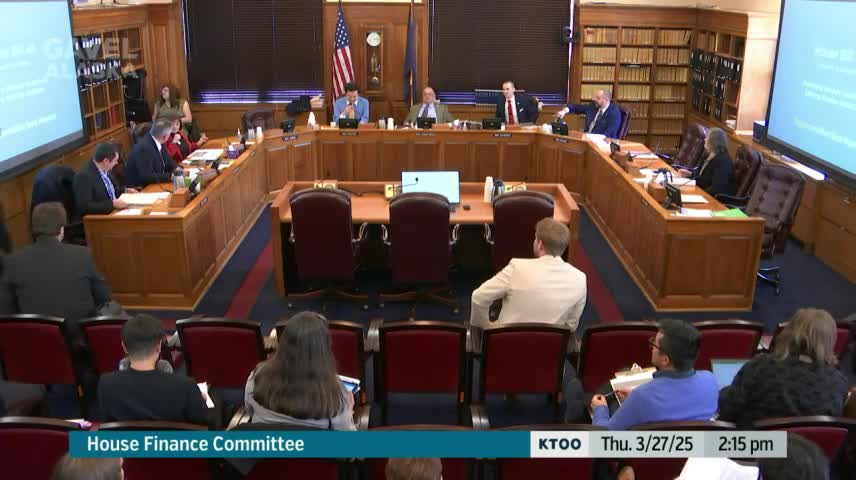
House committee hears sponsor and witnesses on HB 49 to raise tobacco age to 21 and tax e-cigarettes
Summary
Representative Sarah Hannon, sponsor of House Bill 49 and a Republican representing Juneau, opened the House Finance Committee hearing by saying the bill would bring Alaska into alignment with federal law and “raise the minimum age to purchase and possess tobacco products, including electronic smoking products, from 19 to 21.”
Representative Sarah Hannon, sponsor of House Bill 49 and a Republican representing Juneau, opened the House Finance Committee hearing by saying the bill would bring Alaska into alignment with federal law and “raise the minimum age to purchase and possess tobacco products, including electronic smoking products, from 19 to 21.”
The bill as presented would do two things: set the minimum purchase and possession age for tobacco and electronic smoking products at 21 and enact a 25% retail sales tax on e‑cigarette products. Hunter Meacham, staff to Rep. Hannon, told the committee that the measure is intended to protect youth and that “nicotine addiction almost always begins in adolescence.” Meacham and invited witnesses described steep declines in traditional cigarette use but a marked increase in youth vaping since about 2015.
Why it matters: Committee members heard testimony that youth vaping is widespread in Alaska schools, that many students who vape want to quit but struggle to do so, and that tax and age changes are standard tools to reduce youth access. Principal Richard Dormer of Ketchikan High School told members he and other principals are struggling to police vaping on campus and called the trend “a massive epidemic.” Dana Adage, a University of Alaska student with the Youth Advocates program, told the committee flavors and discrete designs have made products appealing and easy to hide and urged the panel to support the bill.
What the bill would change: The proposal raises the legal age for purchase and possession from 19 to 21 and adds explicit statutory language to tax electronic smoking products because Alaska’s tobacco taxation statutes were last amended in 2007, before widespread e‑cigarette sales. Department of Revenue staff explained current Alaska law taxes other tobacco products at the wholesale level (Deputy Director Brandon Spanos said it is “75% of the wholesale price”) while HB 49 would create a retail sales tax specifically for electronic smoking products. Revenue staff said the retail tax is a different taxpayer base and that the fiscal note models a 25% retail tax on the retail price.
Revenue and implementation: The Department of Revenue’s fiscal note used national data to estimate collections and projected about $3.81 million in revenue in fiscal 2028 (the first full fiscal year) with continued growth thereafter; the agency also forecast $4.23 million by FY 2031. Revenue staff said the fiscal note is an extrapolation using national figures and that updated modeling is possible. Department analysts estimated implementing the new retail collection would require two new positions (an auditor and a tax technician) and a one‑time software implementation cost of roughly $250,000, plus modest ongoing compliance costs.
Enforcement and penalties: The bill makes possession by a person under 21 a violation and the hearing included a discussion of enforcement. Nancy Mead, general counsel for the Alaska Court System, said law enforcement can cite violations now and that the bill’s proposed citation structure (a maximum fine the statute set at $150 for the under‑21 possession offense in committee discussion) could be absorbed by the court system without additional appropriation. Committee members asked whether state troopers would ticket under‑21 service members; Mead and staff confirmed law enforcement could issue citations to people under the legal age.
Exemptions and scope: The bill contains an exemption for sales at facilities operated by uniformed services, and sponsors and revenue staff acknowledged sales on federal installations are not subject to state tax. Committee discussion raised the practical question of whether military consumers would shift purchases to tax‑exempt on‑base sales and whether that behavioral response was fully captured in the fiscal note; revenue staff said national data were used for the current estimate and that the analysis could be refined.
Other details from testimony: Witnesses described products marketed with candy‑like flavors and discrete designs that make them easy for young people to conceal at school. Principal Dormer described vape detectors, wide use in bathrooms and cars at open campus lunch, and discipline systems that often exclude students from activities but do not provide cessation support. Representative Hannon and staff said the bill does not ban flavored products outright but includes a marketing restriction: a licensed seller “may not market an electronic smoking product … in a manner likely to promote use to a person under 21.” Meacham said FDA‑approved cessation products would be exempt from the proposed tax if the FDA at some point authorizes a product for that purpose.
Committee action: The committee took invited testimony, reviewed multiple fiscal notes submitted by state agencies, asked Revenue staff for follow‑up modeling, and then set HB 49 aside for further consideration. There was no final vote during the hearing.
What’s next: Committee members asked Revenue to provide refined fiscal modeling and several members signaled possible amendments on tax rate and exemptions. The bill remains in committee for additional work and potential amendment.