Get Full Government Meeting Transcripts, Videos, & Alerts Forever!
Get email alerts on the Health Workforce Licensure Compact topic
No spam. Unsubscribe anytime.
Committee hears bills to join Physical Therapy Licensure Compact to ease cross‑state practice
Summary
House Bills 4101 and 4102 would let Michigan join the Physical Therapy Licensure Compact, enabling licensed physical therapists and physical therapist assistants to obtain compact privileges to practice in other member states without separate full licensure in each state.
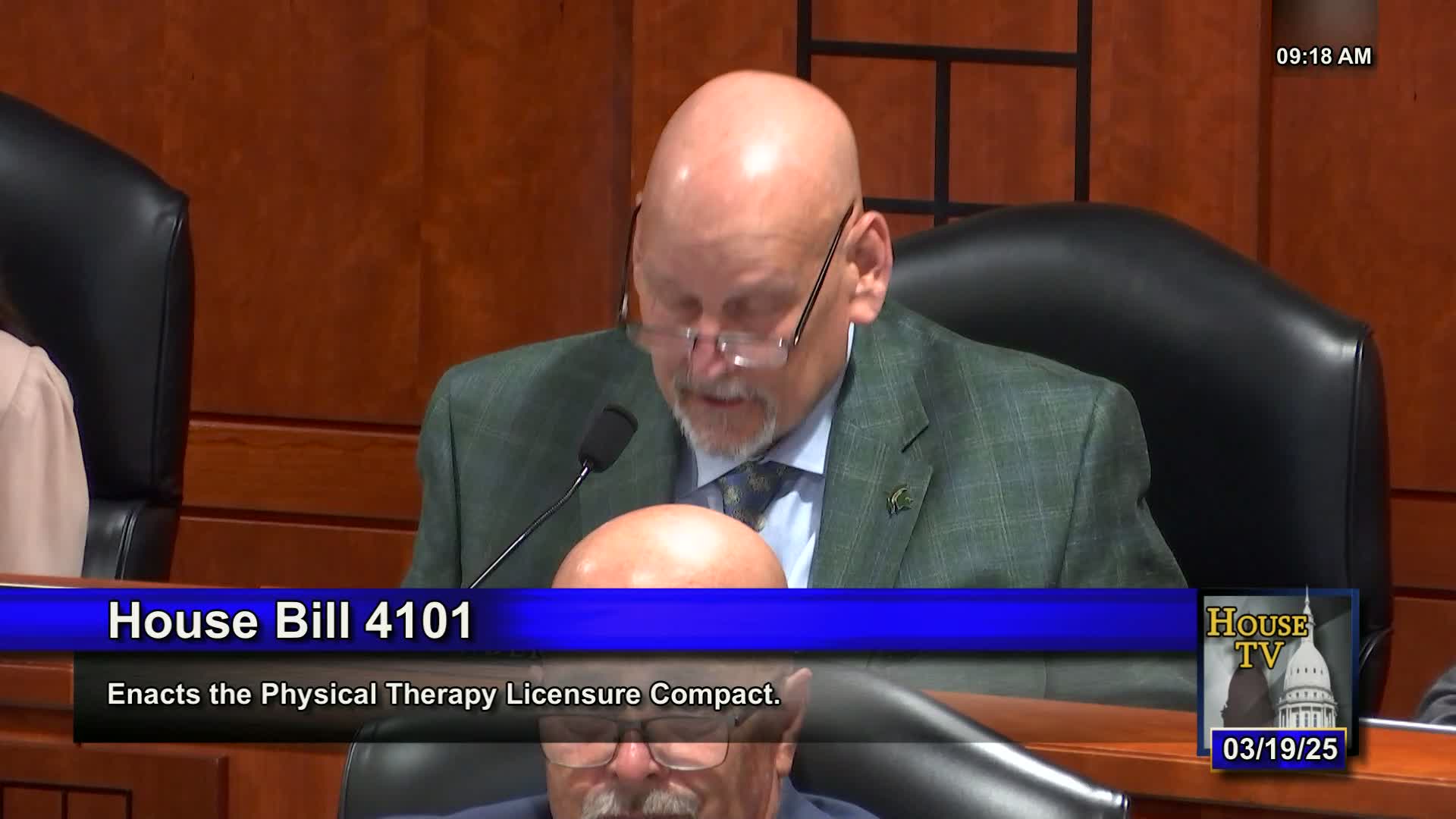
Representatives Rob Beierlein and Tom Fitzgerald (co-sponsors) offered HB 4101 and HB 4102 to join the Physical Therapy Licensure Compact. The bills would add the compact’s framework to Michigan law and authorize participation in the compact’s data system, a prerequisite for granting compact privileges to licensed physical therapists and physical therapist assistants.
"Currently, 32 states have joined the compact," Representative Beierlein told the committee, arguing that Michigan should join to improve access to physical therapy services, especially in rural and underserved communities. Representative Fitzgerald, who helped carry similar legislation previously, said the compact supports telehealth and workforce mobility.
Brian Gilbert, president of the American Physical Therapy Association of Michigan and a former chair of the state licensing board, testified in support. He said the compact preserves state discipline authority and does not change scope of practice: PTs and PTAs must still comply with Michigan laws while practicing here. Gilbert said Michigan trains physical therapists at seven universities and physical therapist assistants at ten programs and called the compact an incentive to retain graduates.
Jeff Rosa, compact administrator for the Physical Therapy Compact Commission, described the practical operation: a licensee who meets eligibility buys a compact privilege for each remote state where they wish to practice; the commission charges a compact-privilege fee and states may impose an additional state fee. Rosa said the commission funds operations through privilege sales and has not charged an annual assessment to states.
Committee members asked about costs and the jurisprudence requirement. Representative Preston asked whether Michigan would require a state jurisprudence exam; witnesses said requirements vary among states and cited models in which a short jurisdictional attestation or modified jurisprudence statement is used. Representative Preston also noted a compact-privilege fee (witnesses referenced an approximately $90 commission fee for a compact privilege). Witnesses said the state retains disciplinary authority and a remote-state action can lead to termination of a compact privilege.
Several organizations submitted written support that was read into the record, and committee members did not record a final vote on the bills at the hearing.