Get Full Government Meeting Transcripts, Videos, & Alerts Forever!
Get email alerts on the Pharmaceutical Dispensing Eye Care topic
No spam. Unsubscribe anytime.
House panel hears bill to let patients take home prescribed eye drops and ointments
Summary
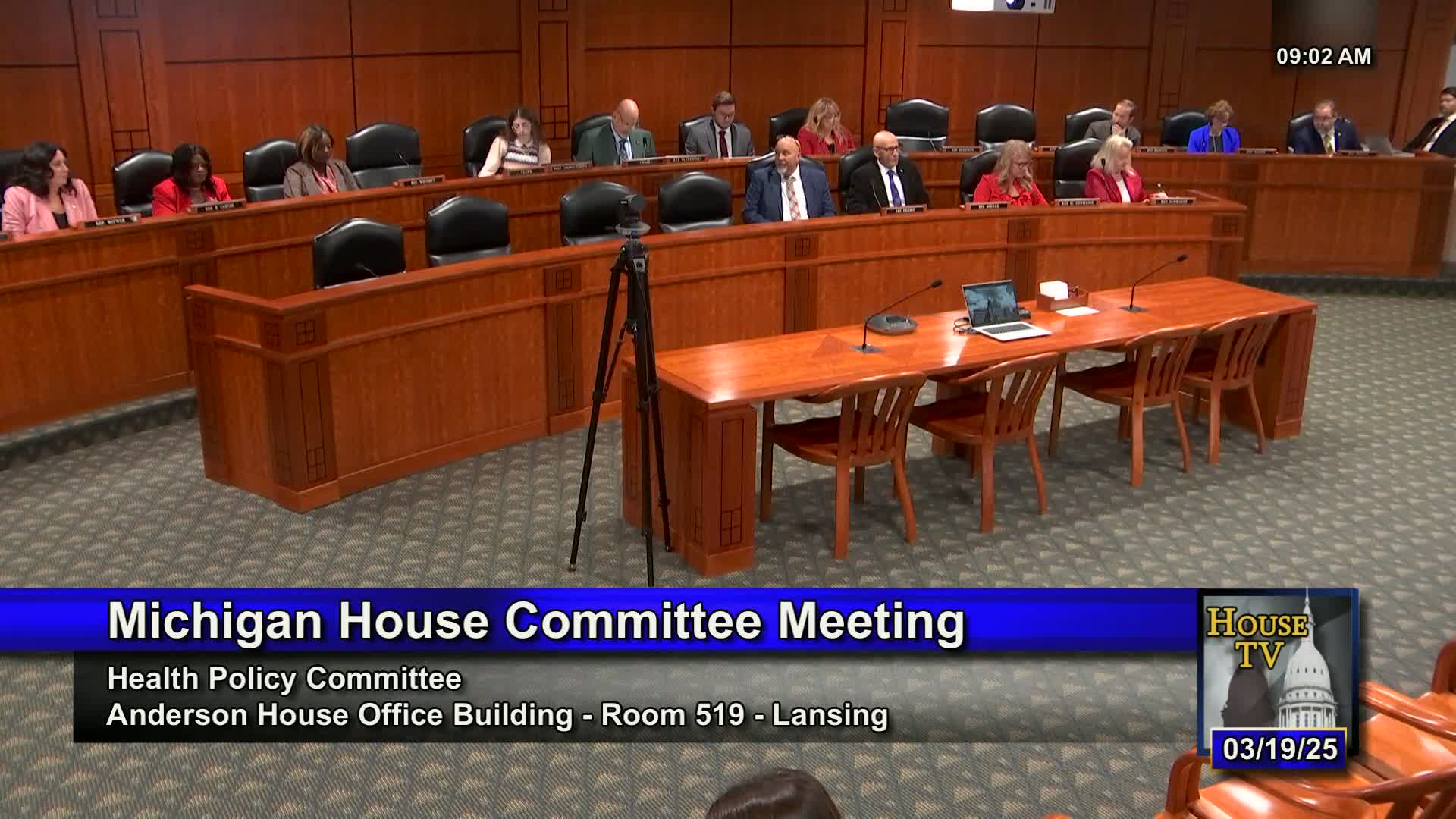
Representative Lynn Steckloff introduced House Bill 4072 to the House Health Policy Committee, saying the bill would allow hospitals, emergency departments and outpatient surgery centers to permit patients to take home topical eye medications they received during care.
Representative Lynn Steckloff introduced House Bill 4072 to the House Health Policy Committee, saying the bill would allow hospitals, emergency departments and outpatient surgery centers to permit patients to take home topical eye medications — such as antibiotic, dilating and anti-inflammatory eye drops — that were opened and used for that patient during care.
"So it's time for Michigan law to evolve to meet the practical needs of our residents," Representative Steckloff told the committee, citing a constituent ophthalmologist who described the practice while training in Illinois.
Dr. Scott Westhouse, a retina specialist speaking on behalf of the Michigan Society of Eye Physicians and Surgeons, told the committee the bill would reduce patient cost, improve access to necessary medicines and cut medical waste. "This bill will ensure that topical eye medicines or drops that are used for patient care within the hospital, emergency room, or surgery center can be taken home with a patient if they need it for their continuing care," he said.
Westhouse cited a 2019 study of medication waste around cataract surgery that found about 48% of topical medication purchased for a procedure was unused or partially used and discarded in the study cohort. He said there were roughly 3,800,000 cataract surgeries in the U.S. in 2019 and that, extrapolating from that study, the discarded medications could amount to about $560,000,000 annually (2019 dollars). He described three common clinical situations affected by the current rule: elective procedures such as cataract surgery, urgent emergency-room care (for example acute glaucoma requiring frequent drops), and inpatient hospital stays in which a portion of a multi-day or multi‑week supply is opened and the remainder discarded when the patient is discharged.
Committee members asked about safety and workflow. Representative Thompson, a nurse, asked whether counseling a patient on safe use and application would be an extra burden on staff; Westhouse said existing standard-of-care counseling would apply and that the bill does not change clinical instructions given to patients. Representative Bonap asked whether law already forbids the practice; Westhouse said current pharmaceutical dispensing laws allow only small samples in some settings and that sending home the larger 5–10 milliliter bottles involved here would violate those dispensing laws under current practice.
Committee staff read in written support from several organizations that had registered in favor of HB 4072, including the Michigan Society of Eye Physicians and Surgeons, the Michigan Health Purchasers Coalition and the Michigan State Medical Society; those registrants did not appear to speak during the hearing.
Procedural note: earlier in the hearing Representative Whitworth moved to adopt the minutes of the committee's March 12 meeting; the motion passed by unanimous consent and was recorded before testimony began.