Get Full Government Meeting Transcripts, Videos, & Alerts Forever!
Get email alerts on the Health Data Utility topic
No spam. Unsubscribe anytime.
Committee hears testimony on bills to create Michigan health data utility; two unrelated bills reported to floor
Summary
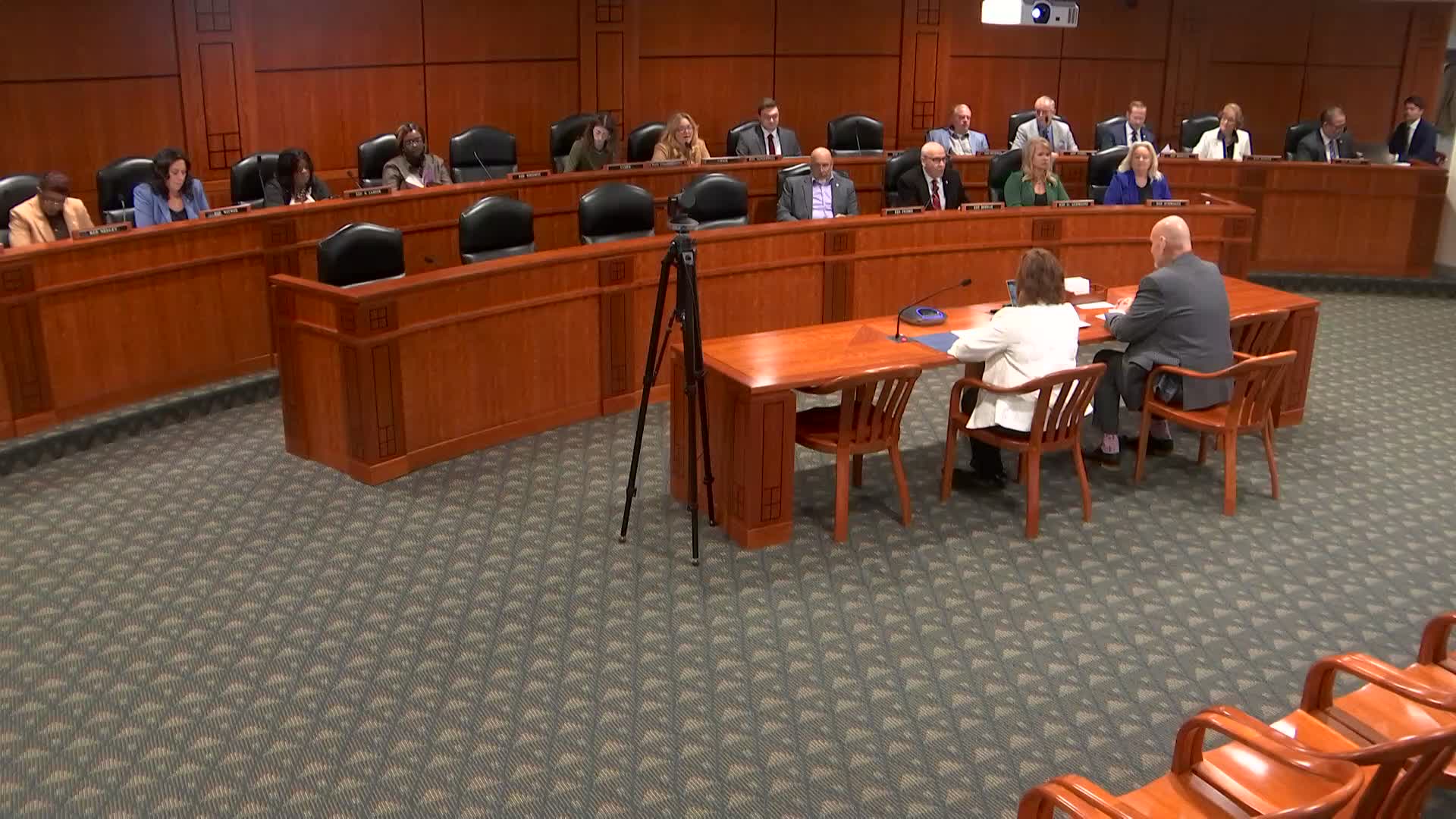
The House Health Policy Committee heard testimony and questions Wednesday on House Bills 4037 and 4038, legislation to create a Michigan health data utility (HDU) to expand electronic health data sharing beyond traditional clinical settings and to fund the HDU through the Insurance Provider Assessment Act.
The House Health Policy Committee heard testimony and questions Wednesday on House Bills 4037 and 4038, legislation to create a Michigan health data utility (HDU) to expand electronic health data sharing beyond traditional clinical settings and to fund the HDU through the Insurance Provider Assessment Act.
The bills were presented by Representative Julie Rogers, who said HB 4037 would establish a statewide health data utility "to combine, enhance, and exchange electronic health data for various health care purposes," and by Chair VanderWaal, who described HB 4038 as the funding bill tied to the Insurance Provider Assessment Act with an initial allocation of $6,000,000 in the first year, rising to $7,000,000 and $8,000,000 in subsequent years.
Supporters told the committee the HDU would extend current health information exchange capacity and allow nontraditional partners — such as schools, foster-care systems and community organizations — to participate in limited, consented data flows that could improve care coordination and reduce duplicated testing. "My hope is that we pass this HDU package this term to coordinate care and get patients the best health care that they deserve," Representative Julie Rogers said.
Why it matters: Proponents said an HDU would let providers access a more complete patient record at the point of care, reducing unnecessary tests and preventing medication errors. Testimony and questions focused on data accuracy, patient choice, cybersecurity, who may request records, how nonmedical community partners would receive only limited referral information, and the bills— funding.
Key details
- Scope and model: Witnesses described the HDU as building on the Michigan Health Information Network (MIHAN) and existing health information exchange (HIE) technical standards. MIHAN representatives said an HDU would be "vendor agnostic," connecting different electronic medical record systems without replacing them, and would extend data exchange to nontraditional sites such as schools and local public-health entities.
- Funding: Chair VanderWaal testified HB 4038 would allocate $6,000,000 in the next fiscal year, $7,000,000 in the following year and up to $8,000,000 in year three with adjustments for inflation, funded through the Insurance Provider Assessment Act (IPAA), described in testimony as a restricted insurance-related fund rather than additional general-tax revenue.
- Patient control and access: Committee members asked whether participation is opt-in or opt-out. MIHAN witnesses said the model relies on patient consent obtained at the point of care (signing HIPAA-related forms) and that patients can opt out later. MIHAN staff said if a patient opts out, data sharing is stopped immediately "with all historical data."
- Who requests records and responsibility for accuracy: Testimony said medical providers would request records in clinical transitions and would remain responsible for medication reconciliation and data accuracy; representatives described the HDU as enabling an electronic double-check to supplement verbal reconciliation.
- Security and breaches: MIHAN officials said the exchange encrypts data in transit and at rest, uses strict access controls, and has no history of data breaches. "We have no history of data breaches," Dr. Isabel Pacheco, Chief Administrative Officer for MIHAN, told the committee. Witnesses said the selected HDU operator would be contractually accountable for cybersecurity and that any HDU vendor must meet security frameworks and be chosen through competitive procurement.
- Nonmedical partners and limited data-sharing: Witnesses said nonmedical partners (for example, a food bank or transportation provider) would not receive full medical records. Instead, with patient consent they would receive limited contact or referral information (a flag indicating a need and contact details) to enable connection to community services.
Witnesses and testimony
- Representative Julie Rogers, Representative for House District 41 (Kalamazoo) — sponsor of the policy bill (HB 4037); described personal experience with incomplete medication lists and urged passage of the HDU package.
- Chair VanderWaal, Chair, House Health Policy Committee — sponsor of the funding bill (HB 4038); outlined the multi-year funding schedule and said the money would come from the IPAA restricted fund.
- Kim Batchelder, Vice President, State Programs, MIHAN — described MIHAN—s role as Michigan—s statewide nonprofit HIE and the HDU concept as expanding data exchange to nontraditional settings.
- Dr. Isabel Pacheco, Chief Administrative Officer, MIHAN — detailed security controls, the opt-in/opt-out process, and MIHAN—s claim of no data breaches.
- Dr. Kevin Bosack, family physician and executive medical director for population health management; board member of MIHAN representing health systems — supported the bills, saying improved access to timely data reduces duplicated testing and medication errors and helps care transitions.
- Larry Wagenekt, pharmacist and parent who described his late child—s repeated blood draws; he urged support for the legislation to reduce unnecessary tests.
Questions and committee concerns
Committee members asked repeatedly about (1) whether participation by providers would be mandatory (witnesses said the bills do not mandate participation and that many hospitals are already connected), (2) the mechanics of patient access and how a provider would retrieve data in real time (witnesses described single sign-on links from an EMR into the exchange and an Active Care Relationship Service that limits access to providers with an established care relationship), (3) how small or rural providers could join without undue cost (witnesses said the implementation and funding bills aim to support connections and that MIHAN provides portal tools for lower-resource providers), and (4) liability and responsibility if a breach occurred (witnesses said the contracted HDU operator would be accountable and that MIHAN follows federal standards including HIPAA).
Votes at a glance (committee actions taken during the meeting)
- On the motion to report House Bill 4077 to the floor with a recommendation that it pass: motion carried, 15 ayes, 0 nays, 0 pass. (Mover recorded in the minutes as Representative Bonack.)
- On the motion to report House Bill 4078 to the floor with a recommendation that it pass: motion carried, 16 ayes, 0 nays, 0 pass. (Mover recorded in the minutes as Representative Smalls.)
Next steps
No formal committee vote was recorded on HB 4037 or HB 4038 during this meeting; committee members took testimony and asked questions. Sponsors and MIHAN staff said the bills would proceed through the committee process and that MIHAN would continue technical and privacy briefings for members.
Ending
Representatives and witnesses urged attention to patient privacy, clarity on consent mechanics, and competitive procurement for any operator. Supporters said a statewide HDU would reduce care fragmentation and administrative waste; skeptics on the committee pressed for clear statutory definitions of "trusted data-sharing organizations," explicit notice requirements to patients if the roster of participating entities changes, and assurances about funding and small-provider support.