Get Full Government Meeting Transcripts, Videos, & Alerts Forever!
Get email alerts on the Prohibited Apps Government Devices topic
No spam. Unsubscribe anytime.
Committee backs bill to restrict certain foreign‑owned apps on government devices, with limited waivers
Summary
House Bill 42‑35, presented by Representative Smith, would require public employers to block or restrict use of specified internet applications created or owned by foreign principals and set limited waivers for law enforcement or department‑approved exceptions.
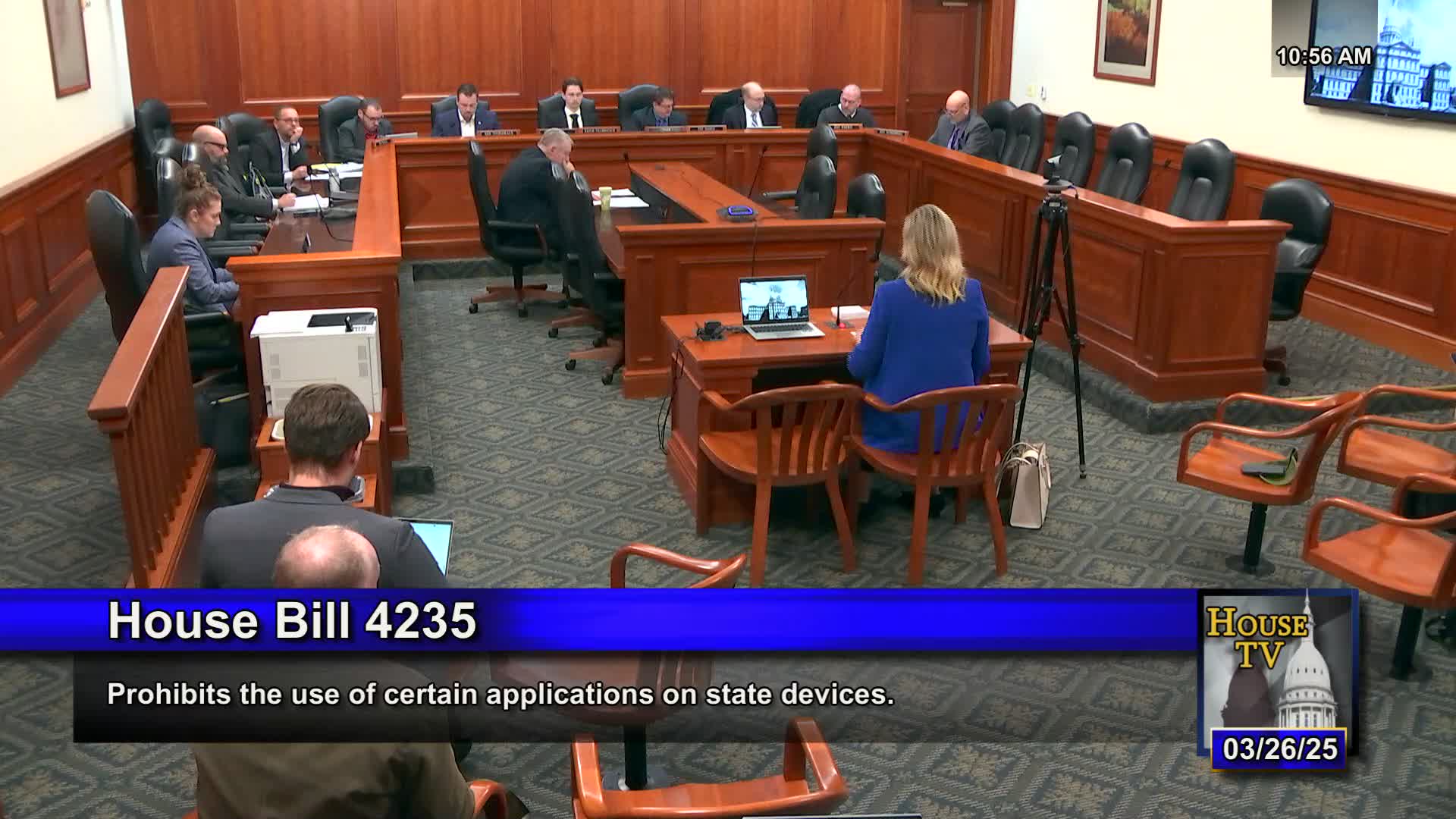
The House Committee on Government Operations adopted a substitute and reported House Bill 42‑35, a cybersecurity measure that would require public employers to block or restrict designated foreign‑owned internet applications on government networks and government‑issued devices.
Representative Smith, who presented the bill, said HB 42‑35 defines “prohibited applications” as internet applications created, maintained, or owned by foreign principals from countries such as China, Cuba, Iran, North Korea, Russia, Syria, and Venezuela. According to Smith, prohibited applications are characterized in the bill by activities that collect sensitive data, compromise emails, conduct cyber espionage, track users, or spread disinformation.
The bill would require public employers to block prohibited applications from networks and restrict access on government‑issued devices (phones, laptops, etc.). Smith said exceptions and waivers are included: law enforcement officers may use prohibited applications when necessary for public‑safety investigations, and public employers can request waivers from the Department of Technology, Management and Budget (DTMB) to permit certain employees access under specific conditions.
Smith told the committee more than 30 states have already banned certain applications on state devices amid national‑security and privacy concerns. She said both the Trump and Biden administrations have prohibited certain applications on government‑issued devices.
Representative McFall asked whether the bill’s waiver framework would permit communications staff at colleges or universities to use restricted apps for recruiting or outreach. Smith said the bill’s only explicit exemption in her understanding was for law enforcement; she offered to follow up to confirm whether additional waivers could cover communications or recruiting uses.
The committee adopted the H‑1 substitute (which changes the bill’s effective date to Dec. 31, 2025) and then reported HB 42‑35 with recommendation as substituted. Both actions were recorded with roll call tallies of 3 ayes, 0 nays, 2 pass.