Get Full Government Meeting Transcripts, Videos, & Alerts Forever!
Get email alerts on the Drain Assessments Dnr topic
No spam. Unsubscribe anytime.
Bill would let drain commissioners assess DNR land for maintenance costs
Summary
Lawmakers heard testimony on House Bill 4118, which would allow county drain commissioners to apply special assessments to Department of Natural Resources-managed land within drainage districts; proponents said exemptions shift costs to private landowners, while no final committee action was recorded.
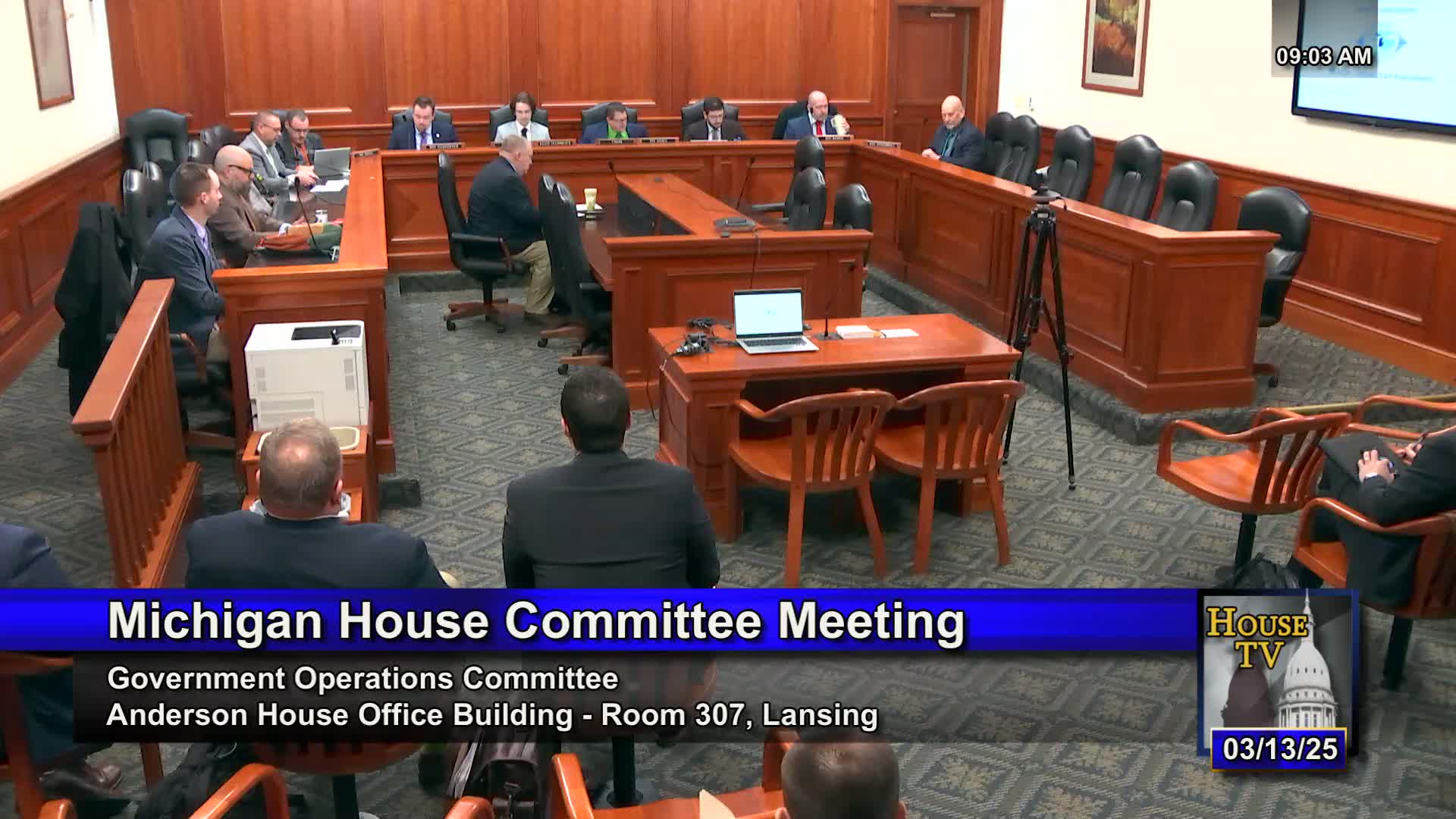
The Committee on Government Operations heard testimony on House Bill 4118 on whether county drain commissioners may levy drain assessments on Department of Natural Resources-managed land within drainage districts.
Representative Matthew Schutte, sponsor of the bill, told the committee that "this legislation allows county drain commissioners to apply drain assessments to DNR managed property the same way they do to private property or other state property such as that managed by the Department of Transportation." He said current law exempts DNR-managed land from drain assessments and that exemption can place an "unfair burden" on nearby private landowners.
Supporters from the Michigan Association of County Drain Commissioners said drainage districts vary widely in size and ownership and that some districts include large swaths of DNR land. Cole Hendricks, legal counsel for the Michigan Association of County Drain Commissioners, told the committee that one example, the Severance Drain in Allegan County, includes a little more than 3,000 acres of DNR land in a 5,200-acre district (about 58 percent). Hendricks and Joe Bush, Ottawa County Water Resources Commissioner and past MACDC president, said smaller examples exist where DNR lands make up 30–74 percent of a drainage district, leaving the remaining private landowners to shoulder most maintenance costs when DNR land is exempt.
Hendricks explained the funding mechanism for established drains: each drain has a drainage district that serves as a special assessment district, and costs for construction and maintenance are apportioned among properties that benefit. He said assessments typically account for acreage and land use, which can weight industrial or developed parcels higher than wooded or agricultural DNR lands.
Representative McFall asked whether the state Department of Natural Resources has an inventory of drains on its lands; Hendricks said he did not believe an inventory exists and suggested county drain commissioners could work with state staff to develop one. Representative Fitzgerald noted the drain code dates to a 1956 recodification and asked why DNR lands were historically exempt; Hendricks answered that state-owned properties have traditionally been exempt from taxes and assessments, and that current circumstances—large contiguous tracts of DNR land within some drainage districts—have changed the distribution of costs.
Committee members asked technical and policy questions: Representative VanderWaal clarified that the bill would apply only to drains, not lake-level assessments, and Hendricks said the Department of Transportation already contributes in situations where state highways lie within drainage districts. A representative of the Department of Natural Resources filed a written card opposing the bill but did not speak.
No formal vote or committee decision on House Bill 4118 was recorded in the transcript; the committee received testimony and questions but did not take final action during the hearing.
The testimony cited multiple local examples and provided acreage and percentage figures to illustrate the range of DNR ownership inside drainage districts; proponents asked the committee to approve the bill so assessments would be applied "like other properties within the drainage district on benefits derived."