Get Full Government Meeting Transcripts, Videos, & Alerts Forever!
Get email alerts on the Juvenile Justice Shawano Closure topic
No spam. Unsubscribe anytime.
State officials describe plan to close Shawano Center and move operations to Macomb as lawmakers press for northern Michigan capacity
Summary
Michigan health officials told a House appropriations subcommittee they will close the Shawano juvenile treatment center in Grayling and move youth and operations to the renovated Michigan Youth Treatment Center in Macomb County, a transition the department says will improve staffing and family access but that lawmakers and northern providers warned may leave northern Michigan without secure capacity.
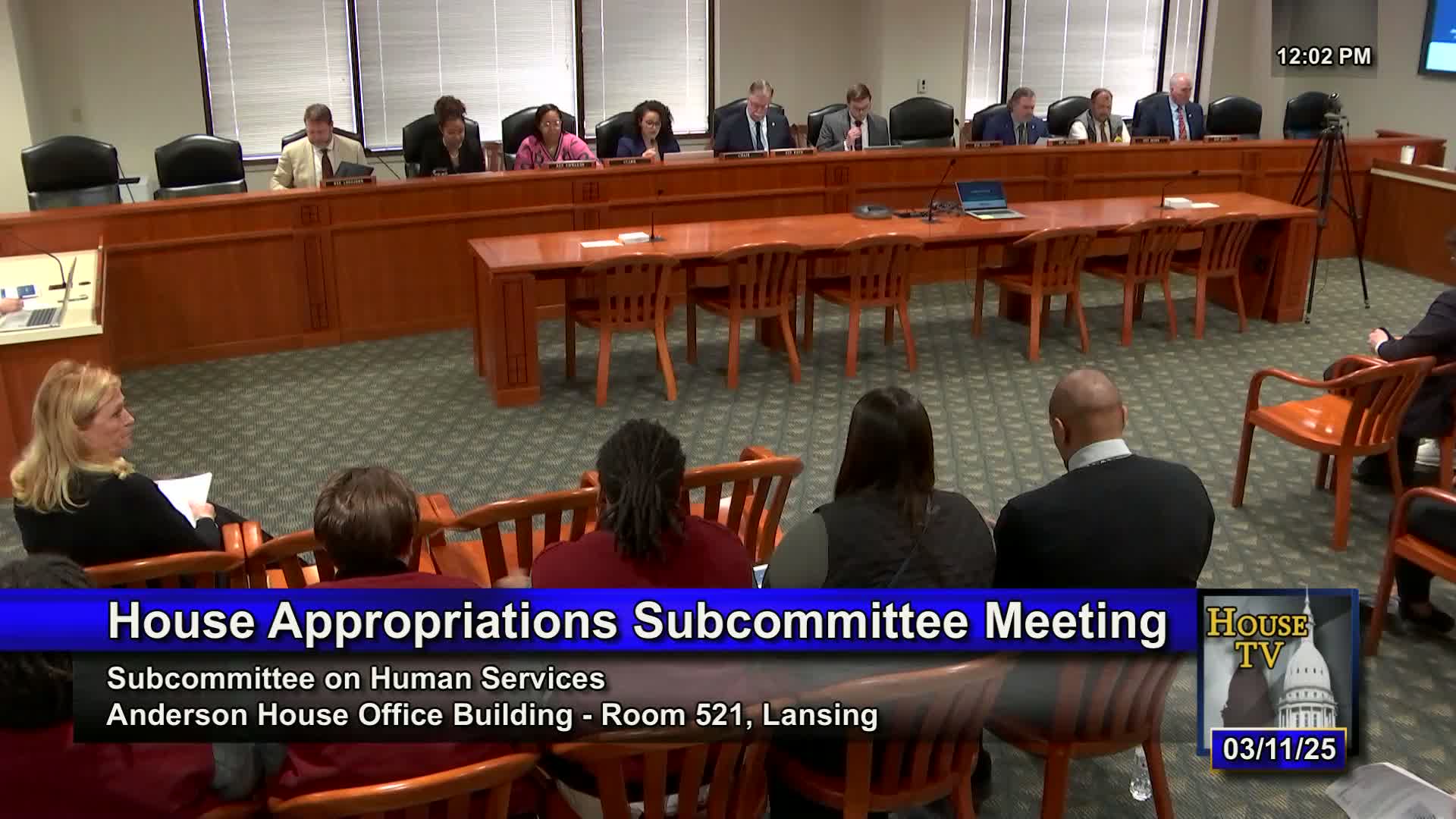
LANSING — Michigan Department of Health and Human Services officials told the House Appropriations Subcommittee on Human Services that the Shawano Center in Grayling will close and operations and youth will move to the Michigan Youth Treatment Center at the Macomb County Juvenile Justice Center in Mount Clemens as part of a broader juvenile justice realignment.
Demetrius Starling, senior deputy director for the department’s Children’s Services Administration, told the subcommittee the department’s mission is “to ensure all youth and families of diverse populations involved in Michigan's juvenile justice system have equitable access to a continuum of research and evidence based services that provide rehabilitation opportunities in a safe, supportive, and respectful environment that honors the youth and family voice.” He said the department began moving youth in January 2025 with a planned completion of transition by early summer.
The move is intended to consolidate state-operated treatment capacity into a renovated Michigan Youth Treatment Center built in 1989 and located in southeast Michigan. Starling said the Michigan Youth Treatment Center will have a 60‑bed capacity after renovations and, when fully operational, “will be able to sustain 111 staff.” He described the relocation as a response to staffing and family‑access challenges in the Grayling region and said the department expects improved family involvement and staffing stability at the Macomb site.
Amy Apke, senior deputy director of financial operations for MDHHS, outlined the juvenile justice budget and recent infrastructure investments. She said the department’s juvenile justice (JJ) budget is $43,500,000; roughly two‑thirds of that funding is for Bay Pines and the Michigan Youth Treatment Center. Apke said about half of the JJ budget is general fund and roughly 18% is federal funding. The executive budget includes an additional $12,800,000 to expand task‑force recommendations and support Bay Pines and the realignment of funding for the Michigan Youth Treatment Center.
Starling and Apke also reviewed recent bed expansions and grants the department said increase placement options statewide. Starling listed providers and placements the department has added or contracted with: Spectrum Juvenile Justice Services (40 residential secured beds), St. Clair Youth Treatment Center in Macomb (20 beds when open), Highfields (12 beds), Holy Cross (3 beds), Bethany Christian Services (2 beds), Team Wellness Center at Eastern Market (45 day‑treatment placements) and Valor Place (12 nonsecure mental‑health stabilization beds). He said the department has expanded placement options to more than 100 placements for juvenile justice youth.
Starling said FY25 appropriations include $10,000,000 for juvenile justice infrastructure grants, $5,000,000 for state GRAMA facilities (listed as Bay Pines and Shawano), and $5,000,000 for non‑state facilities broken down in the presentation as $2,000,000 for Vista Maria, $1,000,000 for Spectrum and $465,000 for Highfields; the presentation also listed $1,300,000 for the County of Lenawee public defender office and $200,000 for the Saginaw County Tenth Judicial Circuit Court. He said legislation enacted in October 2024 increased the reimbursement rate for community‑based services from 50% to 75%.
Several legislators expressed concern that closing Shawano will leave northern Michigan without adequate secure juvenile treatment capacity. Chair Roth opened questioning by noting the relocation improves access for families in southeast Michigan but “it does then leave an issue with Northern Michigan.” Representative Mueller and other members pressed the department on what will happen to Shawano staff, how secure bed capacity for northern counties will be maintained, and whether youth will be sent out of state. Starling said the department has a transition plan and has met repeatedly with staff; some employees will move to the new facility, others will be offered other state positions or assisted in finding alternatives.
Representative Beeson and others warned against concentrating youth solely for cost reasons and asked the department to provide outcome data showing that the new configuration improves results. Starling responded the department is pursuing restorative, therapeutic approaches and is working with federal partners and local stakeholders on evidence‑based services.
Providers and local officials appearing after the department’s presentation urged more capacity and raised questions about specifics of the transition. Dr. Ray Moss, program director at St. Clair Youth Treatment Center / Rite of Passage, brought two students to testify about their experiences. Student Kamani Brown told the subcommittee: “Everything changed. I feel the I feel the level of security there. I wasn't watching my back,” and described improvements in schooling and therapy. Moss said St. Clair is licensed for 60 beds and currently had 18 youth on site, with staff prepared to take more placements.
Representatives of Wolverine Human Services described nonsecure and secure options the agency can provide, including a Vassar campus that operates nonsecure services and a 100‑bed secure facility in Saginaw that lost its license in February 2020 and — according to the organization — could be relicensed in July 2025. Matthew Wallach of Wolverine emphasized the need for case‑management technology to track outcomes and recidivism.
Cameron Clark, family court administrator for Leelanau County, said northern Michigan remains underserved and urged state investment in a northern facility. “There are really no facilities North Of US 10 for, the assessment and the treatment of young people,” Clark told the committee, and he outlined a prior proposal from Grand Traverse and Leelanau counties for a 32‑bed facility to serve northern counties.
The subcommittee did not take formal action on facility closures or new capital projects during the hearing; the only recorded motion was approval of the March 4 meeting minutes. Chair Roth said members could submit additional questions to the department in writing and requested follow‑up information on county placements out of state and the financial relationships between county and state oversight.
The committee’s discussion highlighted competing priorities: improving therapeutic services and family access by consolidating state facilities versus ensuring geographic equity and secure capacity for northern Michigan counties. Lawmakers asked the department for more detailed transition plans for staff and youth, outcomes tracking for new placements and clarification about bed types and how county placements interact with state responsibility.
If the department implements the planned transitions described at the hearing, the department said youth moves began in January 2025 and are expected to conclude by early summer 2025; no vote or legislative approval was recorded at this hearing for the Shawano closure itself.