Get Full Government Meeting Transcripts, Videos, & Alerts Forever!
Get email alerts on the Appropriations Health And Human Services topic
No spam. Unsubscribe anytime.
House subcommittee reviews $7.3 billion human services budget, flags TANF shifts and foster-care changes
Summary
The House Appropriations Subcommittee on Human Services reviewed the fiscal year 2024-25 human services portion of the DHHS budget, hearing that the program area totals $7.3 billion gross with $1.3 billion in general fund support and that major topics include TANF use, FIP rules, foster‑care payments to kin, childcare fund county reimbursement and juvenile‑justice facility changes.
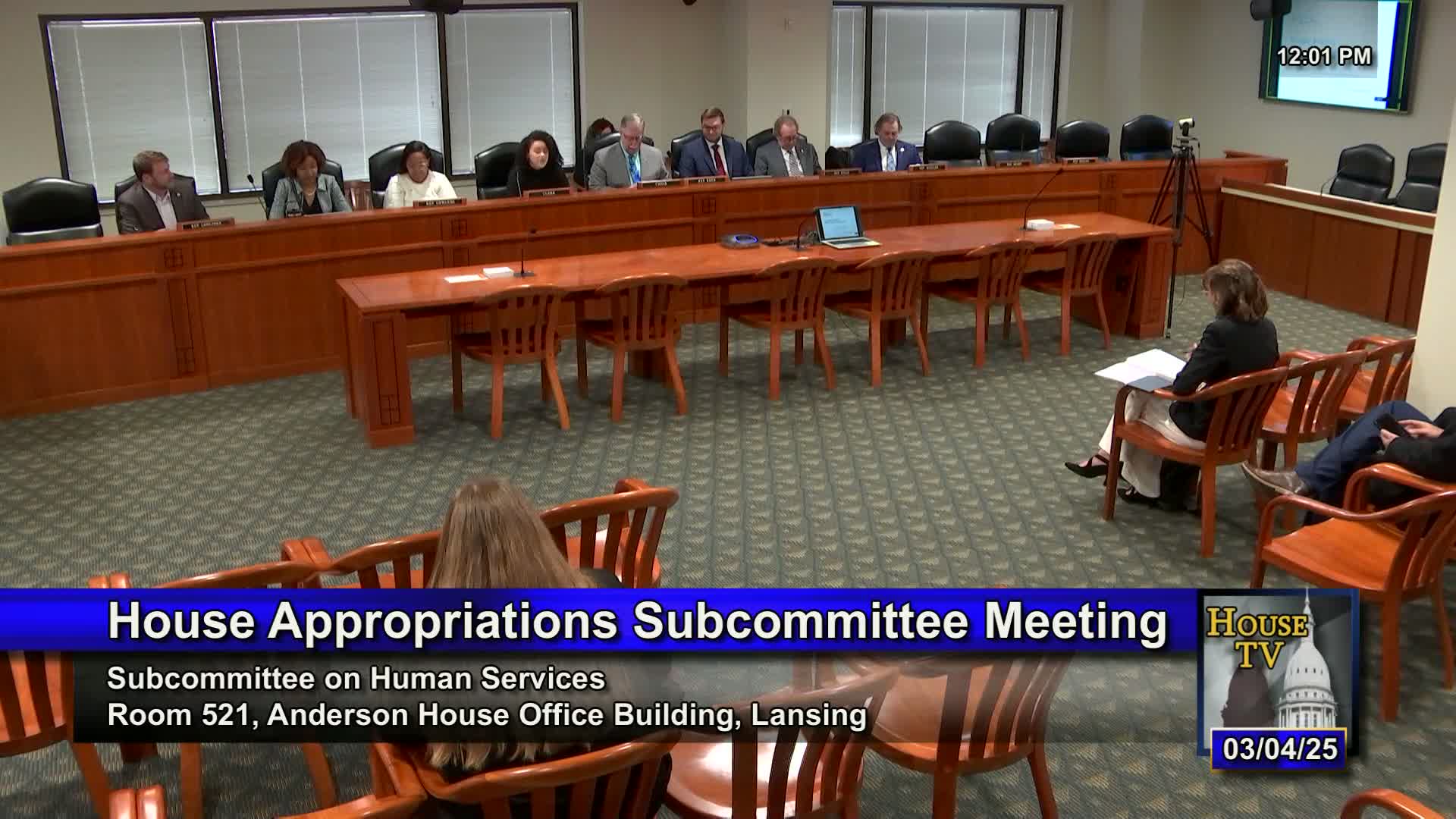
The House Appropriations Subcommittee on Human Services reviewed the fiscal year 2024-25 human services portion of the Department of Health and Human Services (DHHS) budget during a meeting on Oct. 12, 2025. House Fiscal Agency analysts Sydney Brown and Cassidy Ackman presented an overview showing a $7.3 billion gross appropriation and a $1.3 billion general fund allocation for human services, and answered members’ questions about program rules, funding sources and recent statutory changes.
The presentation outlined why the budget matters: about 80% of the $7.3 billion is federal funding, TANF and SNAP are large federal sources that flow through multiple program lines, and about 63% of the $1.3 billion in general fund support is concentrated in child-welfare programs. The analysts also described program-specific caseloads, eligibility rules and recent statutory or administrative changes that affect how funds are spent.
Brown and Ackman said the human services appropriation includes public assistance, child welfare (including foster care, adoption subsidies and family preservation), juvenile justice, disability determination and local office operations. They summarized that roughly 62% of the human services gross appropriation supports public-assistance programs and that about $45.6 million of the $7.3 billion is one-time funding for the current fiscal year.
On TANF and MOE: Cassidy Ackman explained that Michigan’s annual federal TANF grant is about $773 million and that TANF combined with state maintenance-of-effort (MOE) appropriations totals “over $1.3 billion” in fiscal year 2024-25. She said states have flexibility in how they use TANF and what state spending they claim as MOE; historically Michigan routed substantial TANF or MOE dollars to K‑12 at‑risk and school‑readiness programs but noted that in fiscal 2024-25 much of that spending was redirected to other areas, including public assistance and earned-income tax–credit increases that were claimed as MOE. Representative Kelly asked whether the choice to treat different state spending as MOE was a legislative decision; Ackman responded that it is a policy choice by the state about what spending to claim as the match.
On cash assistance (FIP) and work rules: Ackman described the Family Independence Program (FIP) as Michigan’s cash assistance program for households with dependent children. She gave a worked example of eligibility: in the current fiscal year, a family of three would qualify with monthly income under $925 (about $11,100 annually), financial assets under $15,000 and real-property assets under $200,000. She said Michigan must include work requirements in its TANF/FIP plan to meet federal conditions and that the state recently returned its lifetime TANF limit from 48 months back to the federal 60‑month limit effective this year. Ackman noted that some new FIP cases are funded with state general fund dollars so they are not counted against federally measured workforce participation rates reported to the U.S. Department of Health and Human Services.
On SNAP and State Disability Assistance: The analysts noted that SNAP (the Food Assistance Program) is federally governed and that households generally qualify with income below roughly 200% of the federal poverty guideline and limited financial assets; Ackman said Michigan’s monthly food-assistance caseload is approximately 700,000–754,475. State Disability Assistance (SDA) is state funded; new SDA cases receive a $200 maximum monthly benefit for a single adult, with higher payments in special living arrangements. The SDA monthly caseload was presented as an estimated 2,129 cases for the current fiscal year.
On foster care and child‑welfare funding: Brown reviewed child‑welfare lines including foster care, the childcare fund, adoption subsidies and guardianship assistance. She said the foster care appropriation is about $330.8 million gross, with roughly 60% general fund and about 34% federal funding (including Title IV‑E, Title IV‑B and TANF). Brown explained Title IV‑E covers about 65% of out‑of‑home placement costs when children are removed under a court order; funding eligibility depends on how a child is removed and the legal status. She also explained a recent statutory change requiring maintenance payments to unlicensed relatives in kinship placements; that change increased payments because most removed children are placed with relatives who previously were not eligible for maintenance payments.
Childcare fund and county reimbursement: Brown said the childcare fund reimburses counties for out‑of‑home placement costs (historically at 50%) and now reimburses counties 75% for in‑home care services after a statutory change; the state pays those funds first and counties reimburse a portion (25%). Representative Roth asked whether counties had failed to reimburse; Brown said she was not aware of systemic repayment problems but that county data quality could complicate tracking and she would check the records.
Adoption subsidies and family preservation: Brown said the adoption‑subsidy program is about $232.4 million gross with roughly 67% federal funding and that adoption subsidy eligibility generally requires the child to be SSI eligible or AFDC‑eligible under legacy standards. Family‑preservation programming was appropriated roughly $78.5 million, about 67% funded with TANF, and Brown said the fiscal 2024-25 budget included about an $8.5 million TANF increase for family‑preservation services to support reunification and in‑home supports.
Juvenile justice and facility changes: Brown summarized juvenile‑justice spending, noting the recent closure of the Shawano Center and that Bay Pines (and contracted private providers) and the Macomb facility will house youth going forward. She said the state planned to move youth previously at Shawano to the Macomb facility, which will be considered the Michigan Youth Treatment Center; the presenters said they were still awaiting clarification about how the closure would change funding and that a deeper juvenile‑justice discussion was planned for the following week.
Energy assistance and LIHEAP/MEAP: The analysts said energy assistance includes LIHEAP (the federal block grant) and Michigan’s MEAP; they reported approximately $225 million gross appropriated for energy assistance and cited $71.6 million gross for non‑energy state emergency relief services in fiscal 2024‑25. They described LIHEAP as funding direct energy assistance, a heat‑meet program, the home‑heating tax credit and some weatherization; MEAP provides additional assistance and self‑sufficiency services and draws from a state low‑income energy assistance fund supported by a utility surcharge.
Local office operations and staffing: Brown emphasized DHHS’s network of more than 100 local and district human‑service offices that process public‑assistance applications, manage child‑welfare cases and provide other field services. She said personnel costs are a large share of the human services appropriation; staffing increases have been driven in part by a settlement in the Children’s Rights litigation that required lower caseload‑to‑worker ratios in child welfare.
Child support enforcement: The presentation noted that operating a child support enforcement program is a federal TANF condition; MDHHS’s Office of Child Support administers that program and contracts with local prosecuting attorneys and friends of the court. The presenters reported approximately $1.3 billion in child support collected and dispersed to families in fiscal year 2024 and a child‑support enforcement appropriation of about $235.4 million gross, largely funded by Title IV‑D federal funds that require a state match.
Questions from members focused on which line items are multiply funded, how kinship care is checked and paid, county repayment to the childcare fund, why MOE claims shifted away from K‑12 at‑risk programs, the effect of changing TANF time limits from 48 to 60 months, and the disposition of Shawano Center. The presenters provided factual answers where available, said some answers required follow‑up, and committed to returning data on multi‑funded line items and county repayment records.
Looking ahead, committee members scheduled more detailed juvenile‑justice budget discussion for the next meeting and staff said they would follow up with additional data on county reimbursements and the prevalence of multiply funded line items.