Get Full Government Meeting Transcripts, Videos, & Alerts Forever!
Get email alerts on the Higher Education Budget topic
No spam. Unsubscribe anytime.
Higher-education budget peaks at $2.324 billion; Michigan Achievement Scholarship is largest single program
Summary
Senior fiscal analyst Perry Zilak told the House Appropriations Subcommittee that the FY25 higher-education gross appropriation is roughly $2.324 billion, with the Michigan Achievement Scholarship receiving $330 million and higher education representing 13% of the state's general fund expenditures
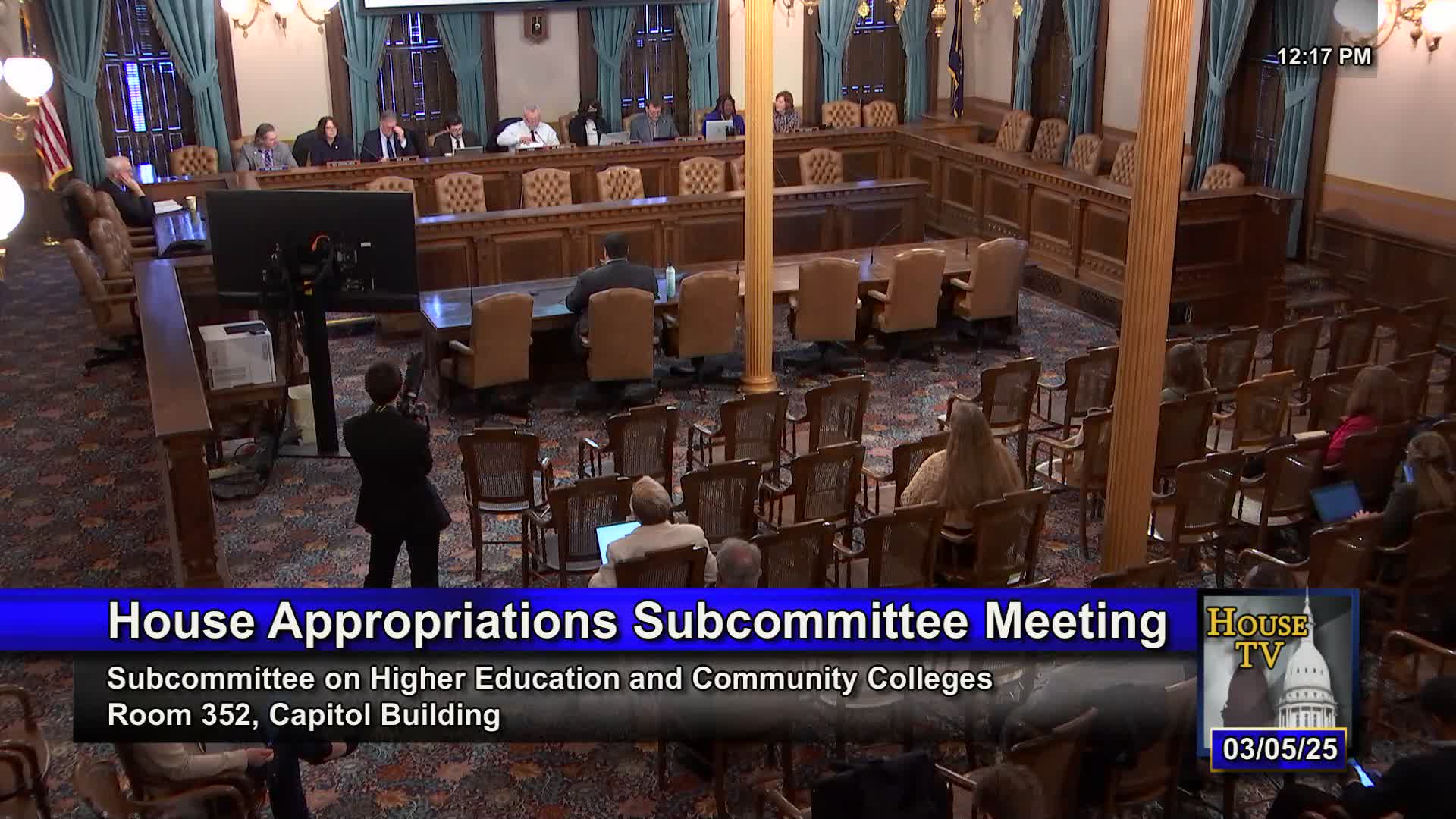
The House Appropriations Subcommittee on Higher Education and Community Colleges received an overview of the state’s higher‑education budget, with House Fiscal Agency senior analyst Perry Zilak saying the gross appropriation for fiscal year 2024–25 is about $2.324 billion.
Zilak told the panel that about $1.859 billion of that amount is state general fund/general purpose and roughly $461.7 million is state restricted revenue (primarily school aid fund usage); federal funding in the higher‑education budget is relatively small (about $3.2 million in the current appropriation). He said higher education accounts for roughly 3% of the overall state budget but about 13% of the state general fund spending.
Why it matters: Zilak said the budget’s largest single program is the Michigan Achievement Scholarship, which the legislature funded at $330 million for FY25. He described the scholarship’s main tracks: up to $5,500 for students entering a public or private four‑year institution, a community‑college “guarantee” that covers district tuition and fees at the community‑college level, and limited awards for private training programs (up to $2,000). The scholarship also includes an additional $1,000 award for Pell‑eligible community‑college students.
Zilak also reviewed longer‑running budget issues for higher education. He opened with a description of constitutional autonomy under Article 8 of the Michigan Constitution, which establishes boards of control for the University of Michigan (Ann Arbor), Michigan State University and Wayne State University and limits legislative direction over institutional operations. He cautioned that some legislative directives in recent budgets can fall into a “gray area” where court review would be required to determine if constitutional autonomy is violated.
The subcommittee heard that operations funding for the 15 public universities is distributed as a base plus new operations funding and reimbursements for specific tuition‑waiver programs; total operations grants were shown at about $1.7 billion for FY25. Zilak described the tuition‑restraint requirement attached to increased operations funding: institutions must limit resident undergraduate tuition increases to a specified ceiling (the presentation referenced a 4.5% cap; the supplemental dollar threshold cited in committee documents was not fully legible in the transcript) and certify participation in transfer and reverse‑transfer practices. Zilak said all institutions certified compliance with the transfer‑related best practices in October.
On financial aid, Zilak said the Michigan Achievement Scholarship now represents about 61% of the budget’s financial‑aid spending. He also noted the Michigan Reconnect program at $52 million and other targeted grants such as the tuition incentive program for Medicaid‑eligible students, My GEAR UP (federally funded, about $3.2 million), and survivor and veterans’ tuition grants. He said phased‑out scholarships (the tuition grant and state competitive scholarship) are being replaced by the Achievement Scholarship for new high‑school graduates.
In committee Q&A, Representative Roth asked whether delays in FAFSA processing have affected enrollment and the need for state assistance; Zilak said the federal FAFSA redesign led to rollout challenges and that some students likely missed postsecondary enrollment because of delayed FAFSA processing. “We’ve some students probably missed out on going to any post secondary because of just that delayed rollout,” Zilak said.
No formal votes were taken on these budget presentations. Zilak said several items — including the balance of school‑aid fund use between K‑12 and postsecondary, and the longer‑term costs of the Michigan Achievement Scholarship as cohorts grow — will return for later committee consideration.