Get Full Government Meeting Transcripts, Videos, & Alerts Forever!
Get email alerts on the Early Childhood And Child Care Funding topic
No spam. Unsubscribe anytime.
State fiscal analyst: child-care funding at MILEAP will need more general fund support after federal carryforward ends
Summary
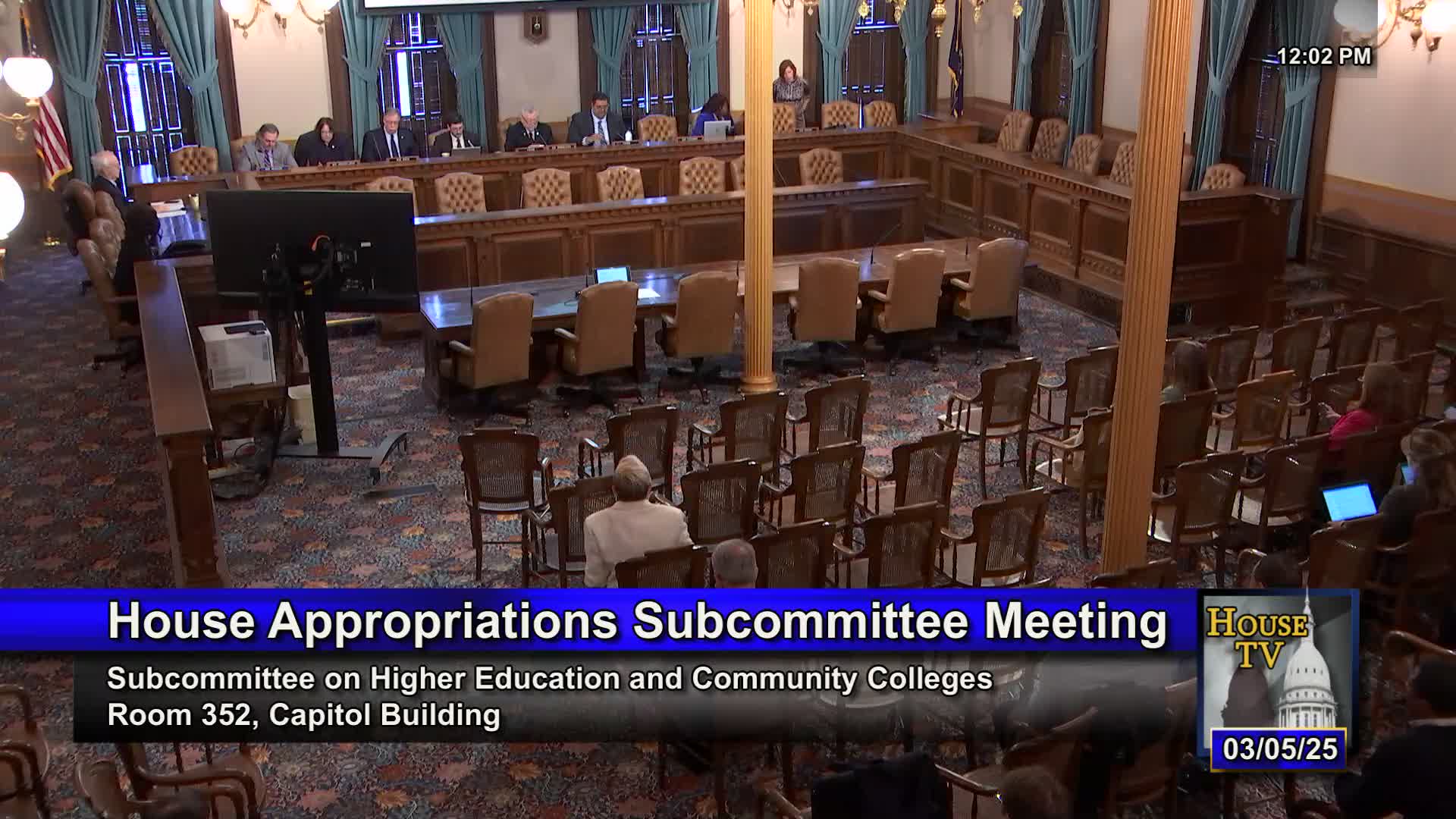
The House Appropriations Subcommittee on Higher Education and Community Colleges heard on Oct. 12 that the Michigan Department of Lifelong Education, Advancement and Potential (MILEAP) will need additional state general fund support in fiscal 2026 to maintain current child-care eligibility rules.
The House Appropriations Subcommittee on Higher Education and Community Colleges heard on Oct. 12 that the Michigan Department of Lifelong Education, Advancement and Potential (MILEAP) will need additional state general fund support in fiscal 2026 to maintain current child-care eligibility rules.
Noel Benson, a fiscal analyst with the House Fiscal Agency, told the panel that MILEAP’s total budget for fiscal year 2024–25 is about $643.9 million and is “almost entirely federal and general fund.” Benson said roughly 79% of the department’s budget is federal funding and 21% is state general fund; smaller amounts are restricted and private funds.
Benson said 91% of MILEAP’s funding supports the Office of Early Childhood Education (about $584.2 million), and roughly $499 million of that is for the Child Development and Care (CDAC) scholarship, the state’s child-care subsidy program. He said the program currently serves families with income up to 200% of the federal poverty guidelines — about $51,600 for a family of three — and that providers are reimbursed on a block schedule that varies by child age, provider type, licensing status, quality rating and hours of care.
Why it matters: Benson told lawmakers the program’s recent expansion of eligibility — maintained at 200% of the federal poverty guidelines after COVID-era increases — drove caseload growth that exceeded projections, and the state has been spending federal carryforward balances to cover the gap. “The carry forward going into ’26, we’re not going to have any,” Benson said, adding that maintaining current program guidelines into fiscal 2026 will require more general fund appropriations.
Benson gave the subcommittee a breakdown of the MILEAP budget: total department $643,900,000; child development and care appropriation $499,000,000; approximately $429,500,000 of CDAC funding comes from federal Child Care and Development funds and about $65,100,000 from state general fund. He said one-time appropriations and smaller office budgets round out the total.
Lawmakers asked for additional detail. Representative Rogers noted anecdotal reports from providers that the expansion of preschool funding can influence the supply of infant/toddler providers; Benson said he had not seen conclusive data on provider shifts and offered to follow up. Representative Roth asked Benson to identify the restricted funds in MILEAP’s budget; Benson listed the adult foster care facilities licenses fund, certification fees, the child home and center licenses fund and the Michigan Merit Award Trust Fund, noting the trust fund accounts for about two-thirds of the restricted balance.
The presentation also described provider reimbursement ranges Benson said were in current program guidance: licensed-exempt providers may be reimbursed roughly $2.55 to $4.30 per hour, and licensed providers’ two‑week payment ranges were discussed at the hearing (Benson offered to provide the detailed schedule to the committee on request).
No formal action or vote was taken. Committee members asked staff to follow up with more detailed breakdowns on provider counts by age group, a fuller split of federal vs. state and one‑time funding within CDAC, and data on education-partnership grantees and outcomes.
Next steps: subcommittee members said they expect follow-up materials from fiscal staff and MILEAP to clarify the carryforward timeline, provider-rate schedules and the department’s request for fiscal 2026.