Get Full Government Meeting Transcripts, Videos, & Alerts Forever!
Get email alerts on the Appropriations General Government topic
No spam. Unsubscribe anytime.
Appropriations subcommittee reviews governor's FY26 general government budget; members press for more detail on outside counsel, IT projects and revenue sharing
Summary
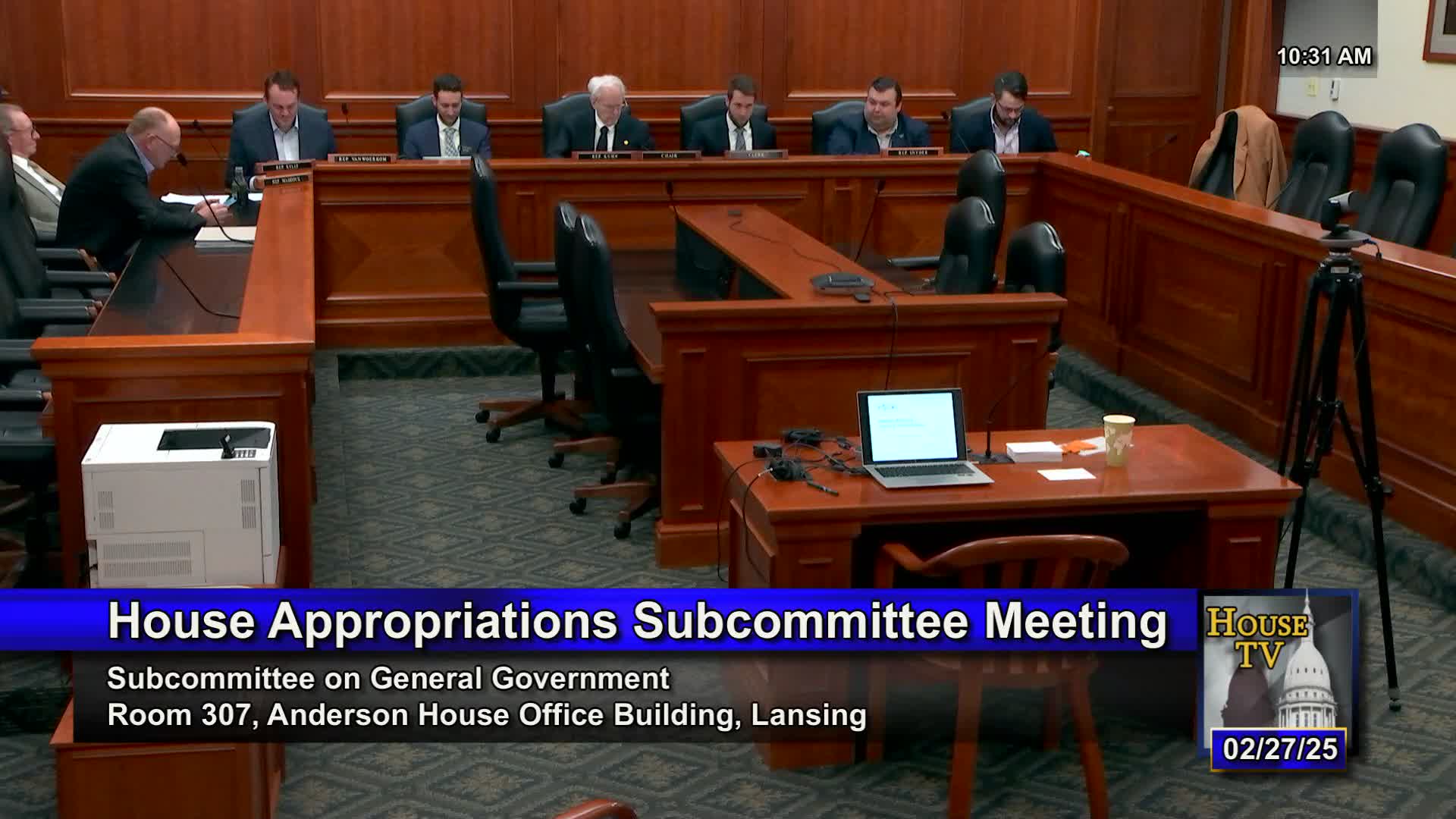
Michael Knausson, a senior fiscal analyst with the House Fiscal Agency, presented the House Appropriations Subcommittee on General Government with the governor's fiscal 2026 recommended general government budget, describing a $5.2 billion gross package dominated by restricted revenue pass‑throughs, centralized IT spending and SBA rent and debt service.
Michael Knausson, the House Fiscal Agency senior fiscal analyst who oversees the general government budget, presented the subcommittee with an overview of the governor's fiscal 2026 recommendations and answered members' questions.
Knausson told the committee the general government budget totals about $5.2 billion gross, with roughly $1.8 billion flowing as revenue-sharing pass-throughs to local units and nearly $1 billion in interdepartmental grants (IDGs), about $1 billion of which covers centralized IT services in the Department of Technology, Management and Budget (DTMB). He summarized that about a quarter of the budget is IDG-funded and about a quarter is general fund, and that restricted funds account for more than half of the gross total.
The presentation highlighted several large items in the governor's recommendations: continued revenue-sharing payments, state building authority (SBA) rent and debt service that together account for hundreds of millions of general fund dollars, and a major centralization of IT operations under DTMB. Knausson said the governor recommends additional information-technology investment fund (ITIF) appropriations — including an additional $20 million for replanning the unemployment insurance system replacement (Midas) and about $23.5 million for a multi‑year replacement of the Civil Service Commission's Human Resource Management Network (HERMAN). He also noted a governor-directed deposit recommendation of $50 million to the budget stabilization (rainy day) fund that would bring its balance to about $2.5 billion if included.
Members pressed for more detail on programs and transparency. Representative Kelly asked about an attorney general initiative targeting oil and gas and whether it was separately budgeted; Knausson replied that the work shows up under a table labeled "utility rate increases" and that the AG spent about $2.2 million on that activity in fiscal 2024, with $1.9 million of that listed as restricted funding. Representative Kelly later pressed for more breakdowns of attorney general operations and for missing outside‑counsel reports; Knausson said a boilerplate‑required report exists but that the AG's online reporting has not been updated past 2023 and he would try to locate the specific statutory or boilerplate reference and the latest reports.
Vice Chair Bender and other members asked for specifics on debt service and what bonds are covered; Knausson identified three general‑obligation bond programs accounted for in the SBA debt service line: the Quality of Life Bond, the Clean Michigan Initiative (environmental protection), and the Great Lakes Water Quality Bond. When members asked for further breakdowns, Knausson said he would provide additional detail.
On DTMB and IT spending, Knausson outlined that DTMB's budget is about $1.8 billion, with 63% in IDGs and approximately $1 billion in IT IDG flows. He said DTMB manages 261 active IT projects as of February and that ITIF continues to fund a rotating set of legacy‑modernization projects (typically 5–10 new projects each year and about 20 active projects at any time). Knausson described the fiscal 2026 ITIF recommendation as the second‑largest in recent history and noted it includes funds for Midas replanning and the Civil Service Commission HERMAN replacement; the governor also recommends $7.5 million in limited‑term ongoing appropriation for Civil Service to cover half of HERMAN project costs and additional staff for HR services statewide.
Members also asked about a $25 million one‑time DTMB request for state facilities maintenance and demolition. Knausson characterized those projects as routine capital maintenance (roofs, HVAC, parking lot improvements, demolition) and said the department can provide a list of projects previously funded and likely candidates for the upcoming allocation.
Several representatives pressed about staffing increases in specific departments. Representative Brett Maddock asked how many complaints the Department of Civil Rights receives and how many lead to litigation; Knausson said he could provide the report that lists initiated, closed and pending complaints (fiscal 2023 showed just over 2,000 complaints initiated) and said he would update the committee with current figures. Representative Mattick asked about large pay increases for certain classified employees (referenced as "level 15"), requesting an analysis of recent increases; Knausson said he was not familiar with that classification detail and recommended asking the Civil Service Commission to provide the requested analysis.
Knausson also reviewed the Make It in Michigan Competitiveness Fund: state deposits total about $337.8 million (a prior $50 million and a $286.8 million appropriation), with about $128 million available as of January and roughly $202 million already allocated. He said some projects have drawn down federal matching funds while others have not because a presidential order paused certain federal disbursements tied to the Inflation Reduction Act, CHIPS and other federal programs; that pause leaves the federal matching status of several projects uncertain.
On elections, Knausson said the Department of State's motor vehicle operations are largely restricted‑funded while election administration is primarily general fund; he noted the governor's supplemental recommended reappropriation of lapsed HAVA (Help America Vote Act) work projects and additional federal HAVA funds totaling $9.6 million for fiscal 2025 activities.
Knausson closed by offering to supply follow‑up materials and more detailed breakdowns on requests raised during the hearing.
Ending: The subcommittee did not take formal votes at the hearing; members instructed staff to follow up on requested detail (AG outside‑counsel reporting and program breakdowns, lists of DTMB maintenance projects, Civil Rights complaint counts and a Civil Service commission staffing/pay analysis). The chair scheduled a follow‑up meeting focused on boilerplate reporting and oversight language for the next week.