Get Full Government Meeting Transcripts, Videos, & Alerts Forever!
Get email alerts on the Appropriations General Government topic
No spam. Unsubscribe anytime.
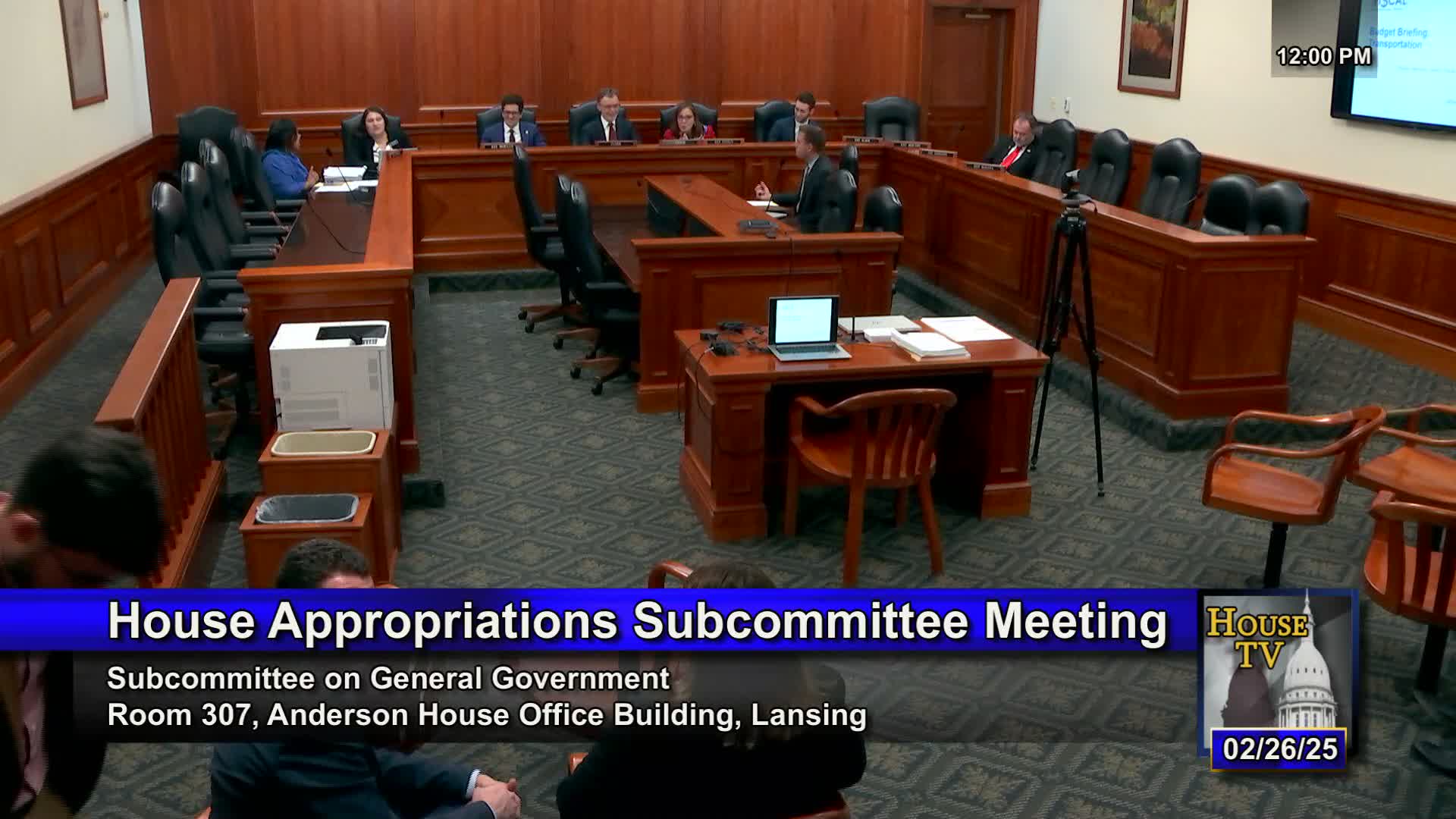
Appropriations subcommittee hears Michigan transportation budget briefing; fiscal analyst cites $2.5 billion trunk‑line shortfall
Summary
House Fiscal Agency analyst Bill Hamilton told the House Appropriations Subcommittee on State and Local Transportation that the current state transportation budget totals about $6.8 billion and that Michigan faces an estimated $2.5 billion shortfall to return state trunk‑line pavement to a 90% “good” condition target.
House Fiscal Agency analyst Bill Hamilton gave the House Appropriations Subcommittee on State and Local Transportation an overview of the current state transportation budget and revenue sources, telling committee members that Michigan’s gross transportation appropriations are roughly $6.8 billion and that the state trunk‑line system faces an estimated $2.5 billion funding gap to return pavement to the commission’s 90% good‑condition goal.
Hamilton said the current budget is driven primarily by state restricted revenue and federal aid. “The largest revenue source is state restricted,” Hamilton said during the presentation. He explained that state restricted sources total about $4.2 billion, federal revenue about $2.3 billion, and State General Fund/General Purpose revenue approximately $193 million in the current year budget.
Hamilton said about 83% of the appropriation dollar total supports road and bridge programs (roughly $5.7 billion), about 12% funds public transportation (about $805.6 million) and roughly 5% supports aeronautics (about $330.3 million). He said the budget provides capital and operating assistance to roughly 80 public transit agencies and capital assistance to about 95 publicly owned public‑use airports.
The analyst described the Michigan Transportation Fund (MTF), created in statute by Public Act 51 of 1951, as the primary collection and distribution account for restricted transportation revenue. He said a plurality of MTF receipts now come from vehicle registration taxes and that combined motor fuel taxes on gasoline and diesel total about $1.6 billion — a figure that Hamilton said is roughly similar to the vehicle registration component. He also noted that the motor fuel tax increased to 31¢ per gallon on January 1 of this year.
Hamilton highlighted distribution rules set by Act 51 and pointed out that the MTF “never has a fund balance at the end of the year” because monthly distributions are made to counties, cities and villages and remaining funds flow to trunk‑line accounts. He contrasted that distributive model with federal funding, which is “made available” for qualified projects under the Infrastructure Investment and Jobs Act (IJA), which Hamilton said is authorized through 09/30/2026.
On system condition, Hamilton cited pavement‑condition measures provided by the Michigan Department of Transportation (MDOT). He said MDOT met a State Transportation Commission performance goal in the 2000s but that the trunk‑line pavement measure has declined since, and at current funding levels MDOT projects a continued decline. Hamilton said MDOT’s presentation estimates an additional roughly $2.5 billion is needed to reach and sustain the 90% good‑condition goal for the trunk‑line system; he also noted county road commissions have reported larger needs for local systems.
Committee members asked detailed questions. Representative Edwards asked whether fewer young adults obtaining driver’s licenses would reduce registration revenue; Hamilton replied registrations are partly a tax on vehicle value and that registration revenue has tended to rise over time even when the count of registrations falls. Representative Morgan asked whether appropriations are adjusted for inflation; Hamilton said the budget process includes economic adjustments for state employee costs and that MDOT tracks construction cost changes but recommended asking MDOT for a detailed inflation‑adjusted analysis.
On debt and bonding, Hamilton summarized a published table showing outstanding state trunk‑line fund debt as of 09/30/2023 at a little under $3.3 billion and annual debt service of roughly $226 million in 2023 (with a higher estimate cited for a later year). He said the State Transportation Commission has authorized up to $3.5 billion in state trunk‑line bonds for a recent program; MDOT has sold about $2.8 billion of that authority and had approximately $700 million of remaining authority under that cap, and the department has indicated it may use the remaining authority this year depending on cash‑flow and market conditions.
Committee members also discussed project scopes and coordination — for example whether utility, sewer or drainage work is covered by transportation appropriations — and Hamilton said those items are typically not directly earmarked but can be included in major reconstruction work when appropriate. Members asked for guidance on researching line‑item detail and Hamilton pointed them to House Fiscal Agency publications and the HFA website, where staff have posted the MTF publication, a budget briefing, and other background materials.
The subcommittee chair said the committee will hold additional meetings to dig into the details and to consider policy and funding choices; at the meeting’s close a member moved to excuse absent members but no vote on that motion is recorded in the transcript.
Why this matters: the subcommittee will allocate transportation appropriations and consider proposals to address pavement decline, local road needs and bonding choices. Hamilton’s briefing set baseline numbers and legal constraints — including Act 51 distributions and the statutory earmark for a $600 million income‑tax credit to the MTF created by the November 2015 road package — that members said they will use as they plan future hearings.