Get Full Government Meeting Transcripts, Videos, & Alerts Forever!
Get email alerts on the Addiction Services topic
No spam. Unsubscribe anytime.
Senate committee hears sponsor testimony on bill to shorten ADAMH contract notice, require recovery-housing certification
Summary
Senate Bill 138, presented at a committee hearing, would halve ADAMH contract-notice periods, require a state-local data‑sharing plan and make operating uncertified recovery residences a first‑degree misdemeanor; the committee took testimony and no vote was held.
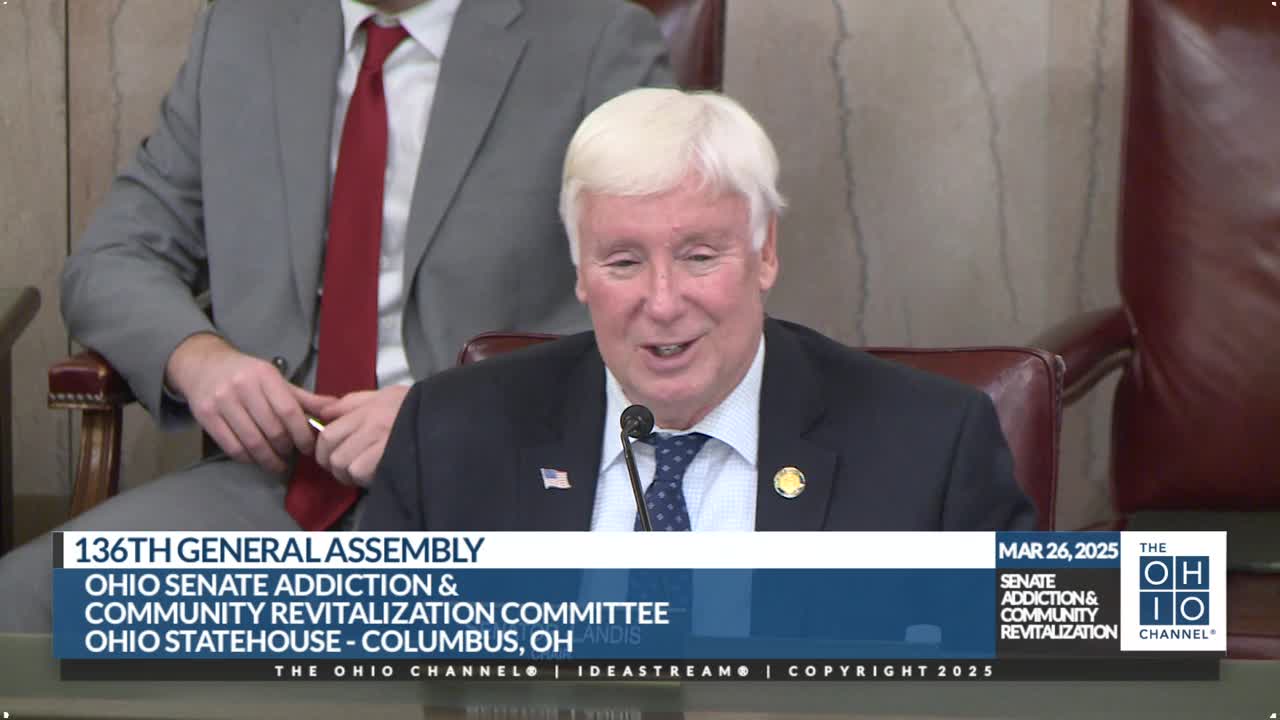
The Senate Addiction and Community Revitalization Committee heard sponsor testimony on Senate Bill 138, which would change contracting rules for Alcohol, Drug Addiction and Mental Health (ADAMH) boards, require a data‑sharing plan between the state and local boards, and make it a first‑degree misdemeanor for recovery residences to operate or advertise without certification. Senator Terry Johnson, vice chair of the committee and the bill’s sponsor, presented the measure; the committee did not vote.
Johnson said the bill is the product of years of work and compromise. “This bill is the culmination of several years of work, research, and compromise,” Senator Terry Johnson said, calling the proposal a “crowning achievement” of negotiations among ADAMH boards and health‑care providers. He summarized three main changes in the bill: shortening certain contract‑notice requirements, directing the state agency to work with local ADAMH boards on data integration, and strengthening enforcement of recovery‑housing standards.
The bill would reduce an existing 120‑day notice requirement — used when either an ADAMH board or a provider chooses not to renew a contract — to at least 60 days, Johnson said. It also provides a six‑month transition period after the bill’s effective date to allow boards and providers time to implement the contracting changes. “This will allow the boards to react in a timelier manner, meeting the needs of their residents, while ensuring a continuum of care for the patients,” Johnson said.
Johnson told the committee the measure directs the Ohio Department of Mental Health and Addiction Services (OhioMHAS) to collaborate with local ADAMH boards on developing a data‑sharing and integration plan. Johnson described data as “the lifeblood of the ADAMH boards” and said better information will help boards identify community needs and allocate services.
The third major provision would make it a first‑degree misdemeanor for any recovery housing residence that operates or advertises without required certification or accreditation. Johnson said some uncertified operators “prey financially off those wrestling with addiction,” and that local boards currently lack tools to stop such conduct. He cited Scioto County as a local example of what he called unregulated recovery housing activity.
Committee Chair Landis praised Johnson’s work and bipartisan negotiations that produced the bill, saying the sponsor and former Senator Sykes had “taken the time to really work with both groups, to come up with meaningful legislation.” The hearing was limited to sponsor testimony and committee questions; no committee motion, vote, or formal amendment occurred during the session.
Senator Johnson framed the bill as balancing local ADAMH boards’ authority with providers’ roles and as intended to protect individuals seeking recovery while stewarding taxpayer funds. “We must ensure that this money is being spent efficiently and effectively,” he said.
The committee concluded the first hearing on Senate Bill 138 with no vote; the bill’s next steps were not specified during the meeting.