Get Full Government Meeting Transcripts, Videos, & Alerts Forever!
Get email alerts on the Judiciary topic
No spam. Unsubscribe anytime.
Subcommittee reviews $373.4 million judiciary budget; one-time IT funding and grants highlighted
Summary
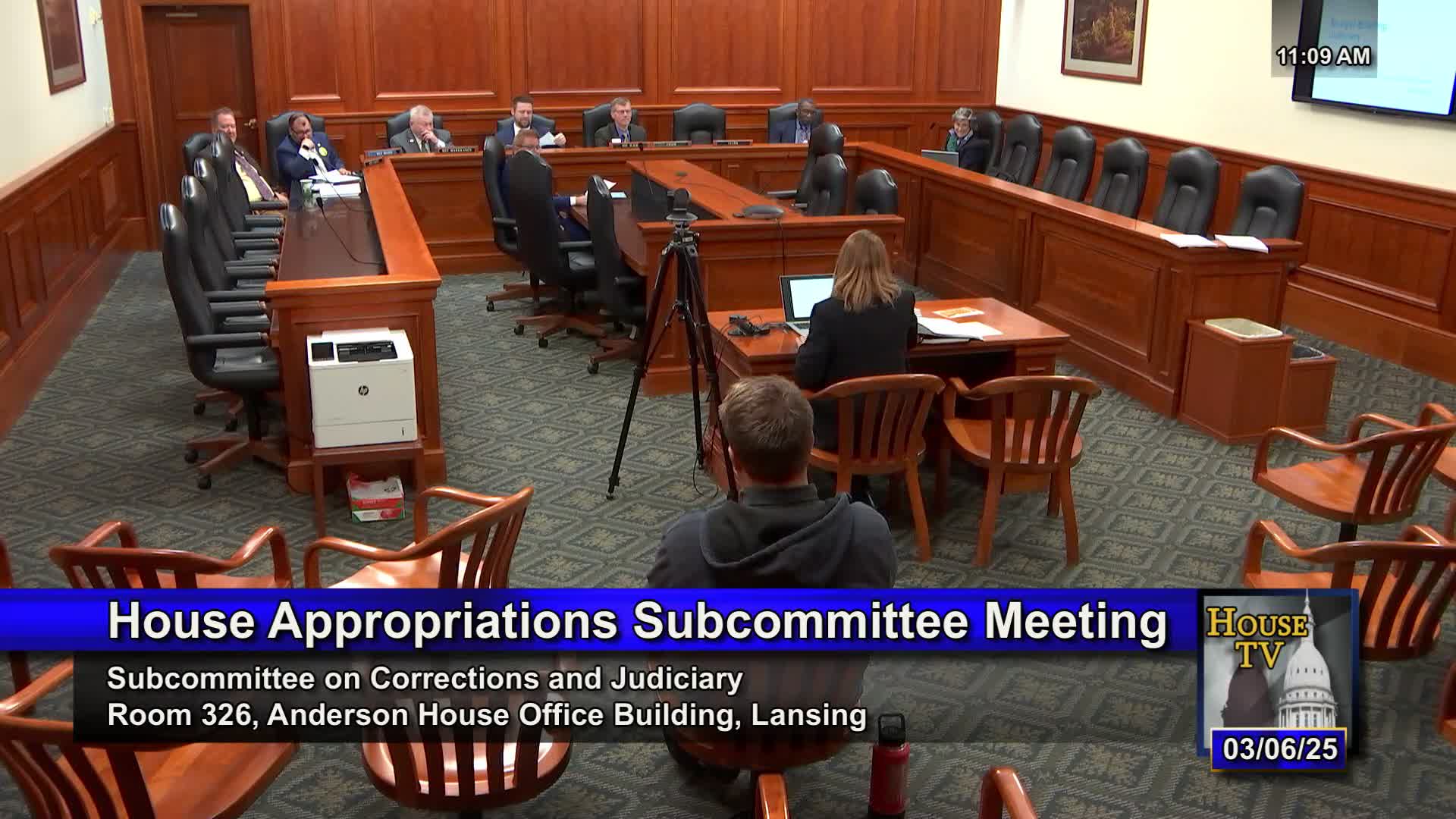
House Fiscal Agency analyst Robin Risco told the subcommittee the judiciary budget for fiscal 2025 totals about $373.4 million, most funded by the general fund, and includes grant programs for problem-solving courts and previously authorized one-time funding for a statewide case-management system.
Robin Risco, fiscal analyst for the House Fiscal Agency, briefed the House Appropriations Subcommittee on Corrections and Judiciary on the fiscal 2025 judiciary budget, saying total gross appropriations are about $373.4 million with $266.1 million from the general fund.
Risco opened by emphasizing the separation of powers, noting that although the legislature appropriates funding for the judicial branch, it cannot direct the actions of judges. She pointed to Article 6, Section 1 of the Michigan Constitution as the source of judicial authority.
The presentation traced a five-year funding history and identified a large one-time increase in fiscal 2023 of $150 million to support a statewide judicial case-management system that raised year-to-year totals in that budget cycle. Risco said that removing that one-time funding explains much of the budget decline between fiscal 2023 and 2024.
Risco said the judiciary budget is funded predominantly with state general fund and state restricted funds. She listed major restricted sources, including the Court Equity Fund ($50.4 million), the Judicial Electronic Filing Fund ($12 million), the State Court Fund ($8.4 million) and the Juror Compensation Fund ($6.6 million). She also said roughly $7.1 million in federal funding supports grants primarily from the U.S. Department of Health and Human Services and the National Highway Traffic Safety Administration.
Risco described major spending areas: judicial salaries and compensation, the Supreme Court and trial court operations, indigent defense, appellate defender offices and grants to local trial courts. She said justices’ and judges’ compensation accounted for a large share — roughly 33% for judicial salaries, 24% for the Supreme Court and 24% for trial court operations — and that judicial salaries are calculated under Michigan law and oversight bodies she cited, including the State Officers' Compensation Commission and provisions of the Revised Judicature Act of 1961 as amended.
Risco outlined grant programs that support local trial courts, including the Court Equity Fund reimbursements (about $60.8 million gross) and funding for problem-solving courts: roughly $13 million for drug treatment courts, about $5.7 million for mental health courts and $1.1 million for veterans treatment courts. She said participation in those programs rests with local judges and cannot be mandated by the state.
Committee members asked follow-up questions. A member asked where National Highway Traffic Safety Administration funds were targeted; Risco answered that those federal funds were “targeted at drug treatment courts and then for drunk driving programs.”
A question about Supreme Court justices’ salary increases drew Risco’s explanation that the House had passed a resolution in a previous session recommending an increase — she recalled “7%, I wanna say, with a $10,000 expense allowance” — but that the resolution passed the House and did not pass the Senate.
Risco closed by summarizing that judiciary funding supports compensation, court operations and a portfolio of grants to local courts and problem-solving programs, and she offered to answer further questions when the committee called other witnesses.