Get Full Government Meeting Transcripts, Videos, & Alerts Forever!
Get email alerts on the Corrections topic
No spam. Unsubscribe anytime.
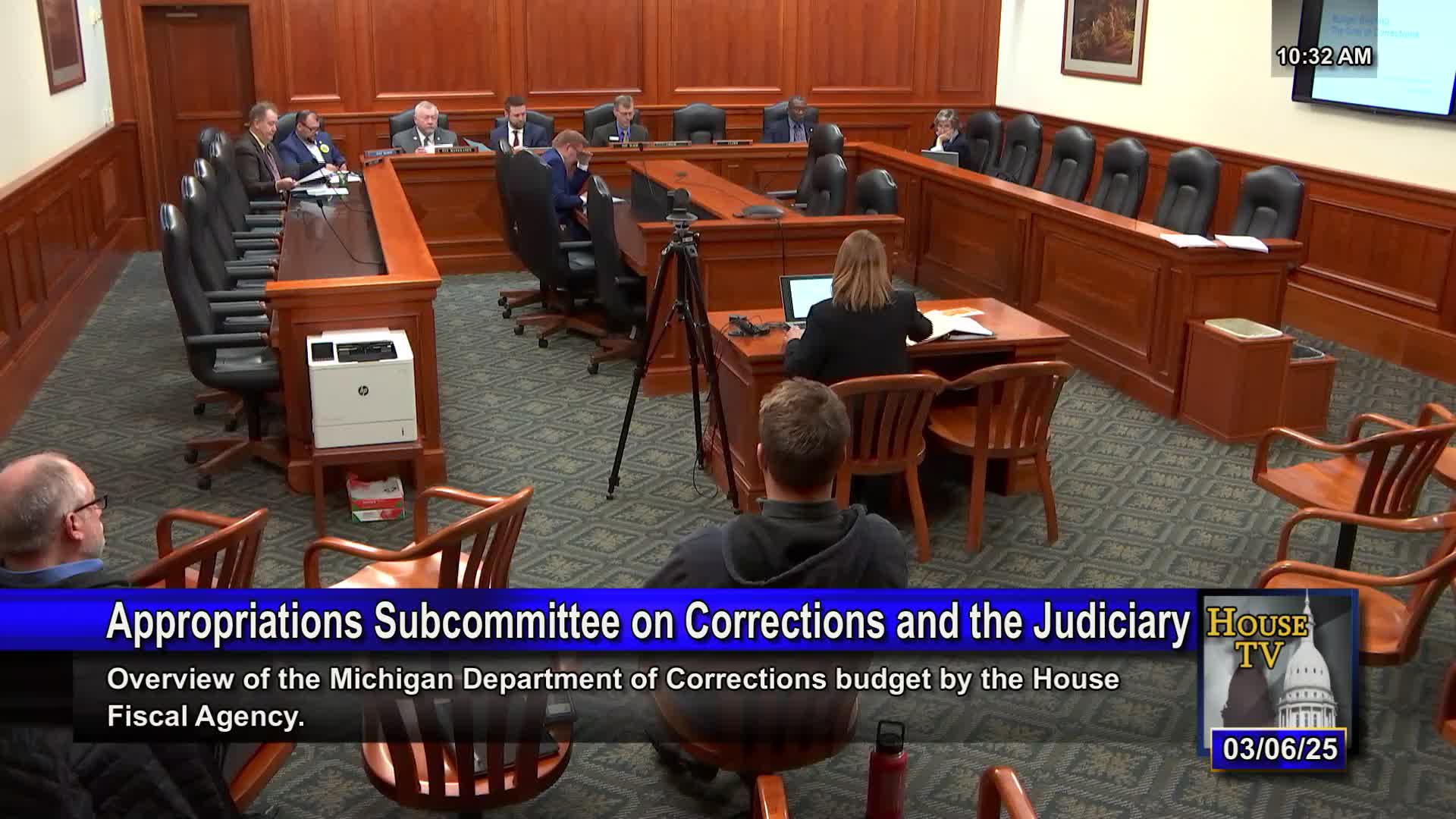
Subcommittee hears overview of $2.1 billion corrections budget; staffing, health care drive costs
Summary
House Fiscal Agency analyst Robin Risco told the House Appropriations Subcommittee that the Department of Corrections' fiscal 2025 budget totals about $2.1 billion, accounts for roughly 14% of state general fund spending, and is driven by personnel and prisoner health-care costs amid persistent vacancies and overtime.
Robin Risco, fiscal analyst for the House Fiscal Agency, told the House Appropriations Subcommittee on Corrections and Judiciary that the Department of Corrections (MDOC) fiscal year 2025 budget totals about $2.1 billion and is mostly financed by the state general fund.
Risco said the corrections budget represents roughly 14% of the state’s general fund-general purpose budget and about 3% of the state’s adjusted gross budget. “The budget is 1 of the bigger budgets,” she said, noting that about 98% of MDOC personnel costs are financed with general fund revenue.
The presentation highlighted three primary drivers of recent budget growth: employee costs, programming, and physical and mental health care for prisoners. Risco told the committee the department received roughly $1.8 billion in federal COVID-relief funding across years that was used for hazard pay, personal protective equipment, testing and later to offset payroll costs for frontline workers; restoring those federal dollars contributed to increases in general-fund appropriations in subsequent years.
Risco said total appropriations rose by about $86.6 million in the five-year comparison she presented, with fluctuations tied to facility closures and one-time funding shifts. She noted closures — including the Michigan Reformatory and the south side of the Gus Harrison Correctional Facility — produced multi-million-dollar savings and substantial FTE reductions in prior years.
Staffing shortfalls and overtime emerged as central concerns. Risco said MDOC employed 10,638 people (about 22% of the state workforce) and reported 2,239 vacancies across classifications as of late February; 967.4 of those vacancies were corrections officer positions and 183.5 were registered nurse vacancies. Custody-staff overtime, she said, accounted for the large majority of overtime hours. “A total of 2,572,496 overtime hours were worked in fiscal year 24 by department employees,” she said, and the department spent about $118.2 million in fiscal 2024 on overtime costs.
Risco summarized recruitment and retention efforts the department is pursuing, including travel units to fill understaffed facilities, targeted recruitment events, efforts to remove educational barriers, and legislative and civil service actions to permit recruitment and retention bonuses.
On prisoner population and health-care needs, Risco said the total offender population under MDOC supervision was 73,397 as of Feb. 1, 2025, with 32,574 people incarcerated. She reported 87% of prisoners are expected to be released, that roughly 13% are serving life sentences, and that the average total annual cost per prisoner in fiscal 2024 — combining operations and health care — was roughly $46,000. The daily per diem in fiscal 2024 was $137.44 for operations alone.
Risco said the aging prison population is increasing health-care costs: by 2024 about 52.1% of prisoners were older than 40 and 28.2% were older than 50, raising demand for specialized care. She reported about 12 prisoner deaths per month, named drug overdoses, homicide and suicide among leading nonmedical causes, and cancer and cardiovascular disease as the top medical causes of death. Risco added there were about 201 active oncology patients, 86 prisoners in hospice care and 59 prisoners receiving dialysis.
Risco described offender-success programming funded in fiscal 2025 at about $94.2 million, including roughly $58.8 million for education, job training and career readiness programs offered inside facilities. She listed vocational villages and partnerships with postsecondary institutions that provide certifications and degrees to inmates.
Committee members asked several follow-up questions. Representative Cam asked whether ambulance runs into penitentiaries were reimbursed to local units; Risco replied that the health-care unit has a line item to fund contracted prisoner health-care providers and that the department changed providers in May 2024, with related disputes now in court. Representative Beeson asked whether the overtime hours chart distinguished mandated hours from voluntary overtime; Risco said she did not have that breakdown and suggested the department director could answer when staff testify.
Representative O’Neil asked about expansion of reentry services in so-called Prosperity Regions; Risco said she did not have the regional boundaries on hand. A Department of Corrections representative, identified in the meeting as Kyle, replied: “Region 1 is all of the Upper Peninsula. Region 4 is West Michigan, kind of anchored by Kent County, but, also, moving north through Muskegon and all those surrounding counties. The remaining regions that are mentioned, 2, 7 and 8, essentially are moving west to east across the state… Region 7 is the capital region. So, that's Clinton, Ingham, and Eaton County.”
Risco closed by repeating that personnel costs and prisoner health care have been key drivers of budget growth and that the legislature faces competing public preferences: some members of the public want reduced corrections spending while others favor keeping public-safety risks confined to incarceration.
There were no formal votes recorded during the presentation portion of the meeting; the committee transitioned afterward to the judiciary overview.