Get Full Government Meeting Transcripts, Videos, & Alerts Forever!
Get email alerts on the Egle Geologic Resources topic
No spam. Unsubscribe anytime.
EGLE division outlines orphan-well work, groundwater database, and push for Class VI primacy
Summary
Adam Weigandt, director of Geological Services and Management Divisions at Michigan EGLE, told a House appropriations subcommittee the division is focusing federal grant money on orphan wells, building a statewide groundwater data system, and preparing to seek EPA primacy for Class VI carbon sequestration wells.
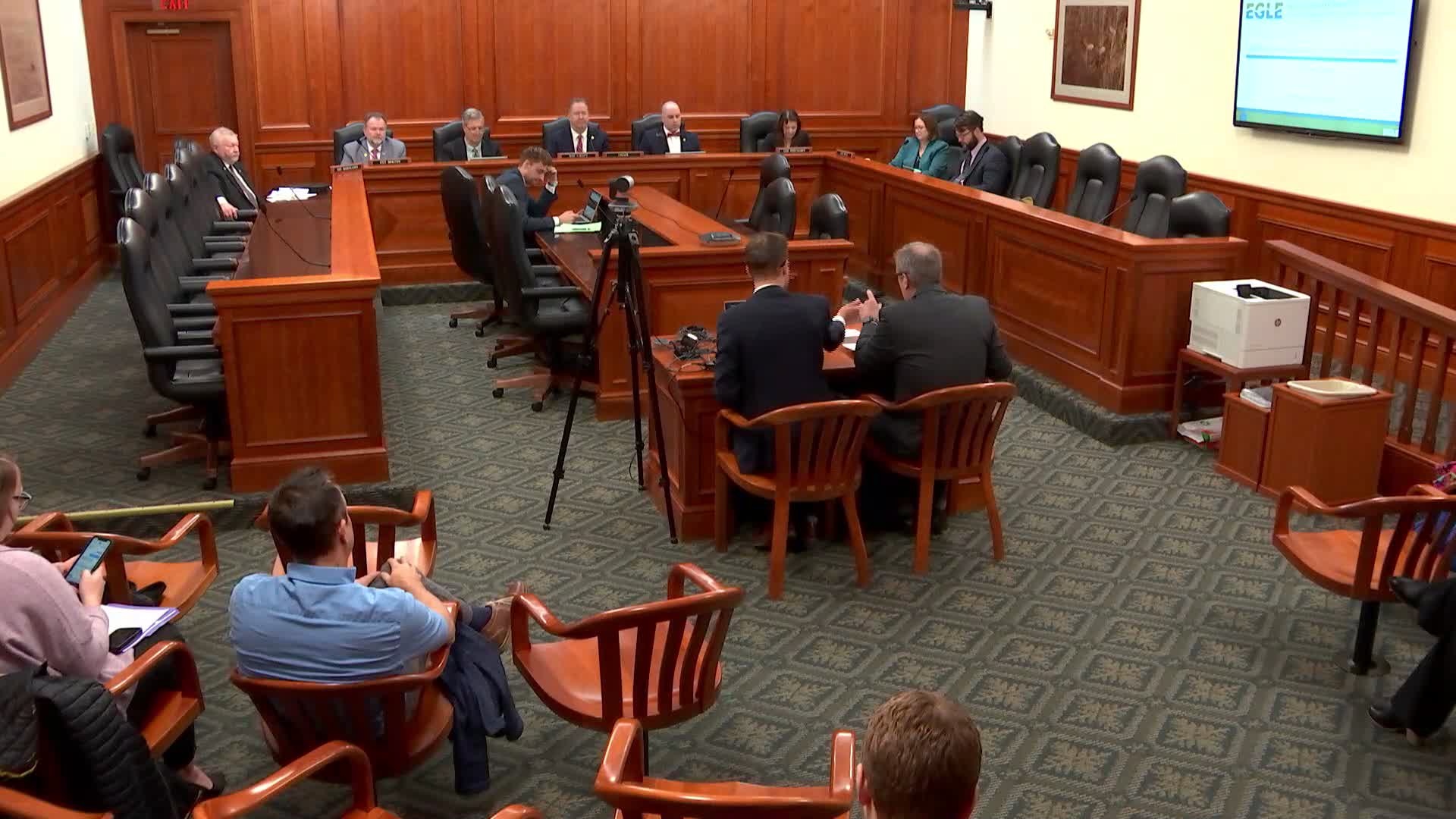
Adam Weigandt, director of Geological Services and Management Divisions for the Michigan Department of Environment, Great Lakes, and Energy (EGLE), told the House Appropriations Subcommittee on Environment, Great Lakes and Energy on Oct. 12 that his division is prioritizing work on orphan wells, a statewide groundwater data system, and regulatory readiness for carbon-capture injection wells.
Weigandt said the division regulates more than a dozen extractive-industry programs in state law — from oil and gas to mining and underground storage — and described efforts to address legacy wells, expand groundwater data management, and pursue federal primacy to regulate Class VI carbon sequestration wells. "It's an honor to be here today to give you a division overview of, the Geologic Resources Management Division," Weigandt said in opening his presentation.
Why it matters: EGLE oversees long-lived infrastructure and sites that can pose public-health and environmental risks if not managed — orphan wells, mine waste and large groundwater withdrawals are all issues that can persist for decades. The division's work and the use of federal grants directly affect site cleanups, water-resource planning and the timeline for permitting new carbon-sequestration projects.
Most of Weigandt's presentation described three sustained lines of work. First, the orphan-well program: the division runs a Part 616 orphan-well program that can plug wells when no solvent operator can be found. Weigandt said state and federal funds have recently increased the program's activity. He said Michigan received a $25 million initial grant under federal programs tied to the Infrastructure Investment and Jobs Act, followed by a roughly $5.8 million formula grant and an application for a $5 million matching grant. The Michigan Legislature provided a $5 million ongoing appropriation intended to match the federal money, he said. Using those funds, EGLE plugged roughly 220 wells in the program's first federal grant year and has plugged hundreds over recent years; he noted the pace slowed last year because additional cultural- and species-protection requirements from federal agencies slowed field work.
Weigandt gave examples of cost variation for plugging wells, saying newer wells in known conditions can be plugged for about $20,000 apiece but can run as high as $150,000 for some Antrim wells; older, harder-to-access wells can cost much more. He described two wells in a Grand Rapids gravel-pit park where access and site conditions drove costs near $1 million per well.
Second, groundwater data and water-use assessment: Weigandt said EGLE has received IT investment funding to build a statewide groundwater data-management system that will consolidate disparate databases, support modelers, and make data public and accessible. He described creating a new section that houses both groundwater modelers and a groundwater data unit, and said the division has a groundwater monitoring network under development to feed real-time and historical data into the system. Weigandt summarized the water-withdrawal permitting framework: the department uses an online withdrawal assessment tool that allows registration for some large-volume withdrawals; site-specific review or a Part 327 permit is required if the tool shows potential adverse resource impacts or for withdrawals above statutory thresholds in certain zones.
Third, permitting and regulatory change for new technologies: Weigandt said EGLE is preparing to seek primacy from the U.S. Environmental Protection Agency to regulate Class VI wells for carbon capture, utilization and sequestration (CCUS). He described a $1.9 million grant to support the Class VI primacy work, the need for state authorizing legislation, administrative rules and a primacy application (which requires a governor's letter and an attorney-general legal opinion). "We intend to spend that money this year," Weigandt said, and added that EPA has recently issued primacy to other states and that best-case timelines for approval could be six months to a year if the application and rules are complete.
Weigandt also reviewed other division responsibilities and trends: oversight of iron and nonferrous mining (including active operations and projects in the Upper Peninsula), co-regulation of intrastate natural-gas storage with PHMSA and the Michigan Public Service Commission, sand-dune mining limits that date to the 1970s, and emerging activities such as geothermal, pumped underground storage, hydrogen and critical-minerals recovery from mine waste. He said the division is taking a more active approach to well-bonding and well management, including limiting blanket bonds to 100 wells and meeting annually with operators to review plugging plans.
Committee questions elaborated funding and cost topics. Representative Price asked, "in your opinion, what would happen to oil and gas operations in Michigan if EGLE has no funding for staff or programming?" Weigandt and Deputy Director Travis Boscol answered that a combination of industry fees, federal grants and General Fund support finance the programs; lacking funding would reduce the department's ability to enforce standards that keep operations from causing environmental harm. On the cost question, Weigandt reiterated the per-well ranges and the Grand Rapids example; he said a decade ago the average plugging cost was about $76,000 per well.
Weigandt flagged other funding and grant programs: a roughly $5 million methane-emission-reduction grant to help companies plug marginal conventional wells, ongoing federal tranches for orphan-well plugging that are awaiting DOI guidance, and an Interior grant and legislative matching funds to support a multi-year orphan-well program. He also described an Upper Peninsula Geologic Repository (relocated and rehabbed with legislative funding around 2018) that stores drill core and is co-located with Michigan Geologic Survey staff.
The subcommittee took a brief procedural action at the start of the meeting: Representative Markkanen moved to approve minutes for March 4; with no objections the minutes were approved.
Ending note: Weigandt closed by saying the division's "bread and butter" mission remains protecting public health, safety and the environment while allowing lawful development of minerals and water resources. He asked the committee for continued support to finish the groundwater data work, maximize federal grant value for orphan wells, and pursue Class VI primacy.