Get Full Government Meeting Transcripts, Videos, & Alerts Forever!
Get email alerts on the Mdard Budget topic
No spam. Unsubscribe anytime.
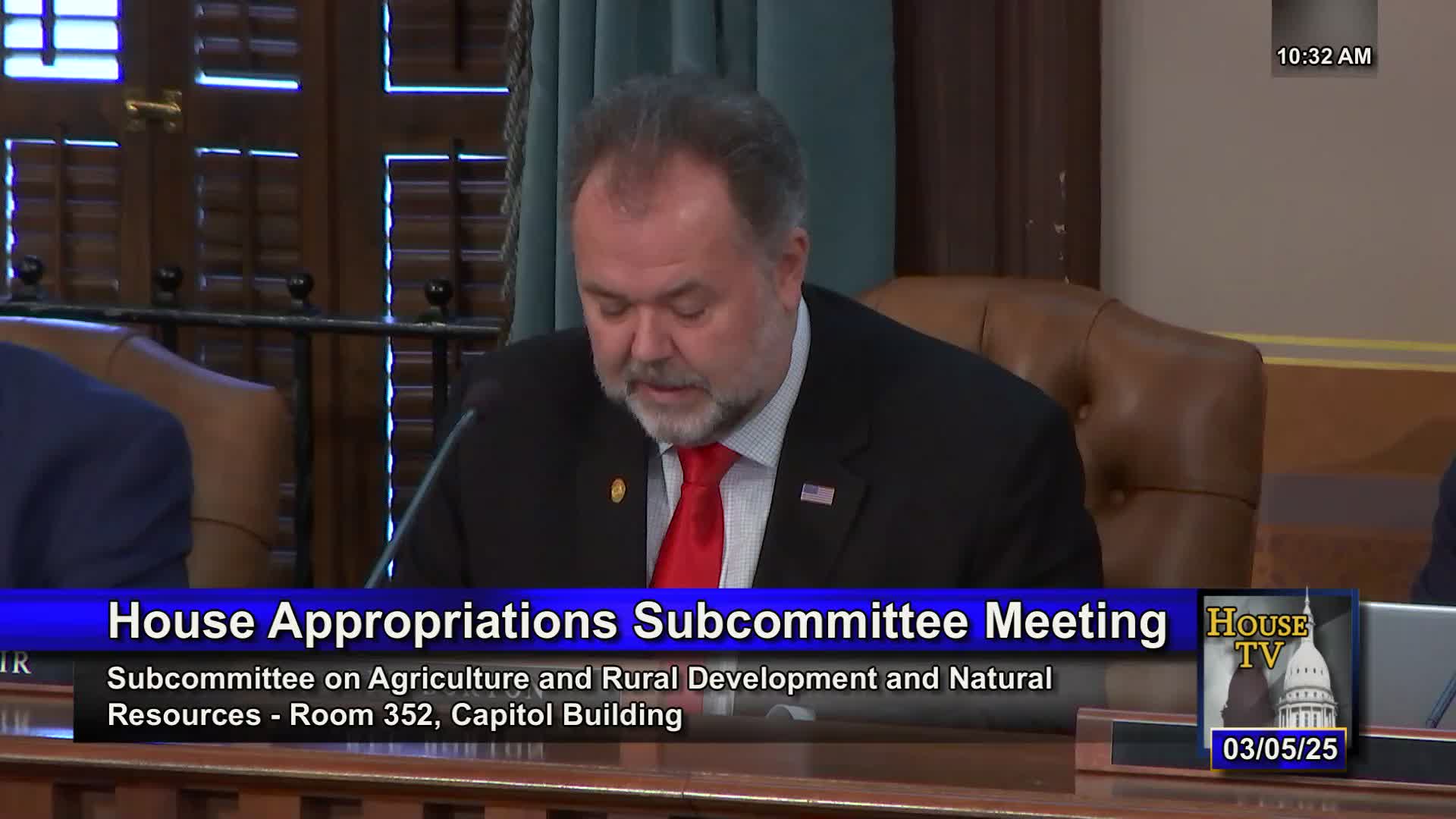
Subcommittee reviews MDARD budget; bovine tuberculosis, food safety and MEEP funding highlighted
Summary
The House Appropriations Subcommittee on Agriculture, Rural Development and Natural Resources convened and received a high-level overview of the Michigan Department of Agriculture and Rural Development (MDARD) budget from House Fiscal Agency analyst William Hamilton, who outlined funding sources and major program areas and answered members’ questions about bovine tuberculosis testing and pesticide regulation.
The House Appropriations Subcommittee on Agriculture, Rural Development and Natural Resources convened and heard a presentation from William Hamilton, a House Fiscal Agency analyst, on the current-year budget for the Michigan Department of Agriculture and Rural Development (MDARD). Hamilton said the MDARD gross appropriation in the bill is $156,900,000 and that the budget is supported primarily by state general fund, state restricted funds and federal revenue.
Hamilton told members the department’s main duties in the budget include food safety and quality assurance, milk safety and quality assurance, animal industry disease prevention and response, environmental stewardship programs and agricultural development. "This is my first time chairing MDARD…I'm honored to chair this committee," said Chair Borden at the start of the session, noting the subcommittee’s focus on natural resources and farmers.
Hamilton said roughly 57% of MDARD’s budget in the presentation is supported by general fund sources (listed in the presentation as $89,100,000), about 30% by state-restricted sources ($47,200,000 in the slides) and the remainder by federal revenue (the presentation lists $20,400,000). He described four internal bureaus in the department: Food Safety and Animal Health; Environment and Sustainability; Agriculture Development; and Laboratory and Consumer Protection.
On food regulation, Hamilton said MDARD administers a "farm to table" program under the department’s primary food statute (referred to in the presentation as the food law of February) and that MDARD licenses and inspects roughly 18,000 food establishments, including processors, distribution centers and retail food outlets. He said food-safety and milk-safety appropriations were shown in the packet as totaling $24,800,000 (with $15.3 million noted as general fund support in the slide material).
On dairy and milk safety, Hamilton said MDARD enforces the state’s Grade A and manufacturing milk laws (referred to in the presentation as the Grade A milk law of 02/2001 and the manufacturing milk law of 02/2001) and inspects dairy farms and processors. The presentation listed a figure for dairy industry coverage in the slide text as "approximately 9 93 dairy farms" (as printed in the packet slides).
On animal health, Hamilton said MDARD’s authority is established under the Animal Industry Act and that the department employs a state veterinarian who oversees livestock and poultry disease programs. He summarized disease programs for bovine tuberculosis (bovine TB), chronic wasting disease and highly pathogenic avian influenza, and said bovine TB containment has been a long-running, costly program. The presentation noted that since 1995 through 2024 the combined spending tied to bovine TB was $205,800,000 (with MDARD’s share listed as $150,900,000 in the packet).
Hamilton described Michigan’s bovine TB status: most of the state is treated as having bovine TB status that allows normal cattle movement, but four counties remain listed as "modified accredited," meaning additional testing and restrictions apply in those areas. He noted the presentation was assembled before a recent confirmed bovine TB herd was announced and said he would provide additional information to the subcommittee after the meeting.
During questions, Representative Green asked whether the bovine TB testing requirements that apply to cattle also apply statewide to captive cervids (farm-raised deer and elk) and who pays for testing. Hamilton confirmed MDARD regulates farmed cervids and said he did not have the fee or testing-frequency details available at the moment and would follow up. Representative Green specifically asked whether captive cervids are tested statewide while cattle are subject to testing only in the four modified-accredited counties; Hamilton said he would find out and report back. Representative Green also asked whether captive cervid farmers pay an approximately $250 test fee; Hamilton said he did not have the exact answer and would provide follow-up information.
Representative Roth asked for more detail about the pesticide and plant-pest management program (described in the presentation as PPPM, pesticide and plant-pest management) and the roughly $14.5 million presented for that program. Hamilton said the program includes pesticide registration, licensing for commercial applicators, dealer registration and a fertilizer regulatory program and that more line-item detail is available in the packet and the bill. He offered to provide further detail by email.
Hamilton also reviewed two laboratory facilities MDARD operates — the Geggley laboratory in East Lansing and a metrology laboratory in Williamston — and a small county-fair and horse-racing grant program that the packet lists as funded from an Agriculture Equine Development Fund. He closed by offering to take questions and provide follow-up information on the specific line-item clarifications members requested.
The subcommittee’s formal review then moved on to the Department of Natural Resources budget after members’ questions. Hamilton said he would supply requested clarifications on captive cervid testing, testing fees and PPPM program expenditures.
Ending: The presentation ended with Hamilton offering to follow up on unanswered technical and fee questions. The subcommittee adjourned MDARD questions and proceeded to the next agenda item.