Get Full Government Meeting Transcripts, Videos, & Alerts Forever!
Get email alerts on the Corrections Reentry topic
No spam. Unsubscribe anytime.
MDOC outlines offender-success budget, cites lower recidivism; auditors find facility lapses
Summary
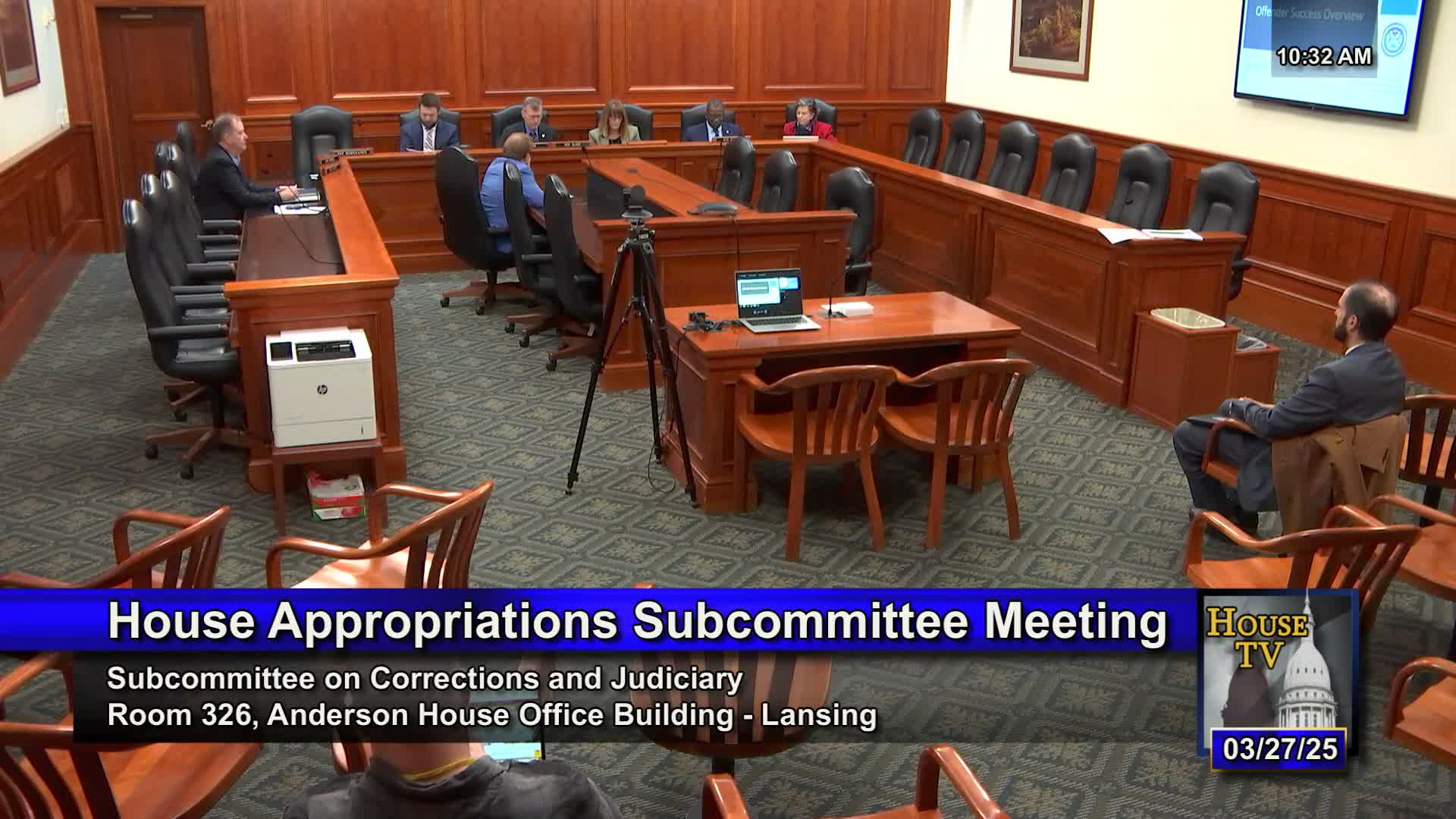
At a House Appropriations Subcommittee on Corrections and Judiciary meeting, Kyle Kaminski of the Michigan Department of Corrections reviewed offender success programs and FY budget lines tied to reentry and education, cited falling recidivism and prison intakes, and addressed recent auditor general facility audits that found operational lapses.
The House Appropriations Subcommittee on Corrections and Judiciary heard a briefing from Kyle Kaminski, offender success administrator and legislative liaison for the Michigan Department of Corrections, on the department's offender success (OS) programs, related FY budget lines and performance measures. Committee members asked about program scalability and recent audits of three prisons by the state auditor general.
The presentation focused on how MDOC's OS portfolio — staff who deliver in-reach services, education and vocational training, community residential services, performance‑based regional reentry contracts and specialized health/mental‑health reintegration contracts — fits together to reduce recidivism and prison intake while supporting postrelease self‑sufficiency. Kaminski cited long‑term trends showing lower prison intake and a decline in the three‑year recidivism rate from about 43 percent in the early 2000s to about 22.7 percent for the most recent cohort measured.
Kaminski described the major budget lines and their primary purposes. The offender success services staffing line funds in‑reach staff, curriculum and licensure costs; education carries roughly 270 FTEs and about $40 million in annual expenditures; community residential (probation residential) beds are contracted statewide with a FY25 reimbursement structure that includes a $200 initial assessment fee and $70 per day; offender success programming is roughly $15.5 million and funds community‑based clinical programs (including sex‑offender treatment) and the health services community reintegration contract (internal codes D47/D48) for cases with high behavioral or physical health needs; and the criminal justice reinvestment line is just over $2.5 million for evidence‑based pilots and data tools.
Kaminski also highlighted education and workforce initiatives: three vocational villages (Ionia, Jackson and the women's facility in Ypsilanti) that run immersive career and employer partnerships (DTE, Meijer, Ford) and 12 postsecondary programs run with external colleges and universities. He said the department is the state's largest adult basic education provider and estimates roughly 13,000–15,000 annual participants across MDOC education programs and roughly 9,000–10,000 annual completions (figures described as approximate during the briefing). Kaminski noted that Pell Grant eligibility restored in 2023 and a FY26 MDFC line (initially $1.75 million, adjusted in the FY26 request to $2.0 million) supports four‑year partners' costs.
On reentry and community supports, Kaminski described MDOC's 10 regional offender success community partner contracts, performance incentives and fee‑for‑service housing payments. He said housing is the single largest cost for parolees, with about one‑third of people leaving prison needing initial housing supports; typical stays in transitional housing average 70–80 days downstate and can be longer in the Upper Peninsula because of limited supply. He quantified specialized returns planning as roughly 400–500 D47 (higher mental‑health needs) cases and about 100–150 D48 (higher physical‑health needs) cases handled through a statewide contractor each year.
Committee members raised scaling and oversight questions. Representative Cabot asked whether county jails could adopt programs at local scale; Kaminski pointed to voluntary community corrections plans (structured by statute PA 511 of 1988) and the Muskegon county diversion pilot supported by the criminal justice reinvestment line as existing county‑level examples. Representative O'Neil praised the education and vocational programs and graduations he had attended.
Kaminski also addressed three facility audits released that week by the auditor general. He acknowledged the findings, saying the department "has acknowledged those findings. We agree that those findings are problematic." He described steps the department had already taken and planned to take across all 26 facilities: refocusing first‑line supervisors on coaching and mentoring, instituting additional internal quality‑assurance and internal audits, and investigating instances where documentation (for example, search logs) could not be corroborated. "That is unacceptable," Kaminski said, adding that each such scenario was referred for investigation and potential discipline.
The subcommittee approved two procedural motions on unanimous voice votes: minutes from the March 20 subcommittee meeting and a motion to excuse absent members. The chair said the next meeting would be scheduled in about three weeks, and the subcommittee then adjourned.
The briefing outlined multiple appropriations and pilot lines that together support education, vocational training, in‑reach casework, transitional housing and clinical services for incarcerated people and parolees. The department characterized the OS portfolio as a decade‑long evolution of the Michigan Prisoner Reentry Initiative and reentry efforts, emphasizing integration of education, employment and clinical supports with community partners to lower recidivism and prison admissions.
Questions for follow up noted in the meeting record include: how the department will verify corrective actions after the auditor general findings, and what technical assistance MDOC can provide counties seeking to replicate successful programs at local jails.