Get Full Government Meeting Transcripts, Videos, & Alerts Forever!
Get email alerts on the Statewide Case Management System topic
No spam. Unsubscribe anytime.
Michigan judicial branch asks for $7.2 million in ongoing funds to sustain statewide case management system
Summary
Michigan’s chief justice told the House appropriations subcommittee that the statewide court case management system (CMS) requires $7.2 million in ongoing funding so the system can be staffed and supported as more trial courts come online.
Michigan’s chief justice told the House appropriations subcommittee that the statewide court case management system (CMS) requires $7.2 million in ongoing funding so the system can be staffed and supported as more trial courts come online.
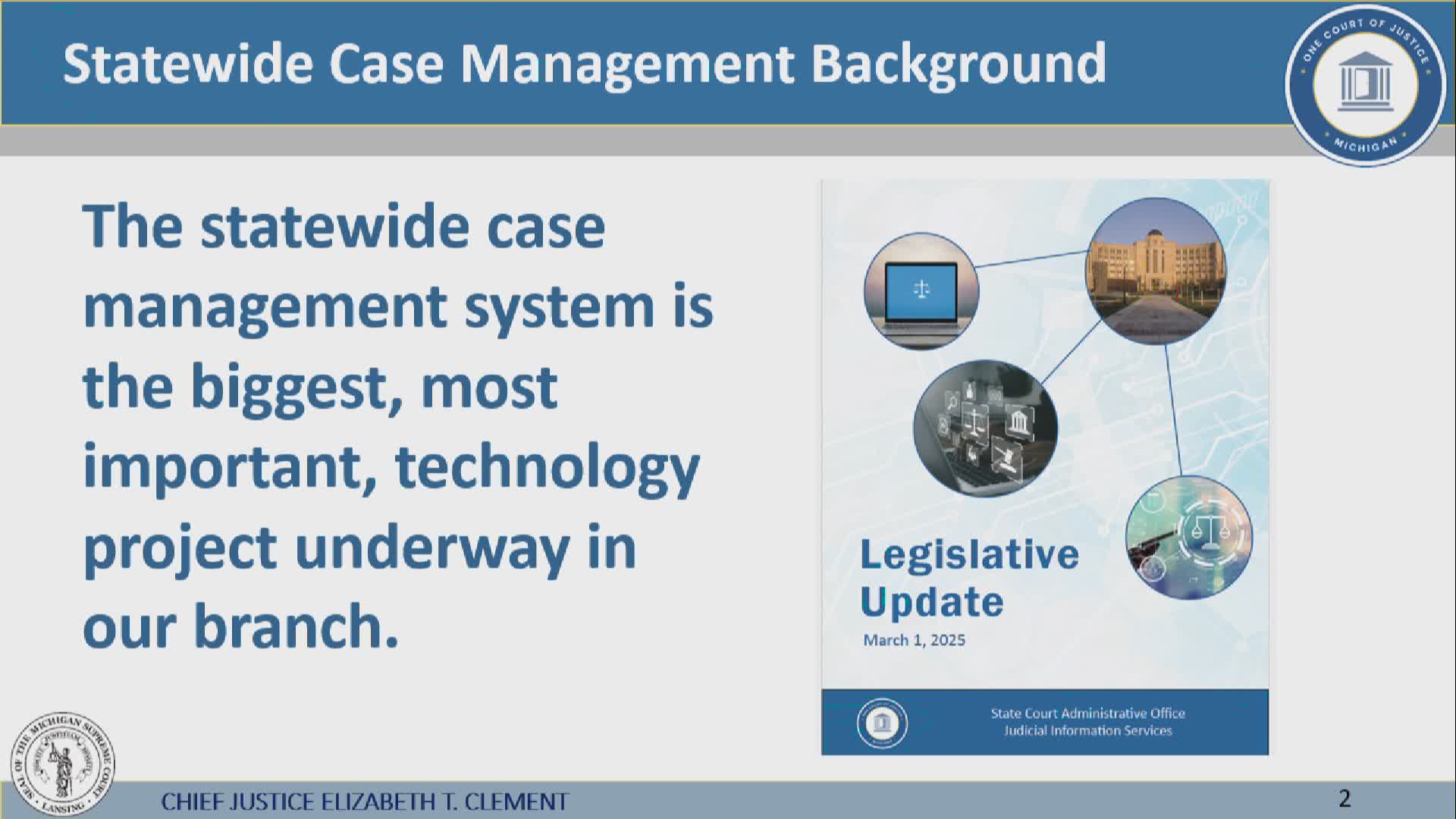
The request was presented during a subcommittee budget hearing where the chief justice described the CMS as “the biggest and most important technology project” across Michigan’s judicial branch and asked for sustained operating dollars after a 2022 one‑time appropriation funded the initial build‑out.
Why it matters: the CMS is intended to link trial courts across Michigan to improve data collection, reduce duplicate local costs, expand online court services and allow interoperability with law‑enforcement and other justice partners. Committee members pressed SCAO officials on migration challenges and staffing plans; a member of the public raised concerns about how the system assigns cases.
Background and funding history
Committee testimony said the Legislature provided $150,000,000 in one‑time funds in 2022 to build the statewide infrastructure and that SCAO sought $38,000,000 in ongoing funds in that budget cycle but did not receive it. The chief justice told the committee that SCAO has obligated about $65,000,000 of the one‑time appropriation and has about $85,000,000 remaining to complete onboarding of the largest, most complex courts.
“Once we have covered the statewide CMS project, then I want to go back and highlight several other important proposals but I want to focus on this first because the statewide case management system is so important,” the chief justice said during opening remarks.
Status, benefits and costs
Testimony said the Judicial Information System (JIS) — the SCAO’s existing case management product — is the viable platform for a statewide CMS. As of February 2025, SCAO reported roughly 250 of 302 trial courts using JIS (69 circuit courts, 107 district courts and 74 probate courts). Officials said remaining courts are among the largest and most complex to migrate.
SCAO told the subcommittee it estimated annual local cost savings of more than $700,000 in just three mid‑to‑large counties (Saginaw, Ingham and Kalamazoo) after switching from private vendors to JIS. The branch cited additional benefits including reduced local IT maintenance and licensing fees, standardized case lifecycle workflows aligned with rules and statutes, easier statewide updates when statutes change, better interoperability with the Michigan State Police and Secretary of State, and expanded online services such as e‑filing.
Challenges and implementation details
SCAO identified two major hurdles: data migration from legacy systems (historical data can be “messy,” complicating schedules) and the local court effort required for onboarding (courts must maintain operations while dedicating staff to migration). The testimony said there are 12 different legacy case management systems currently in use and five “homegrown” systems that need migration.
To address local resource limits, SCAO said it has implemented a reimbursement program for local funding units to cover overtime or temporary staff so courts can dedicate personnel to onboarding.
Officials also framed the current funding ask as a step toward a long‑term cost model: “Ongoing funding is necessary to ensure the system is maintained and supported into the future,” the chief justice told the committee, explaining the annual requests will scale with the number of courts being brought onto the system.
Other SCAO capacity requests discussed at the hearing
The chief justice presented several additional, connected budget requests and proposals intended to strengthen SCAO services to trial courts and the public, including: - Three field‑service FTEs for court management assistance, plain‑language form rewriting and expanded dispute‑resolution programs (MI Resolve). - Funding to expand finance and human resources capacity, enabling auditing of each trial court once every four years and stronger HR support. - One additional legal editor in the Supreme Court reporter‑of‑decisions office (SCAO supported request), intended to reduce a backlog in edited, published opinions. - A permanent grant officer position to shepherd federal grant applications and compliance (SCAO cited a recent $10,000,000 federal award related to juvenile justice work as an example of missed‑opportunity risk without dedicated grant staff). - Continued investment in Michigan Legal Help (SCAO said the site had more than 3,000,000 visits last fiscal year; SCAO reported about 150,000 DIY forms completed and nearly 40,000 personal protection order forms among them) and expansion of problem‑solving courts (SCAO said it expects applications from about 15 new programs).
Public comment and concerns about algorithmic case assignment
A member of the public, Peter DeFlippis, testified remotely and said he had repeatedly received appellate assignments he characterized as nonrandom. DeFlippis told the subcommittee: “I see the only purpose algorithms would serve in the CMS would be to allow courts to manipulate and rig a system.” He asked why his cases had been repeatedly assigned to the same small group of judges and urged further review.
Committee staff interrupted the public commenter to note that the hearing’s primary purpose was the budget, but the chief justice and other SCAO representatives acknowledged the public comment and offered to provide additional information or follow‑up with committee members and staff.
What the subcommittee heard about next steps
SCAO said it will continue annual requests for ongoing funds until the branch secures the staffing and operating budget needed to maintain the system. Officials offered to provide additional information on comparative models in other states and on staffing‑scale plans tied to specific onboarding milestones. SCAO also made procurement and onboarding status available in the hearing record (detailed slides were included in the presentation). The chief justice invited one‑on‑one meetings with lawmakers to address questions in more detail.
Ending
The appropriations subcommittee did not take any formal votes at the hearing. Members of the panel asked for follow‑up materials on CMS comparisons with other states, a staffing plan for scaling support as courts are onboarded, and documentation of the three‑county cost‑savings analysis. The subcommittee scheduled another meeting next week on related reentry programming; SCAO officials said they would provide additional CMS detail to committee staff on request.