Get Full Government Meeting Transcripts, Videos, & Alerts Forever!
Get email alerts on the Enrollment School Closures topic
No spam. Unsubscribe anytime.
Granite School District outlines yearlong study of elementary consolidations as enrollment falls
Summary
District planning staff said Granite is projecting about a 1,000‑student drop annually and laid out a yearlong process to identify elementary schools for possible consolidation, citing funding pressures, split‑grade classrooms and program preservation concerns.
Steve Hogan, director of planning for Granite School District, told a community meeting that the district will spend roughly a year studying potential elementary school consolidations as enrollment declines "approximately a thousand students a year." Hogan said the study will focus on elementary schools and will not include wholesale closures of junior high or high schools.
The study matters because the district projects continuing declines in elementary enrollment that, according to Hogan, reduce economies of scale and can force schools into split‑grade classrooms and make some programs financially unsustainable. "We are not considering closing junior highs and high schools currently," Hogan said, and added that most boundary and grade‑configuration changes would be a byproduct of elementary‑level changes.
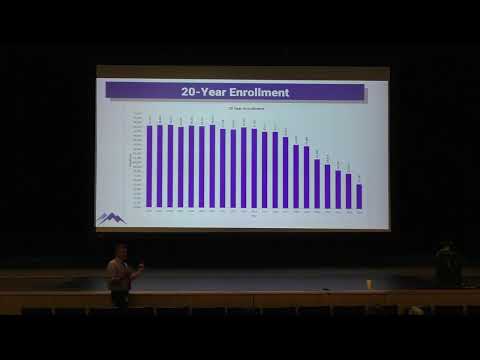
Hogan described the district's data inputs, including a Facility Condition Index completed about eight years ago and October enrollment projections. He said the district uses "average everyday capacity" measures when assessing buildings and that lower FCI scores indicate a building will need maintenance or rebuilding sooner, not that the building is unsafe. He repeated that the district is projecting an approximate 1,000‑student decline per year and showed 20‑year enrollment charts illustrating long‑term changes.
Parents and other residents at the meeting raised concerns about program loss and community impacts if nearby schools were consolidated. A parent from the Oak Ridge attendance area said many families whose children live in Oak Ridge chose other neighborhood schools because those schools offered advanced and language‑immersion programs; she urged the district to show data on how program availability affects enrollment. "If Oak Ridge offered advanced programs, we would come back to the school that we can walk to," the parent said.
Hogan and other district speakers described practical consequences the district is trying to avoid: split‑grade classrooms (two grades in one room), reduced availability of inclusion and special‑education supports, and fewer elective or advanced offerings when a school becomes very small. Hogan said smaller schools do not automatically mean smaller class sizes and explained that funding follows students, primarily through the state Weighted Pupil Unit (WPU), local property tax, and program‑specific funding. He gave the district’s WPU figure as roughly $4,800 per student and said the district faces budgetary pressure entering the next budget cycle, including a roughly $8 million shortfall in the draft budget before new appropriations are set.
The district outlined a process timeline: work will begin in February, with public engagement and boundary analysis through the spring; staff hope to narrow the list to a handful of schools by July (August at the latest) and continue engagement and final board decisions over the following months, with the formal board decision expected by December. Hogan emphasized the district’s intent to prioritize community transition work — student welcome events, joint PTA/SCC activities and equipment re‑use — if a consolidation is approved.
No formal board vote or motion was recorded in the portions of the meeting provided. Hogan said the study will consider program availability, busing eligibility and mobility rates and that some follow‑up analyses (for example, where students who attend a school live and where DLI or advanced program students originate) will be shared with the public when available.
The district encouraged community members to review planning and boundary resources on the Granite planning website and said staff will continue to hold public meetings and collect feedback as the study proceeds.